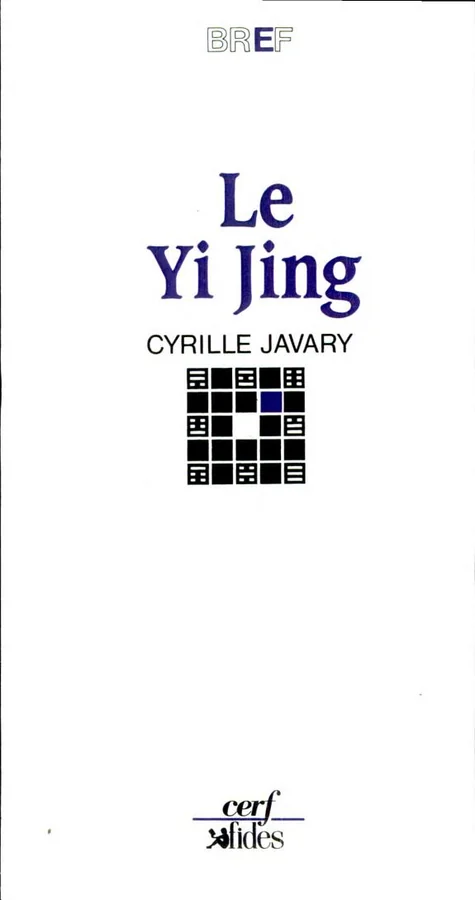
Le Yi Jing
 73
73

Le Yi Jing
Cyrille Javary's Le Yi Jing presents a rigorous, almost academic, examination of the I Ching, moving beyond the sensationalism often attached to divination. Its strength lies in its methodical breakdown of the hexagrams and their philosophical underpinnings, offering a clear 'discourse on the method' for engaging with this ancient text. Javary succeeds in demonstrating the I Ching's role as a foundational text for Chinese culture, not just a tool for predicting the future. However, the book's detailed exposition, while valuable, can sometimes feel dense for readers seeking a more intuitive or immediately practical guide to consultation. A particularly insightful section details the trigram combinations and their inherent meanings, illustrating the systematic nature of the I Ching's symbolic language. For those prepared for its intellectual depth, Le Yi Jing serves as an authoritative guide to the Book of Changes.
📝 Description
73
### What It Is Le Yi Jing, authored by Cyrille Javary, is not merely a text on divination but a comprehensive exploration of the I Ching, the ancient Chinese "Book of Changes." It functions as a foundational "discourse on the method" for understanding Chinese culture, presenting the intricate harmony of its 64 hexagrams. The work details their construction and application, positioning them as tools for informed decision-making rather than simple predictive devices.
### Who It's For This volume is intended for serious students of Eastern philosophy, comparative religion, and esoteric traditions. It appeals to those seeking a structured approach to understanding the I Ching beyond superficial fortune-telling. Readers interested in the philosophical underpinnings of Chinese thought, including Taoism and Confucianism, will find substantial material. It is also for individuals who approach divination as a psychological or philosophical practice, seeking guidance in life's complexities.
### Historical Context First published in 1989, Javary's work emerged during a period of renewed Western interest in Eastern wisdom traditions. While the I Ching itself dates back millennia, scholarly and popular engagement with it saw significant growth throughout the 20th century, influenced by figures like Carl Jung and his theories on synchronicity. Javary's approach offers a detailed exposition, distinguishing itself from more esoteric or purely divinatory interpretations that were prevalent. The book addresses a need for a thorough, methodologically sound presentation of the I Ching's structure and philosophical depth.
### Key Concepts The core of Le Yi Jing revolves around the 64 hexagrams, each composed of six lines, either solid (Yang) or broken (Yin). These symbols represent fundamental archetypal situations and transformations. The text emphasizes the interconnectedness of these hexagrams, illustrating how they depict the dynamic interplay of Yin and Yang forces in the universe. Javary's method focuses on the hexagrams as a framework for understanding cosmic order and human affairs, providing a lens through which to analyze situations and anticipate potential developments.
💡 Why Read This Book?
• Gain a systematic understanding of the 64 hexagrams, learning how their Yin and Yang line combinations form a symbolic language for analyzing situations, a core concept presented by Javary. • Explore the I Ching as a "discourse on the method" of Chinese culture, understanding its role beyond mere divination, as explained in the book's foundational approach. • Develop a framework for decision-making by studying the hexagrams' dynamic interplay, a practical application detailed in Javary's exposition of their usage.
⭐ Reader Reviews
Honest opinions from readers who have explored this book.
❓ Frequently Asked Questions
What is the original publication year of Cyrille Javary's Le Yi Jing?
Le Yi Jing by Cyrille Javary was first published in 1989, marking its emergence during a period of significant scholarly and popular interest in Chinese philosophy and esoteric texts.
How does Le Yi Jing differentiate itself from typical divination books?
Le Yi Jing positions the I Ching not just as a tool for fortune-telling but as a profound "discourse on the method" of Chinese culture, emphasizing its philosophical structure and application in decision-making.
What are the primary components explored in Le Yi Jing?
The book primarily explores the 64 hexagrams of the I Ching, detailing their construction from Yin and Yang lines and their symbolic representation of cosmic and human situations.
Is Le Yi Jing suitable for beginners in I Ching study?
While comprehensive, its methodical and philosophical approach makes it best suited for serious students or those with some prior exposure to Eastern thought, rather than absolute beginners seeking simple divinatory techniques.
What is the connection between the I Ching and Chinese culture according to this book?
Javary presents the I Ching as a foundational text that exposes the harmony of Yin and Yang, serving as a 'discourse on the method' essential to understanding the core principles of Chinese culture.
Who is Cyrille Javary?
Cyrille Javary is a recognized scholar and author specializing in Chinese civilization, particularly its philosophical and symbolic dimensions, with Le Yi Jing being a significant contribution to understanding the I Ching.
🔮 Key Themes & Symbolism
Hexagrammatic Structure
The work meticulously dissects the 64 hexagrams, the fundamental building blocks of the I Ching. Each hexagram is presented as a composite of two trigrams, each composed of six lines—either solid (Yang) or broken (Yin). Javary illustrates how these combinations generate a complex symbolic language capable of representing a vast spectrum of human situations and natural phenomena. This structural analysis is crucial for understanding the I Ching not as random symbols but as a systematic, interconnected cosmology.
Yin and Yang Dynamics
Central to Le Yi Jing is the exploration of Yin and Yang, the primordial dual forces whose interplay governs all existence in Chinese philosophy. The book demonstrates how the I Ching visualizes this dynamic through the alternating solid and broken lines of its hexagrams. Understanding this constant flux and balance is presented as key to interpreting the hexagrams' messages and applying them to life's challenges, reflecting the 'harmony of the hexagrams'.
Divination as Method
Javary reorients the perception of the I Ching from mere fortune-telling to a sophisticated "discourse on the method" for approaching life's decisions. The book explains how consulting the I Ching involves engaging with its symbolic logic to gain perspective on a situation, rather than seeking definitive predictions. This approach highlights the I Ching's function as a tool for introspection and strategic thinking, aligning with traditional Chinese philosophical practices.
Cultural Foundation
Le Yi Jing argues for the I Ching's status as a cornerstone of Chinese culture. The text details how its principles of harmony, change, and cyclical progression are woven into the fabric of Chinese thought, influencing philosophy, ethics, and even governance. By examining the hexagrams and their meanings, the reader gains insight into the worldview that shaped one of the world's oldest continuous civilizations.
💬 Memorable Quotes
“The I Ching is the 'discourse on the method' of Chinese culture.”
— This statement frames the I Ching not as a mere text for divination, but as a foundational philosophical system that explains the underlying principles and logic governing Chinese thought and societal structures.
“The harmony of the hexagrams and their use for decision-making.”
— This phrase emphasizes the interconnectedness of the I Ching's symbolic representations and promotes its practical application as a guide for navigating complex choices, moving beyond simple prediction.
“Grand livre du Yin et du Yang.”
— Translating to 'Great book of Yin and Yang,' this highlights the I Ching's role as a primary text for understanding the fundamental principles of duality and balance that permeate Chinese cosmology.
“Divination, divagation?”
— This rhetorical question challenges the common perception of the I Ching as purely a tool for fortune-telling (divination), suggesting it might lead to aimless wandering (divagation) if misunderstood, implying a deeper, more structured purpose.
“The work exposes the harmony of the hexagrams.”
— This points to the underlying order and interconnectedness within the I Ching's symbolic system, suggesting that a key function of the text is to reveal this cosmic and philosophical coherence.
🌙 Esoteric Significance
Tradition
Le Yi Jing functions within the broad lineage of esoteric interpretations of ancient wisdom texts, bridging Western academic inquiry with Eastern philosophical traditions. While not strictly Hermetic or Kabbalistic, its focus on symbolic systems, cosmic harmony, and methods for discerning universal principles aligns with the aims of many esoteric schools. The work's emphasis on the I Ching as a tool for self-understanding and decision-making echoes the practical, transformative goals found in various mystical paths.
Symbolism
The core symbolism revolves around the Yin (broken lines) and Yang (solid lines) dichotomy, representing fundamental cosmic forces of receptivity and activity, darkness and light. The hexagrams, formed by combining these lines into eight trigrams and then into 64 unique figures, symbolize archetypal situations and transformations. For instance, the trigram 'Heaven' (☰) often represents creative force and strength, while 'Earth' (☷) symbolizes receptivity and nurturing, illustrating the text's fundamental symbolic language.
Modern Relevance
Contemporary practitioners of Jungian psychology and archetypal studies often draw upon the I Ching, viewing its hexagrams through the lens of synchronicity and the collective unconscious. Furthermore, individuals engaged in modern mindfulness practices and systems thinking find value in the I Ching's depiction of dynamic change and interconnectedness. The work's structured approach to consultation continues to inform those seeking philosophical guidance in personal development and strategic planning.
👥 Who Should Read This Book
• Students of comparative philosophy and religion seeking a rigorous introduction to the I Ching as a cultural and philosophical cornerstone. • Practitioners of divination arts interested in understanding the symbolic logic and decision-making framework of the I Ching beyond simple fortune-telling. • Individuals drawn to Eastern thought exploring the concepts of Yin and Yang and their application in understanding cosmic harmony and personal transformation.
📜 Historical Context
Published in 1989, Cyrille Javary's Le Yi Jing arrived during a resurgence of interest in Eastern philosophies in the West, a trend amplified by scholars like Joseph Needham and cultural figures like Alan Watts who popularized aspects of Chinese thought. The I Ching itself, with roots stretching back to the Zhou Dynasty (c. 1046–256 BCE), had seen numerous interpretations, from Confucian commentaries emphasizing ethics to Taoist practices focusing on transformation. Javary's work distinguished itself by offering a systematic, methodologically sound exposition, aiming to clarify the I Ching's role as a foundational 'discourse on the method' for Chinese culture. It provided an alternative to more mystical or purely divinatory readings that often dominated Western perceptions. The book's detailed exploration of hexagrammatic structure and symbolism engaged with a readership seeking deeper understanding beyond superficial engagement, contributing to a more nuanced academic and esoteric reception of the text.
📔 Journal Prompts
The harmony of the hexagrams as a model for life's patterns.
Connecting the Yin and Yang dynamics to personal challenges.
Applying the I Ching's 'discourse on the method' to a current dilemma.
The significance of the 64 hexagrams in representing universal archetypes.
Reflecting on the I Ching's role in Chinese cultural understanding.
🗂️ Glossary
I Ching
Also known as the Book of Changes, an ancient Chinese divination text and foundational philosophical work, composed of 64 hexagrams.
Hexagram
A figure composed of six stacked horizontal lines, each line being either solid (Yang) or broken (Yin). There are 64 unique hexagrams in the I Ching.
Trigram
A figure composed of three stacked horizontal lines, either solid or broken. Eight trigrams form the building blocks of the 64 hexagrams.
Yin
In Chinese philosophy, the passive, dark, feminine, or receptive principle, represented by a broken line (--) in the I Ching.
Yang
In Chinese philosophy, the active, light, masculine, or creative principle, represented by a solid line (—) in the I Ching.
Divination
The practice of seeking knowledge of the future or the unknown by supernatural means, often interpreted in the context of the I Ching as a method for gaining perspective.
Discourse on the Method
A philosophical concept referring to a systematic approach or framework for understanding and interacting with the world, applied here to the I Ching's role in Chinese culture.