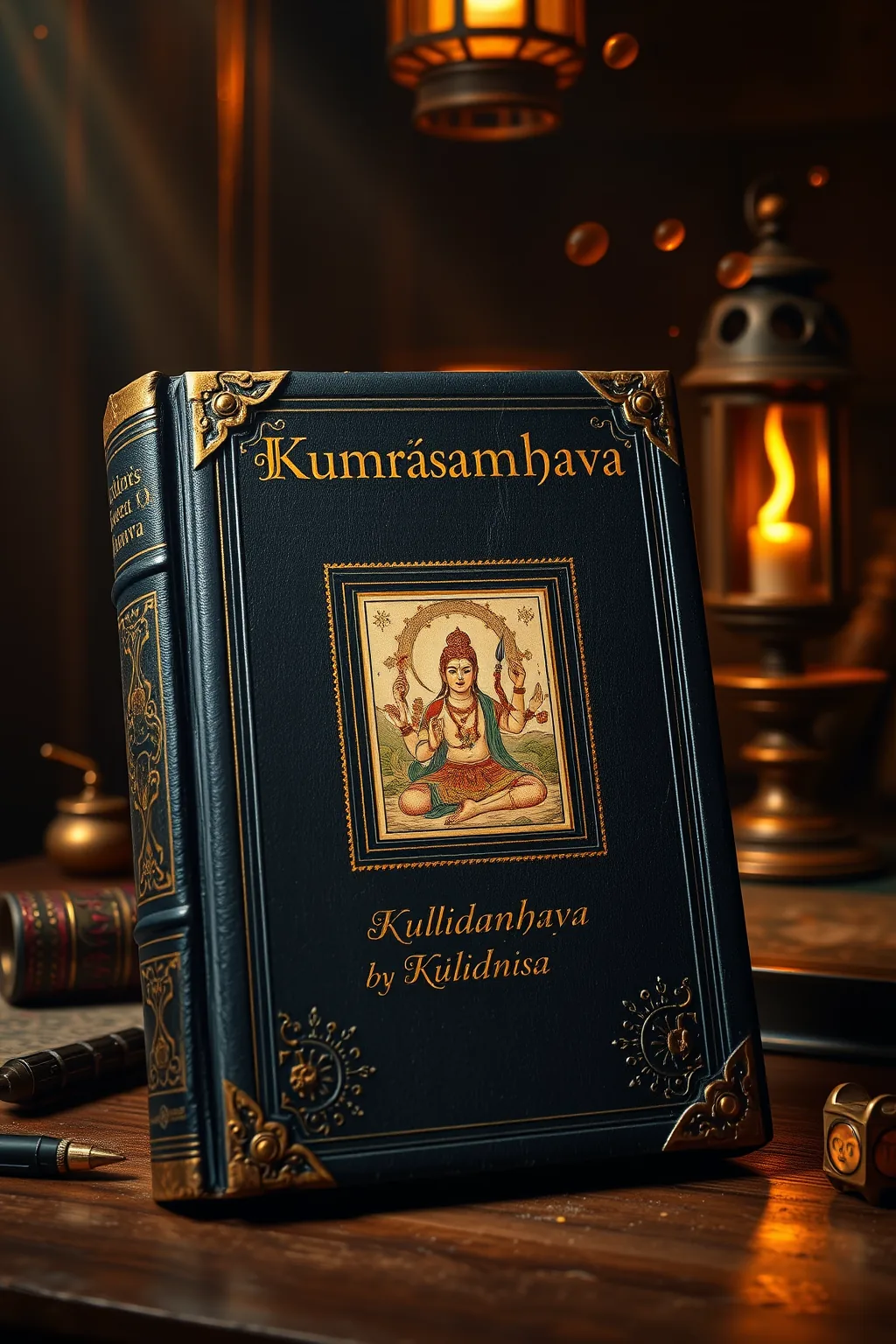
Kumārasambhava
 77
77

Kumārasambhava
Kālidāsa's Kumārasambhava presents a complex narrative framework that, while undeniably rich in mythological detail, can prove challenging for the uninitiated. The sheer scope of divine genealogies and cosmic events requires sustained attention. A particular strength lies in the vivid descriptions of nature and the emotional arcs of its divine protagonists; Parvati's prolonged penance, for instance, is rendered with palpable intensity. However, the narrative's devotional underpinnings, while central to its purpose, may not fully engage secular or purely literary critics without a grounding in Shaivite philosophy. Ultimately, Kumārasambhava functions as a foundational text, offering a window into the poetic and theological landscape of classical India.
📝 Description
77
### What It Is
Kumārasambhava, attributed to the classical Sanskrit poet Kālidāsa, is an epic poem of considerable length, recounting the birth of the god Kumāra (Skanda/Kartikeya). Its narrative focuses on the divine union of Shiva and Parvati, necessitated by the need for a powerful heir to defeat the demon Taraka. The poem is divided into cantos, detailing the austerities of Parvati, the divine courtship, and the eventual begetting of the war god.
### Who It's For
This work is intended for scholars of Sanskrit literature, students of comparative mythology, and those interested in the intricate cosmologies of Hindu traditions. Readers seeking to understand the development of Shaivite narratives and the poetic artistry of ancient India will find it particularly rewarding. It appeals to individuals interested in foundational texts of religious and philosophical traditions.
### Historical Context
The precise dating of Kālidāsa remains a subject of scholarly debate, though many place his floruit in the 4th or 5th century CE. Kumārasambhava, as a significant work of classical Sanskrit poetry, emerged during a period when epic and Puranic traditions were solidifying. It stands alongside other major Sanskrit epics and dramas, reflecting the cultural and religious milieu of the Gupta period. Its influence can be traced through later Indian literature and religious discourse.
### Key Concepts
The poem introduces and elaborates on several core concepts within Hinduism. The necessity of divine intervention for cosmic order, exemplified by the threat of Taraka, is central. The arduous path of asceticism (tapas) undertaken by Parvati to win Shiva's favor highlights the power of devotion and penance. The divine marriage itself symbolizes the union of cosmic masculine and feminine principles, a recurring motif in Indic thought.
💡 Why Read This Book?
• Understand the narrative of Kumāra's birth, a pivotal event in Hindu Shaivism, and the divine union of Shiva and Parvati, as depicted by Kālidāsa. • Explore the concept of *tapas* (asceticism) through Parvati's rigorous penance, learning how it functions as a divine strategy in the poem. • Appreciate the poetic style and mythological worldview of classical Sanskrit literature, particularly from the era of Kālidāsa's presumed activity.
⭐ Reader Reviews
Honest opinions from readers who have explored this book.
❓ Frequently Asked Questions
When was Kālidāsa believed to have written the Kumārasambhava?
Scholars generally place Kālidāsa's active period between the 4th and 5th centuries CE, during the Gupta Empire, though precise dates remain elusive.
What is the central theme of the Kumārasambhava?
The poem's core theme is the divine birth of the god Kumāra (Skanda), who is needed to defeat the demon Taraka, necessitating the union of Shiva and Parvati.
What role does Parvati play in the Kumārasambhava?
Parvati undertakes severe austerities (*tapas*) to win the love of Shiva, demonstrating the power of devotion and penance in achieving divine goals.
Is Kumārasambhava a religious text or a piece of literature?
It is both: a significant work of classical Sanskrit poetry that also narrates foundational myths within the Shaivite tradition of Hinduism.
What does 'Kumārasambhava' mean?
The title translates from Sanskrit to 'The Birth of Kumāra', referring to the god Skanda (also known as Kartikeya or Kumāra).
Who was the demon Taraka that Kumāra was born to defeat?
Taraka was a powerful asura (demon) whose reign of terror could only be ended by a son born of Shiva, prompting the events of the poem.
🔮 Key Themes & Symbolism
Divine Union and Procreation
The poem centers on the imperative for Shiva and Parvati to unite and produce a divine offspring. This union is not merely romantic but a cosmic necessity, driven by the threat posed by the demon Taraka. The narrative meticulously details the steps leading to their marriage, emphasizing the divine plan for cosmic preservation. The concept of divine procreation serves as a metaphor for the generation of cosmic order and the overcoming of existential threats.
The Power of Asceticism (Tapas)
Parvati's character arc is defined by her intense ascetic practices. Her *tapas* is a demonstration of unwavering devotion and spiritual discipline aimed at winning Shiva's affection. This theme highlights the belief in the efficacy of severe penance to influence even the gods and achieve seemingly impossible goals. The poem illustrates *tapas* not just as self-denial but as a potent force capable of altering destiny and fulfilling cosmic requirements.
Cosmic Order and Divine Intervention
The overarching narrative is driven by the need to restore balance to the cosmos. The rise of the demon Taraka threatens the established order, necessitating the birth of a divine warrior. This theme underscores the cyclical nature of creation and destruction within Hindu cosmology and the reliance on divine intervention to resolve cosmic crises. The poem serves as a mythological explication of how divine beings act to maintain universal harmony.
Courtship and Divine Love
Beyond the cosmic imperatives, the poem explores the divine courtship between Shiva and Parvati. Kālidāsa imbues their interactions with poetic grace and emotional depth. This aspect explores the divine capacity for love and attachment, portraying the gods as having relatable emotional lives. The successful culmination of their courtship and marriage is depicted as a joyous event, signifying the triumph of divine love and auspicious beginnings.
💬 Memorable Quotes
“The world was purified by the glance of the Lord.”
— This phrase encapsulates the transformative power attributed to Shiva within the Shaivite tradition. It suggests that his divine presence or even a mere look can cleanse and sanctify, highlighting his role as a supreme deity capable of purifying existence.
“For the sake of the world, he assumed a form that was half male, half female.”
— This refers to the Ardhanarishvara form of Shiva, symbolizing the integration of masculine and feminine energies. It represents the concept of cosmic unity and the interdependence of complementary forces in creation and maintenance.
“She endured the extreme heat and cold, the wind and the rain.”
— This passage describes Parvati's rigorous asceticism. It emphasizes the physical hardships she willingly underwent as a testament to her devotion and determination to achieve her spiritual goal of uniting with Shiva.
“The gods were alarmed by the power of the demon Taraka.”
— This highlights the existential threat posed by the demon Taraka to the celestial realms and the established cosmic order. It sets the stage for the divine intervention required to overcome this menace, underscoring the poem's central conflict.
“His mind was fixed on the welfare of the universe.”
— This statement reflects the selfless and cosmic-oriented nature of Shiva's actions. It portrays him not as acting out of personal desire but out of a profound sense of duty towards maintaining universal balance and protecting creation.
🌙 Esoteric Significance
Tradition
Kumārasambhava is deeply rooted in the Shaivite tradition of Hinduism, a major lineage within Indic esotericism. It explores concepts central to Shaivism, such as the supremacy of Shiva, the divine feminine (Shakti) embodied by Parvati, and the cosmic necessity of their union. While not strictly 'esoteric' in the Western sense of secret initiatory practices, its rich symbolism and philosophical underpinnings are subjects of deep contemplative study within the tradition.
Symbolism
Key symbols include Shiva's trident (Trishula), representing creation, preservation, and destruction; the mountain abode of the Himalayas, symbolizing cosmic stability and the dwelling of ascetics; and the divine marriage itself, representing the union of cosmic masculine (Shiva) and feminine (Shakti) principles necessary for manifestation. Parvati's austerities symbolize the soul's arduous journey towards divine union.
Modern Relevance
Contemporary practitioners of Yoga and Tantra often draw upon the archetypes and narratives found in Kumārasambhava. The concepts of divine union, the power of focused spiritual practice (*tapas*), and the cosmic balance between masculine and feminine energies continue to be relevant in modern spiritual discourse and personal development practices.
👥 Who Should Read This Book
• Students of comparative mythology seeking to understand the origins and development of Hindu deities and narratives. • Scholars of Sanskrit literature interested in classical Indian poetic traditions and the works of Kālidāsa. • Individuals exploring the philosophical and theological underpinnings of Shaivism and its devotional practices.
📜 Historical Context
Kālidāsa's Kumārasambhava emerged during the Gupta period (c. 320-550 CE), a golden age for Sanskrit literature and arts. This era saw the flourishing of complex philosophical schools, including advanced developments in Vedanta and various devotional traditions within Hinduism. While Kālidāsa himself is a figure shrouded in historical ambiguity, his works reflect a sophisticated understanding of religious narratives and poetic conventions. The poem's focus on Shaivite mythology places it within a context where devotional movements centered on Shiva were gaining significant traction, alongside traditions like Vaishnavism and Shaktism. Its literary merit and mythological depth ensured its enduring influence, studied by scholars such as Wendy Doniger, who have analyzed its themes within broader Indian religious history.
📔 Journal Prompts
Parvati's arduous penance for Shiva's affection.
The cosmic imperative behind Kumāra's birth.
Shiva's divine nature and its manifestation.
The symbolic meaning of the union of Shiva and Parvati.
The role of the demon Taraka in the narrative.
🗂️ Glossary
Kumāra
A name for the Hindu god Skanda (also known as Kartikeya or Murugan), son of Shiva and Parvati, often depicted as a divine warrior.
Shiva
One of the principal deities of Hinduism, often regarded as the destroyer or transformer within the Trimurti, and the supreme being within Shaivism.
Parvati
A principal deity in Hinduism, the goddess of fertility, love, beauty, marriage, children, and devotion; a form of Shakti and the wife of Shiva.
Tapas
A Sanskrit term signifying asceticism, austerity, or inner heat generated through spiritual practice, believed to yield spiritual power or enlightenment.
Asura
In Hindu mythology, a class of power-seeking deities or demons who often oppose the Devas (gods) in cosmic battles for control of the universe.
Sanskrit
An ancient Indo-Aryan language in which the Vedas, Upanishads, and classical Hindu literature, including Kumārasambhava, were written.
Shaivism
One of the major traditions within Hinduism that worships Shiva as the supreme being and creator, preserver, and destroyer of the universe.