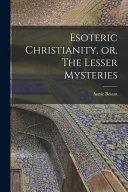
Esoteric Christianity, Or, The Lesser Mysteries
 78
78

Esoteric Christianity, Or, The Lesser Mysteries
Annie Besant's 'Esoteric Christianity' attempts to reconcile the familiar narrative of Christ with a hidden, Gnostic-like tradition of spiritual knowledge. The strength lies in its detailed exploration of biblical symbolism, offering fresh perspectives on well-known stories. For instance, her interpretation of the "miracles" as primarily symbolic representations of inner psychic states is compelling for those inclined toward esoteric thought. However, the work occasionally struggles with a certain dogmatism inherent in its Theosophical framework, which may feel restrictive to readers outside that specific tradition. A particularly striking passage concerns the reinterpretation of the Resurrection not as a physical event but as the awakening of the Christ consciousness within the initiate. While not a dispassionate historical account, the book serves as a significant document of early 20th-century esoteric thought, offering a unique lens through which to re-examine Christian origins and teachings.
📝 Description
78
### What It Is Esoteric Christianity, Or, The Lesser Mysteries by Annie Besant offers a reinterpretation of Christian doctrine through an occult lens. It posits that the "lesser mysteries" refer to the exoteric, or public, teachings of Christianity, while a deeper, esoteric understanding remains accessible to initiates. The work seeks to unveil the hidden spiritual science and symbolism within biblical narratives and church rituals, presenting them not as mere historical accounts but as allegorical maps of inner spiritual development.
### Who It's For This book is directed toward individuals already familiar with the basic tenets of Christianity who possess a curiosity for its underlying mystical dimensions. It appeals to students of comparative religion, occult philosophy, and Theosophy, particularly those interested in understanding how ancient wisdom traditions inform and are reflected within Western religious structures. Readers seeking a spiritual framework that connects personal evolution with cosmic principles will find it relevant.
### Historical Context Published originally in the early 20th century, this work emerges from the milieu of the Theosophical Society, of which Annie Besant was a prominent leader. It reflects a broader turn-of-the-century interest in Eastern religions and esoteric interpretations of Western traditions, seeking to synthesize them. This period saw figures like Helena Blavatsky and Rudolf Steiner also exploring similar themes, challenging orthodox religious interpretations and proposing hidden spiritual histories. Besant’s work contributed to a growing body of literature aiming to revive ancient spiritual knowledge for a modern age.
### Key Concepts The book emphasizes the allegorical nature of scripture, viewing Christ not solely as a historical figure but as an archetype of divine consciousness. It discusses spiritual initiation as a process mirroring Christ’s journey, involving inner transformation and the attainment of higher consciousness. Concepts like karma, reincarnation, and the evolution of consciousness are presented as integral to a complete understanding of Christian teachings, often re-contextualizing miracles and parables as symbolic representations of psychic and spiritual phenomena.
💡 Why Read This Book?
• Gain insight into the Theosophical Society's interpretation of Christian symbolism, learning how Annie Besant viewed figures like Christ as archetypes of spiritual attainment. • Understand the concept of "lesser mysteries" as presented by Besant, differentiating it from exoteric teachings and exploring its implications for personal spiritual practice. • Discover Besant's symbolic interpretations of biblical events, such as her perspective on the Resurrection, which offers an alternative to literal readings and connects to inner transformation.
⭐ Reader Reviews
Honest opinions from readers who have explored this book.
❓ Frequently Asked Questions
What is Annie Besant's "Esoteric Christianity" about?
It reinterprets Christian doctrine through an occult lens, presenting the "lesser mysteries" as the exoteric teachings and a deeper, esoteric understanding accessible to initiates, revealing hidden spiritual science within scripture.
Is this book suitable for beginners in esoteric studies?
Yes, particularly for those with a foundation in Christianity who are curious about its mystical dimensions. It provides a specific Theosophical perspective on core Christian themes.
When was "Esoteric Christianity, Or, The Lesser Mysteries" originally published?
While this edition is dated 2021-09-10, the original publication date aligns with Annie Besant's active period in the early 20th century, likely around 1901.
What is the connection between this book and Theosophy?
Annie Besant was a prominent leader of the Theosophical Society. This book reflects Theosophical principles, such as reincarnation and karma, applied to Christian teachings.
What does "lesser mysteries" refer to in this context?
Besant uses "lesser mysteries" to denote the public, exoteric teachings of Christianity, contrasting them with a hidden, inner, or esoteric knowledge available to those on a path of spiritual initiation.
Is this book in the public domain?
Yes, the original work by Annie Besant is in the public domain in the United States and potentially other countries, making it freely accessible and reproducible.
🔮 Key Themes & Symbolism
Christ as Archetype
Besant posits that Christ represents not merely a historical figure but an archetype of divine consciousness and spiritual attainment. The work interprets his life, teachings, and sacrifice as symbolic of the path available to every human soul seeking union with the divine. This perspective aligns with Gnostic and Theosophical ideas that emphasize the inner Christos within each individual, awakened through spiritual discipline and understanding.
Allegory in Scripture
The book systematically dismantles literal interpretations of biblical events, reframing them as allegories for inner spiritual processes and cosmic laws. Miracles are seen as manifestations of psychic or spiritual forces, and parables as keys to understanding the evolution of consciousness. This approach seeks to reveal a hidden science beneath the exoteric religious narrative, making scripture a guide for personal transformation.
Spiritual Initiation
Besant outlines a path of spiritual development mirroring the "lesser mysteries" of ancient traditions. This involves inner purification, the cultivation of higher faculties, and ultimately, a form of "resurrection" or awakening of the Christ consciousness within. The work suggests that the Christian sacraments and rituals, when understood esoterically, are symbolic representations of these stages of initiation.
Theosophical Synthesis
As a key text from the Theosophical movement, this book attempts to synthesize Christian teachings with broader esoteric principles, including karma and reincarnation. It seeks to demonstrate that these concepts are not foreign to Christianity but are, in fact, integral to its deeper, original meaning, which Besant argues has been obscured over centuries.
💬 Memorable Quotes
“The Christ is the human ideal, the perfect man, the manifestation of the Logos on the physical plane.”
— This highlights Besant's view of Christ as a universal symbol of perfected humanity and divine expression, accessible as an ideal within each person's potential.
“The miracles of the New Testament are not violations of natural law, but illustrations of higher laws.”
— This suggests that events like healings or transformations should be understood not as supernatural breaks from reality, but as expressions of spiritual principles beyond ordinary perception.
“The Resurrection is the symbol of the triumph of the spiritual nature over the material.”
— Besant interprets Christ's resurrection as a representation of the soul's victory over the limitations of the physical body and worldly attachments, a state achievable through inner work.
“The teachings of Jesus were intended for the inner, spiritual man, not for the outer, material man.”
— This emphasizes Besant's belief that the core message of Jesus pertains to inner transformation and spiritual evolution, rather than external, societal rules or dogma.
“The mysteries were veiled to protect them from profanation by the unworthy.”
— This reflects the ancient concept of esoteric traditions being guarded, with deeper truths only revealed to those prepared through study and inner development.
🌙 Esoteric Significance
Tradition
This work is deeply rooted in the Theosophical tradition, which itself draws heavily from Hermeticism, Gnosticism, Neoplatonism, and Eastern philosophies like Hinduism and Buddhism. Besant attempts to synthesize these streams, presenting Christianity not as a unique revelation but as one manifestation of a universal Perennial Philosophy, adapted for Western esoteric understanding. It fits within the Theosophical project of revealing a common spiritual ancestry for world religions.
Symbolism
Key symbols include the figure of Christ, interpreted as the Logos or divine consciousness manifest in humanity, and the cross, seen as a symbol of the four lower elements bound by the spirit. The "lesser mysteries" themselves symbolize the initial stages of spiritual awakening, contrasting with the "greater mysteries" of direct union with the divine, a concept echoing ancient Eleusinian and Orphic traditions.
Modern Relevance
Contemporary esoteric practitioners and comparative religion scholars continue to engage with Besant's work. It informs modern Theosophical study groups and individuals exploring alternative interpretations of Christian texts. Thinkers in the New Age movement and those interested in the spiritual roots of Western civilization often reference Besant's synthesis of Eastern and Western mystical thought.
👥 Who Should Read This Book
• Students of Theosophy and Annie Besant's contributions, seeking to understand her unique perspective on Christian doctrine and its esoteric underpinnings. • Individuals interested in comparative religion and esoteric interpretations of major world faiths, particularly Christianity, who wish to explore non-literal readings of scripture. • Seekers of spiritual meaning who feel disconnected from orthodox religious structures but are drawn to the Christ narrative and desire a deeper, mystical understanding of its symbolism.
📜 Historical Context
Annie Besant's 'Esoteric Christianity, Or, The Lesser Mysteries', first published around 1901, emerged during a fervent period of occult revival and comparative religious study in the late 19th and early 20th centuries. As a leading figure in the Theosophical Society, Besant sought to present a hidden, spiritual interpretation of Christianity, aligning it with what she and her contemporaries believed to be universal ancient wisdom. This era saw significant intellectual currents challenging orthodox religious dogma, with movements like Spiritualism, Theosophy, and various forms of New Thought gaining traction. Key figures like Helena Blavatsky, whose 'The Secret Doctrine' (1888) provided a foundational text for modern Theosophy, heavily influenced Besant's approach. Besant's work positioned itself against both the literalism of mainstream Christianity and the materialism of burgeoning scientific thought, offering a spiritual science. While not facing widespread censorship, her reinterpretations were often met with skepticism or outright rejection by traditional theologians, positioning her work within a contested intellectual landscape.
📔 Journal Prompts
The concept of the "lesser mysteries" in relation to personal spiritual practice.
Christ as an archetype of divine consciousness: personal resonance and interpretation.
Biblical allegories as maps for inner transformation: identifying a personal parallel.
The role of symbolism in understanding spiritual truths, as presented by Besant.
Reconciling esoteric Christian concepts with exoteric religious understanding.
🗂️ Glossary
Lesser Mysteries
In Besant's framework, these refer to the exoteric, or outward, teachings of Christianity, accessible to the general populace. They serve as an introduction to deeper, hidden spiritual truths.
Esoteric Christianity
The hidden, inner meaning and spiritual science behind Christian doctrines and practices, as opposed to the exoteric, or outward, forms understood by the general public.
Logos
A Greek term signifying 'word' or 'reason', used in esoteric and theological contexts to denote the divine principle through which all things are created and ordered; often identified with Christ.
Archetype
A fundamental, universal pattern or model of a person, behavior, or situation, often representing a divine or idealized form, such as the Christ archetype.
Initiation
A ritual or process marking a person's entry into a higher level of knowledge or spiritual understanding within a mystery tradition or esoteric school.
Exoteric
Intended for, or capable of being understood by, the general public; the outward, literal, or common interpretation of teachings.
Spiritual Science
A term used in esoteric traditions to describe the study of spiritual laws and principles, often seen as analogous to physical sciences but dealing with non-material realities.