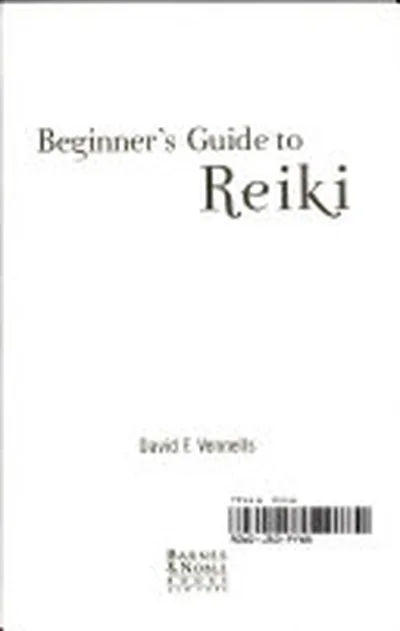
Beginner's Guide to Reiki
 79
79

Beginner's Guide to Reiki
David F. Vennells’ Beginner's Guide to Reiki offers a straightforward entry point into a practice that can otherwise seem shrouded in mystique. The book’s primary strength lies in its no-nonsense approach, stripping away overly complex jargon to present the essential mechanics of Reiki. Vennells focuses on the practical application, detailing hand positions and the attunement process with a clarity that is genuinely helpful for a novice. A notable passage often cited in discussions of introductory Reiki texts concerns the explanation of the 'Chakra' system as it relates to energy blockages, presented here with an accessible, albeit simplified, interpretation.
However, the guide’s brevity, while an asset for beginners, may leave those seeking deeper theoretical or philosophical underpinnings feeling underserved. The spiritual and ethical dimensions of Reiki, while mentioned through the Reiki Principles, are not explored with the depth some might expect. It functions effectively as a manual for initiating practice, but less so as an exploration of Reiki's broader energetic or metaphysical implications. For its stated purpose of guiding absolute beginners, it largely succeeds.
📝 Description
79
### What It Is
Beginner's Guide to Reiki, first published in 2002 by David F. Vennells, serves as an accessible introduction to the Japanese practice of energy healing. It outlines the fundamental principles and techniques necessary for individuals to begin their journey with Reiki. The book aims to demystify the concept of universal life force energy and explain how it can be channeled for personal well-being and for the benefit of others. It covers the attunement process and the basic hand positions used in a session.
### Who It's For
This guide is specifically crafted for individuals new to energy work and holistic healing modalities. It caters to those curious about alternative therapies and seeking a practical, step-by-step approach to learning Reiki. The book is suitable for anyone interested in self-healing, stress reduction, or developing a deeper connection with their own energetic field. It assumes no prior knowledge of esoteric concepts, making it ideal for the absolute novice.
### Historical Context
Reiki, as a system, was developed by Mikao Usui in Japan in the early 20th century. Its introduction to the Western world gained momentum in the latter half of the century, particularly gaining traction in the 1980s and 1990s. Vennells' book emerged during a period of burgeoning interest in Eastern spiritual practices and alternative healing in the West, following the groundwork laid by early Western proponents like Hawayo Takata. The early 2000s saw a significant increase in publications aimed at making these practices more accessible to a wider audience.
### Key Concepts
The core teachings revolve around the concept of 'Ki' or 'Qi' – the vital life force energy that animates all living things. The book explains how Reiki practitioners learn to tap into this universal energy and channel it through their hands. It details the foundational 'Reiki Principles' (often translated as 'just for today') which offer a spiritual framework for daily living. The 'Chakra' system, though not exclusively a Reiki concept, is often discussed in relation to energy flow within the body, and this guide likely touches upon its role in energy healing.
💡 Why Read This Book?
• Learn the fundamental hand positions for channeling energy, as detailed in the book's practical sections, allowing you to begin self-healing or practice on others shortly after reading. • Understand the concept of 'Ki' (universal life force energy) as explained by Vennells, providing a foundational understanding crucial for anyone exploring energy work beyond simple relaxation techniques. • Grasp the essence of the 'Reiki Principles' as presented in the text, offering a daily ethical and spiritual framework for integrating Reiki practice into your life, as introduced in the early chapters.
⭐ Reader Reviews
Honest opinions from readers who have explored this book.
❓ Frequently Asked Questions
When was Beginner's Guide to Reiki first published and by whom?
Beginner's Guide to Reiki was first published in 2002 by David F. Vennells. This early 21st-century publication date places it within a period of growing Western interest in Eastern healing modalities.
What is the core concept of Reiki as explained in this book?
The book explains Reiki as a practice of channeling 'Ki,' the universal life force energy, through the hands to promote healing and well-being. It emphasizes this energy's ubiquitous nature.
Who developed the original system of Reiki?
The original system of Reiki was developed by Mikao Usui in Japan during the early 20th century. Vennells' guide builds upon this foundational work.
Does this book cover the Reiki attunement process?
Yes, Beginner's Guide to Reiki outlines the attunement process, which is considered essential for practitioners to receive the ability to channel Reiki energy. It details what to expect during an attunement.
Is this book suitable for someone with no prior experience in energy healing?
Absolutely. The book is specifically designed as a 'Beginner's Guide,' assuming no prior knowledge and providing step-by-step instructions for newcomers to Reiki and energy work.
What are the basic hand positions taught in the book?
The book details fundamental hand positions used in Reiki sessions, covering key areas of the body for energy distribution. These are presented clearly for easy learning and application.
🔮 Key Themes & Symbolism
Universal Life Force Energy
The central tenet of Beginner's Guide to Reiki is the concept of 'Ki' or 'Qi,' the vital life force that permeates all existence. Vennells explains this energy not as a mystical force but as a tangible, accessible element that can be consciously channeled. The book guides the reader to understand how this energy flows through living beings and how blockages can lead to disharmony or illness, laying the groundwork for understanding Reiki's healing potential. It's presented as a natural, inherent quality of the universe accessible through focused intention and specific techniques.
The Reiki Principles
Beyond the mechanics of energy transfer, the book introduces the foundational 'Reiki Principles.' Often summarized as 'just for today,' these principles offer a spiritual and ethical framework for practitioners. They encourage living in the present, practicing gratitude, managing anger, doing one's work honestly, and showing compassion. Vennells presents these as more than mere guidelines; they are integral to the effectiveness and purity of the Reiki practice, fostering a holistic approach to well-being that integrates spiritual discipline with energetic healing.
Practical Application and Attunement
A significant focus of the guide is on the practical application of Reiki. This includes detailed descriptions of hand positions used to direct energy to different parts of the body, as well as the crucial 'attunement' process. Attunement, in the context of Reiki, is a sacred initiation performed by a qualified practitioner that enables an individual to channel Reiki energy. The book demystifies this process, explaining its importance and what a beginner can expect, thus making the path to becoming a Reiki practitioner seem achievable.
Energy Centers and Flow
While not exclusive to Reiki, the book likely touches upon the concept of 'Chakras' as primary energy centers within the human body. Vennells may explain how these centers can become imbalanced or blocked, affecting physical, emotional, and spiritual health. Understanding these energy hubs is presented as key to effectively applying Reiki, allowing practitioners to focus their healing energy where it is most needed. This provides a framework for understanding the subtle body and how Reiki interacts with it.
💬 Memorable Quotes
“Ki is the universal life force energy.”
— This concise statement encapsulates the fundamental premise of Reiki. It defines the core substance practitioners learn to work with, emphasizing its universal nature and its role as the animating principle of all existence.
“The attunement process opens your channels to receive and transmit Ki.”
— This paraphrased concept highlights the pivotal role of attunement. It explains that this ritual is not merely symbolic but a functional process that activates a practitioner's innate ability to channel universal life force energy effectively.
“Focus on the Reiki Principles for daily living.”
— This interpretation underscores the ethical and spiritual dimension of Reiki practice. It suggests that the principles are not just theoretical concepts but practical guides for cultivating a balanced and harmonious life alongside energy work.
“Basic hand positions guide the flow of energy.”
— This emphasizes the practical, hands-on aspect of Reiki. It clarifies that specific placements of the hands are intentional tools used to direct the channeled life force energy to areas requiring balance or healing.
“Reiki is a natural method of healing.”
— This statement positions Reiki as an organic, non-invasive approach to well-being. It suggests that the practice works in harmony with the body's natural processes rather than imposing external interventions.
🌙 Esoteric Significance
Tradition
Beginner's Guide to Reiki fits within the broader lineage of New Age and alternative healing movements that drew heavily from Eastern philosophies, particularly Taoism and Buddhism, which inform the concept of 'Ki.' While originating in Japan with Mikao Usui, its Western interpretation, and thus this guide, aligns with the Theosophical and later New Age currents that sought to integrate spiritual principles with practical techniques for personal empowerment and well-being. It represents a more secularized or therapeutically focused approach to what historically had deeper spiritual roots.
Symbolism
The primary symbolism in Reiki, as likely presented in this guide, revolves around the channeling of 'Ki' – the universal life force itself, symbolized by light or a subtle energy flow. Hand positions function symbolically, directing this energy to specific points on the body, often correlating with 'Chakras' or energy meridians. The act of attunement can be seen as a symbolic initiation, a transfer of energetic potential that awakens the practitioner's ability to connect with and transmit this vital force.
Modern Relevance
Vennells' guide, despite its 2002 publication, remains relevant as a foundational text for many contemporary Reiki practitioners and students. Its straightforward approach continues to appeal to those seeking practical instruction. Modern holistic health centers, wellness coaches, and even some healthcare professionals who incorporate complementary therapies often draw upon the principles and techniques first popularized by accessible guides like this one, demonstrating its enduring influence on current wellness practices.
👥 Who Should Read This Book
• Aspiring Reiki practitioners seeking a clear, step-by-step introduction to the core techniques and principles of this energy healing art, as detailed in the early chapters. • Individuals interested in holistic health and self-care who want to understand how to work with subtle energy for personal well-being, learning about 'Ki' and its flow. • Students of comparative spirituality looking to explore Japanese healing traditions and their integration into Western wellness practices, understanding the context of Mikao Usui's original system.
📜 Historical Context
David F. Vennells' Beginner's Guide to Reiki, published in 2002, emerged during a significant period of Western assimilation and adaptation of Eastern spiritual practices. While Mikao Usui developed Reiki in Japan in the early 20th century, its widespread introduction to the West began in earnest in the latter half of that century, notably through the efforts of Hawayo Takata. By the turn of the millennium, Reiki had moved beyond niche spiritual circles into broader alternative health discourse, influenced by a general cultural fascination with mind-body medicine and holistic healing that gained steam in the 1980s and 1990s. This period saw a proliferation of books aimed at demystifying practices like Reiki, acupuncture, and yoga for a Western audience. Vennells' work fits within this trend, offering a more accessible entry point compared to earlier, more esoteric texts. It arrived in a landscape where various other energy healing modalities, such as Therapeutic Touch and Polarity Therapy, were also gaining recognition, though Reiki's specific lineage and structured approach offered a distinct pathway.
📔 Journal Prompts
Reflect on the concept of 'Ki' as the universal life force energy.
Consider the ethical implications of the five Reiki Principles for daily life.
Analyze the function of the basic hand positions in guiding energy flow.
Describe your personal understanding of the attunement process.
Explore the relationship between energy blockages and the 'Chakra' system.
🗂️ Glossary
Ki
The Japanese term for the universal life force energy that animates all living things. In the context of Reiki, it is the energy practitioners learn to channel for healing and well-being.
Reiki
A Japanese form of alternative medicine, a type of energy healing. It involves the practitioner placing their hands on or just above a person to channel universal life force energy, promoting relaxation and healing.
Attunement
A sacred initiation process performed by a qualified Reiki Master. It is believed to open and expand the practitioner's ability to channel Reiki energy effectively.
Hand Positions
Specific placements of the practitioner's hands on or near the recipient's body. These positions are used to direct the flow of Reiki energy to different areas for healing.
Chakra
An energy center within the subtle body, according to various Indian spiritual traditions. While not exclusively a Reiki concept, they are often discussed in relation to energy flow and balance.
Usui
Refers to Mikao Usui, the founder of the Usui Reiki Ryoho system of natural healing. His name is central to the lineage and practice of traditional Reiki.
Energy Blockage
A disruption or obstruction in the natural flow of life force energy within the body, which can lead to physical, emotional, or spiritual imbalances and illness.