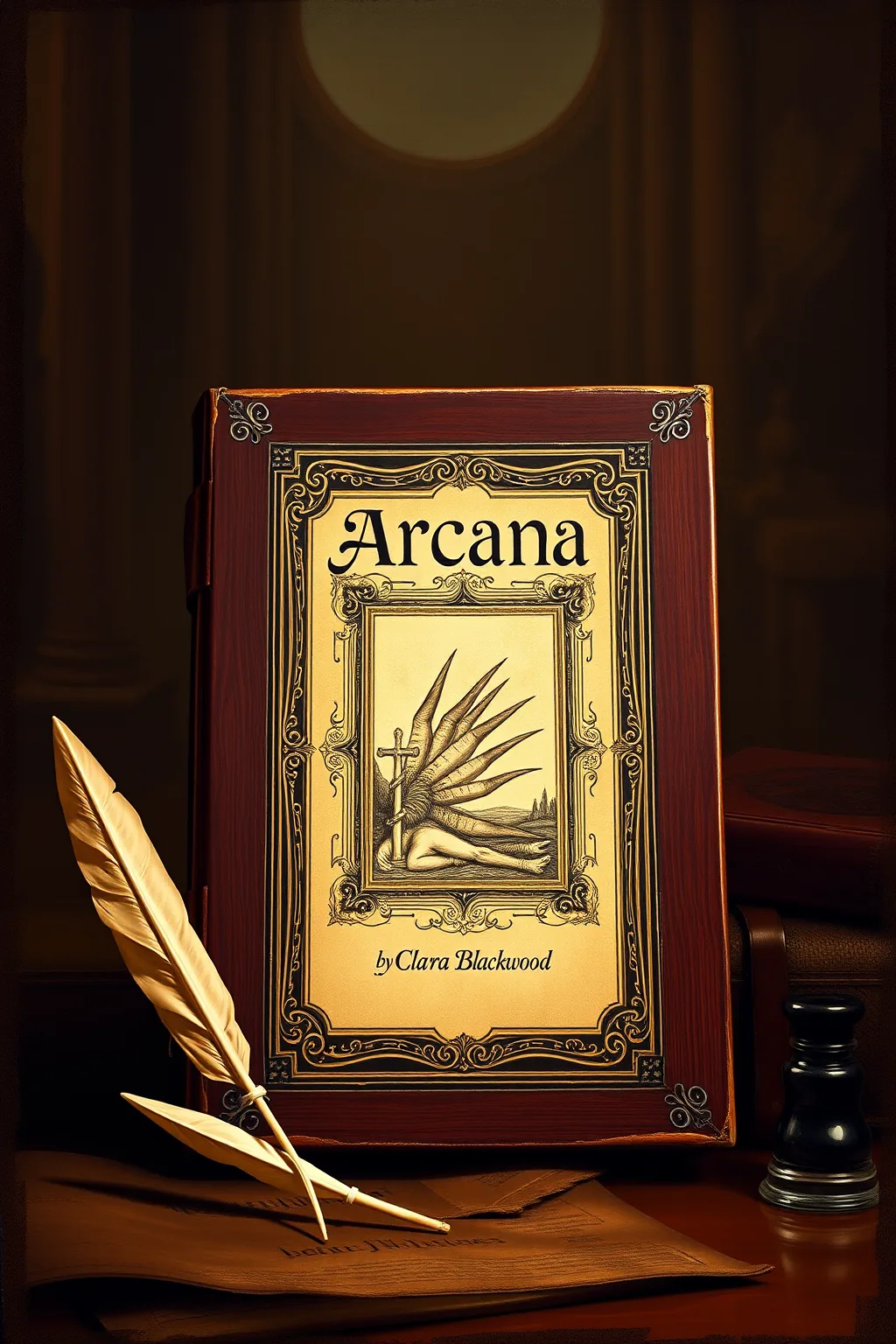
Arcana
 82
82

Arcana
Clara Blackwood’s Arcana offers a welcome, if occasionally dense, exploration of esoteric traditions. The work’s strength lies in its systematic approach to complex subjects, particularly its detailed exposition of the Kabbalistic Tree of Life, which serves as a central organizing principle. However, the sheer volume of information can sometimes overwhelm the reader, demanding significant concentration. A passage discussing the alchemical Great Work, for instance, is rendered with admirable clarity but requires careful rereading to fully absorb its nuances. While it avoids sensationalism, the academic tone might alienate those seeking more immediate, experiential accounts of occult phenomena. Arcana succeeds as a thorough reference for the dedicated student, though its accessibility could be improved.
📝 Description
82
### What It Is Arcana, authored by Clara Blackwood and first published in 2011, presents a comprehensive examination of esoteric philosophy. It moves beyond superficial interpretations to explore the underlying structures and symbolic languages that define various occult traditions. The work functions as both an introduction to complex metaphysical concepts and a reference for those already engaged in occult studies.
### Who It's For This book is designed for the serious student of esoteric thought, whether they are approaching subjects like Hermeticism or Kabbalah for the first time or seeking to deepen their existing knowledge. It caters to readers who prefer detailed explanations and historical context over anecdotal accounts or purely devotional material. Individuals interested in the intersection of philosophy, mysticism, and comparative religion will find particular value.
### Historical Context Published in 2011, Arcana emerged during a period of renewed interest in esoteric studies, often facilitated by digital dissemination. It arrives in dialogue with earlier 20th-century works by figures such as Aleister Crowley and Dion Fortune, yet distinguishes itself by synthesizing diverse traditions and offering a more academically grounded perspective. The book's approach can be seen as a response to a perceived lack of rigorous analysis in some contemporary occult literature, which often prioritized experience over systematic exposition.
### Key Concepts The text systematically unpacks foundational esoteric principles. It details the Tree of Life in Kabbalistic studies, discusses the alchemical process of transformation, and explores the significance of archetypal figures within Western esotericism. Blackwood also addresses the nature of consciousness and its relationship to the divine, drawing parallels between disparate mystical systems to reveal underlying universal truths.
💡 Why Read This Book?
• Gain a structured understanding of the Kabbalistic Tree of Life, learning its Sephirotic correspondences and symbolic meanings beyond common interpretations. • Comprehend the stages of the alchemical Great Work as presented in Chapter 4, understanding its spiritual and psychological dimensions. • Explore the concept of the 'Lesser and Greater Mysteries' as defined by Blackwood, differentiating between initiatory stages in esoteric traditions.
⭐ Reader Reviews
Honest opinions from readers who have explored this book.
❓ Frequently Asked Questions
When was Arcana by Clara Blackwood first published?
Arcana by Clara Blackwood was first published in 2011, marking its entry into contemporary esoteric literature.
What esoteric traditions does Arcana primarily cover?
The book extensively covers Hermeticism and Kabbalah, while also touching upon alchemical symbolism and broader Western esoteric philosophy.
Is Arcana suitable for absolute beginners in occult studies?
While comprehensive, the book's depth requires a dedicated reader. Beginners might find it more beneficial after an initial introduction to esoteric concepts.
Does Clara Blackwood cite specific historical figures in Arcana?
Yes, Blackwood references figures and concepts from established esoteric traditions, implicitly engaging with the historical discourse surrounding these subjects.
What is the primary focus of the symbolism discussed in Arcana?
The symbolism primarily focuses on the Tree of Life, alchemical processes, and archetypal figures within Western mystical traditions.
Where does Arcana fit within the broader spectrum of esoteric literature published around 2011?
Published in 2011, Arcana contributed to a resurgence of interest in detailed, systematic explorations of esoteric philosophy, often contrasting with more experiential or popularized accounts.
🔮 Key Themes & Symbolism
The Kabbalistic Tree of Life
Arcana dedicates significant attention to the Kabbalistic Tree of Life, presenting it not merely as a diagram but as a dynamic map of consciousness and creation. Blackwood meticulously details each of the ten Sephirōth and the twenty-two paths connecting them, exploring their astrological, elemental, and archetypal correspondences. The work emphasizes how understanding this structure can unlock deeper comprehension of both the macrocosm and the microcosm, offering a framework for spiritual development and esoteric practice that has been central to Western mysticism since its introduction to European thought in the late medieval period.
Alchemical Transformation
The book examines alchemy not just as a proto-chemical science but as a profound spiritual discipline. Blackwood interprets the alchemical Great Work—the process of transforming base metals into gold—as a metaphor for the purification and spiritualization of the human soul. The stages of *nigredo* (blackening), *albedo* (whitening), *citrinitas* (yellowing), and *rubedo* (reddening) are explored in detail, correlating them with psychological states and stages of spiritual awakening. This perspective positions alchemy as a practical path toward divine union.
Archetypal Symbolism
Arcana delves into the power of archetypes as fundamental patterns of the collective unconscious, as explored by thinkers like Carl Jung. Blackwood identifies and analyzes key archetypal figures and symbols prevalent in esoteric traditions, such as the Hierophant, the Magus, and the Great Mother. The work suggests that understanding these universal symbols provides a language for the soul and a means to connect with deeper spiritual realities, offering a bridge between psychological depth and mystical experience.
The Nature of Consciousness
A central theme is the exploration of consciousness and its multifaceted nature. Blackwood discusses various states of awareness, from mundane perception to higher mystical states, and their relationship to the divine or ultimate reality. The book posits that esoteric practices are designed to expand and refine consciousness, enabling individuals to perceive subtler realms of existence and to achieve a more profound connection with the universal mind. This investigation into consciousness is presented as crucial for any genuine spiritual pursuit.
💬 Memorable Quotes
“The Tree of Life is not a static diagram but a living map of divine emanation.”
— This highlights the dynamic nature of the Kabbalistic system, emphasizing its role as a process rather than a fixed structure, crucial for understanding spiritual unfolding.
“Alchemy's true gold is the perfected soul.”
— This interpretation underscores the spiritual and psychological focus of alchemy, positing that its ultimate aim is inner transformation rather than material gain.
“Archetypes serve as the primal language of the soul.”
— This suggests that universal symbols and figures are fundamental to human consciousness and spiritual understanding, providing a direct means of communication with deeper realities.
“The lesser mysteries initiate the mind; the greater mysteries transform the being.”
— This distinction clarifies the progressive nature of esoteric initiation, differentiating between intellectual understanding and profound, life-altering spiritual experience.
“Consciousness is the crucible in which spirit and matter interact.”
— This frames consciousness as the essential medium where the material and spiritual realms meet and are potentially transmuted, central to esoteric philosophy.
🌙 Esoteric Significance
Tradition
Arcana primarily aligns with the Western Esoteric Tradition, particularly drawing from Hermeticism and Kabbalah. It acts as a compendium and synthesizer, bridging these lineages. While many works focus on one specific tradition, Blackwood endeavors to show their interconnectedness, interpreting Kabbalistic structures through a Hermetic lens and vice-versa. This approach positions the book as a modern attempt to revive the Renaissance ideal of a unified occult philosophy.
Symbolism
Key symbols include the Tree of Life, representing the divine emanations and paths of spiritual ascent in Kabbalah, and alchemical symbols like the Ouroboros and the Philosopher's Stone, denoting cycles of transformation and ultimate spiritual perfection. Archetypal figures, such as the divine masculine and feminine principles, also feature prominently, serving as focal points for understanding the dynamics of creation and consciousness.
Modern Relevance
Contemporary practitioners of Western esoteric arts, including ceremonial magicians, modern Gnostics, and those engaged in comparative mysticism, find Arcana valuable for its structured approach. Its emphasis on the interconnectedness of traditions and its detailed exposition of core symbols provide a solid reference point for current esoteric studies, offering a framework that complements more contemporary, often digitally-focused, explorations of the occult.
👥 Who Should Read This Book
• Students of Western Esotericism seeking a structured overview of Kabbalah and Hermeticism, particularly those who appreciate detailed symbolic analysis. • Individuals interested in comparative religion and philosophy who wish to understand the underlying connections between seemingly disparate mystical traditions. • Aspiring occultists looking for a foundational text that explains core concepts like the Tree of Life and alchemical transformation with academic rigor.
📜 Historical Context
Published in 2011, Clara Blackwood’s Arcana entered a landscape of esoteric literature marked by both a resurgence of interest and a proliferation of diverse viewpoints. The early 21st century saw many seekers turning to foundational texts, seeking deeper understanding beyond popularized occultism. Arcana positioned itself within this trend by offering a systematic, almost academic, approach to core concepts. It engaged with the legacy of figures like Eliphas Lévi and the Theosophical Society, whose works had shaped modern esoteric thought. Unlike more polemical contemporaries, Blackwood aimed for synthesis, drawing connections between Kabbalah, Hermeticism, and alchemy. The book’s reception likely appealed to those dissatisfied with the often fragmented or experiential nature of some occult writing, favoring a more structured, philosophical exposition.
📔 Journal Prompts
The Tree of Life's Sephirōth: Which Sephirah currently reflects your dominant inner state?
Reflecting on the Alchemical Great Work: What personal 'base metal' requires your focus for transformation?
Archetypal figures in the Tarot: How does the Hierophant's symbolism manifest in your current life?
The concept of the Lesser Mysteries: How does intellectual understanding differ from lived experience for you?
Blackwood's view on consciousness: What practice could expand your awareness beyond its current limitations?
🗂️ Glossary
Sephirah
A divine emanation or attribute within the Kabbalistic Tree of Life, representing a stage in the creative process and a facet of God's manifestation.
Hermeticism
A philosophical and religious tradition based on writings attributed to Hermes Trismegistus, emphasizing the unity of the cosmos and the potential for human spiritual ascent.
Kabbalah
A system of Jewish mysticism that explores the nature of God and the universe through symbolic interpretation, most notably the Tree of Life.
Alchemy
An ancient tradition involving the transmutation of matter (often symbolizing spiritual purification) and the quest for the elixir of life or philosopher's stone.
Archetype
A universal, archaic pattern or image that derives from the collective unconscious and is believed to influence human behavior and thought.
Macrocosm
The universe considered as a complex whole, often seen as a reflection of the microcosm (the human being).
Microcosm
The human being, viewed as a miniature model of the universe or macrocosm.