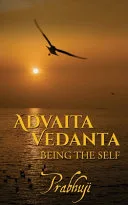
Advaita Vedanta
 77
77

Advaita Vedanta
David Prabhuji's 'Advaita Vedanta' offers a clear, albeit concise, entry point into one of Hinduism's most intricate philosophical systems. The book’s strength lies in its directness; it avoids excessive jargon, making the central tenet—the identity of Atman and Brahman—accessible. Prabhuji’s interpretation of Jñāna-yoga as an existential stance, rather than mere intellectual pursuit, is particularly compelling. However, the work's brevity, a consequence of its original publication in 2020, means that the practical application of self-inquiry, particularly the 'Who am I?' process, feels somewhat underdeveloped. A more detailed exploration of the stages or potential pitfalls in this practice would have added significant value. Despite this, Prabhuji effectively conveys the essence of Advaita for the sincere seeker. The book serves as a well-articulated primer on non-dual realization.
📝 Description
77
### What It Is
Advaita Vedanta, as presented by David Prabhuji, is a profound exposition of a central school of Hindu philosophy. First published in March 2020, it frames this tradition not merely as a set of doctrines but as a lived, existential perspective. The work positions Advaita Vedanta as a sophisticated intellectual and spiritual inheritance, aiming to guide sincere seekers toward an understanding of their fundamental reality.
### Who It's For
This text is specifically curated for individuals who are serious about spiritual inquiry, particularly those seeking liberation (moksha) and a direct apprehension of their true nature. It calls to those who are prepared to engage in rigorous self-examination rather than passive acceptance of dogma. The reader should possess a nascent interest in Eastern philosophies and a commitment to introspection.
### Historical Context
Advaita Vedanta, as a philosophical system, has ancient roots in India, with its most influential proponent being Adi Shankaracharya, who consolidated its teachings in the 8th century CE. It stands in contrast to dualistic schools of Hindu philosophy, such as Dvaita Vedanta. Prabhuji’s work, published in 2020, situates this timeless inquiry within a contemporary framework, making accessible centuries-old wisdom to a modern audience.
### Key Concepts
The core of Advaita Vedanta, as explored in this book, revolves around the concept of non-duality (Advaita), asserting the ultimate oneness of the individual self (Atman) and the universal consciousness (Brahman). The primary methodology offered is Jñāna-yoga, the yoga of knowledge, which employs self-inquiry, most notably the question 'Who am I?', as its central tool for dismantling ignorance and realizing one's inherent identity as pure consciousness, free from the limitations of the phenomenal world.
💡 Why Read This Book?
• You will learn the foundational principle of non-duality (Advaita) and its implication for personal identity, as explained through Prabhuji's 2020 exposition, differentiating it from dualistic philosophies. • You will gain a practical understanding of Jñāna-yoga, the path of knowledge, focusing on the specific self-inquiry technique of 'Who am I?' as a means to attain moksha. • You will feel empowered to question the nature of the self beyond the limitations of time and space, directly engaging with the concept of realizing oneself as Brahman.
⭐ Reader Reviews
Honest opinions from readers who have explored this book.
❓ Frequently Asked Questions
What is the primary goal of Advaita Vedanta as described by David Prabhuji?
The primary goal is liberation, or moksha, achieved through the direct realization of one's true essence as Brahman, the transcendental Self, thereby transcending the limitations of time and space.
What is Jñāna-yoga and how does Advaita Vedanta utilize it?
Jñāna-yoga is the path of knowledge. Advaita Vedanta employs it as an existential view and a practice of self-inquiry, specifically the question 'Who am I?', to understand one's identity as Brahman.
When was David Prabhuji's 'Advaita Vedanta' first published?
David Prabhuji's 'Advaita Vedanta' was first published on March 21, 2020.
What does 'Atman is Brahman' mean in the context of Advaita Vedanta?
This central teaching signifies that the individual soul or self (Atman) is fundamentally identical with the ultimate reality or universal consciousness (Brahman), meaning there is no essential separation.
How does the concept of 'self-inquiry' work in this philosophy?
Self-inquiry, particularly the question 'Who am I?', is a method to investigate the nature of the self, to peel back layers of identification with the body, mind, and ego, ultimately revealing the pure, unchanging consciousness.
Is Advaita Vedanta a religion or a philosophy?
Advaita Vedanta is considered one of the major philosophical schools within Hinduism. While it has profound spiritual implications and practices, its core is a philosophical system exploring the nature of reality and consciousness.
🔮 Key Themes & Symbolism
Non-Duality (Advaita)
This theme explores the core tenet that reality is ultimately one and indivisible. The individual self (Atman) is not separate from the universal consciousness (Brahman). Prabhuji's work frames this not as a theoretical concept but as a direct existential realization, urging the reader to see beyond apparent distinctions and perceive the underlying unity of all existence. This understanding is presented as the key to overcoming suffering and achieving liberation.
The Path of Knowledge (Jñāna-yoga)
Central to Advaita Vedanta, Jñāna-yoga is presented as the primary methodology for realizing one's true nature. This is not passive intellectual study but an active, rigorous process of investigation. The book emphasizes that true knowledge comes from direct experience and self-understanding, moving beyond dogma and belief systems to arrive at an unshakeable conviction of one's inherent oneness with Brahman.
Self-Inquiry ('Who am I?')
The practice of self-inquiry, epitomized by the question 'Who am I?', serves as the cornerstone of the Jñāna-yoga path within Advaita Vedanta. Prabhuji guides the reader to use this question as a tool to deconstruct the false identification with the ego, the body, and the mind. It is a process of persistent introspection aimed at discovering the pure, unchanging consciousness that is the witness to all experience.
Liberation (Moksha)
Moksha represents the ultimate spiritual goal within Advaita Vedanta: freedom from the cycle of birth and death and the cessation of suffering. This liberation is not achieved through external actions or rituals alone, but through the direct experiential knowledge of one's true identity as Brahman. The book posits that this realization dissolves ignorance and reveals the inherent bliss and peace of one's essential nature.
💬 Memorable Quotes
“Advaita Vedanta is one of the most refined philosophical pearls of Hinduism.”
— This highlights the sophistication and value of Advaita Vedanta within the broader Hindu tradition, positioning it as a precious and highly developed system of thought and practice.
“It is reserved for seekers of Truth that want to know their own essence and aspire to liberation, or moksha.”
— This statement defines the intended audience and ultimate aim of studying Advaita Vedanta, emphasizing its suitability for those dedicated to profound self-discovery and freedom from worldly entanglement.
“He proposes to us the path of knowledge called Jñāna-yoga, which much more than a theory or a doctrine, it is an existential view.”
— This emphasizes that Jñāna-yoga, as taught in Advaita Vedanta, is not just an intellectual framework but a comprehensive way of life and a perspective that shapes one's entire existence.
“Jñāna is knowing oneself as Brahman and realizing one's reality as the transcendental Self, beyond time and space.”
— This succinctly defines the essence of spiritual knowledge (Jñāna) within Advaita, equating self-knowledge with the realization of one's identity as the ultimate, timeless, and spaceless reality.
“Its main teaching is self-inquiry: 'Who am I?'”
— This points to the central practical method of Advaita Vedanta, identifying the potent tool of self-questioning as the primary means to achieve the profound understanding of one's true nature.
🌙 Esoteric Significance
Tradition
Advaita Vedanta is a foundational tradition within the broader spectrum of Indian spiritual thought, deeply rooted in the Upanishads, which are considered among the earliest scriptures of Hinduism. While not strictly categorized under Western esoteric lineages like Hermeticism or Kabbalah, its emphasis on direct experiential knowledge of ultimate reality and the unity of consciousness shares significant common ground with Gnostic and Neoplatonic traditions. It represents a sophisticated path of self-realization that has profoundly influenced yogic and meditative practices globally.
Symbolism
Within Advaita, the primary symbolic representation of ultimate reality is Brahman, often described through negation (neti neti – 'not this, not this') to point towards that which is beyond conceptualization. The concept of Atman, the individual self, is symbolically identified with Brahman, dissolving the illusion of separateness. The lotus flower, a common motif in Indic traditions, can symbolize purity and spiritual awakening emerging from the waters of ignorance. The Om mantra is a profound sonic symbol representing the totality of existence.
Modern Relevance
Contemporary thinkers and spiritual practitioners continue to draw heavily from Advaita Vedanta. Its emphasis on non-duality and self-inquiry resonates with modern mindfulness and meditation movements, as well as psychological approaches that explore the nature of consciousness. Philosophers and spiritual teachers worldwide, including figures in the West who engage with Eastern thought, often reference Advaita's core tenets to discuss consciousness, identity, and the pursuit of ultimate truth, demonstrating its ongoing influence on global spiritual discourse.
👥 Who Should Read This Book
• Students of comparative religion and philosophy seeking to understand a major non-dualistic school of Hindu thought, particularly those interested in the works of Adi Shankaracharya. • Dedicated spiritual seekers aspiring to liberation (moksha) who are prepared for rigorous self-inquiry and wish to explore the path of Jñāna-yoga as outlined by David Prabhuji. • Practitioners of meditation and yoga looking to deepen their understanding of consciousness and the self beyond the ego, gaining insights into the Vedantic perspective on realizing Brahman.
📜 Historical Context
Advaita Vedanta, a prominent school of Hindu philosophy, traces its origins to the Upanishads and was systematically consolidated by Adi Shankaracharya in the 8th century CE. Shankaracharya, a pivotal figure, authored numerous commentaries on Vedic texts and established monastic orders, significantly shaping the intellectual landscape of India. His work provided a powerful counterpoint to dualistic philosophies prevalent at the time, such as Dvaita Vedanta, championed by thinkers like Madhvacharya. While Shankaracharya’s teachings have been debated and interpreted for centuries, their influence on subsequent Indian thought, mysticism, and yoga traditions is undeniable. David Prabhuji's 2020 publication, 'Advaita Vedanta', brings these ancient insights into a contemporary context, making the core principles accessible to a modern audience, demonstrating the enduring relevance of non-dual philosophy.
📔 Journal Prompts
The concept of realizing oneself as Brahman, beyond time and space.
The practice of self-inquiry and the question 'Who am I?'.
The existential nature of Jñāna-yoga compared to mere theory.
The ultimate goal of moksha and its significance in Advaita Vedanta.
The relationship between the individual self (Atman) and universal consciousness (Brahman).
🗂️ Glossary
Advaita
Meaning 'non-dual' or 'not two'. It refers to the philosophical school that posits the ultimate oneness of reality, where the individual self is identical to the universal consciousness.
Vedanta
Literally 'end of the Vedas'. It refers to the Upanishads and the philosophical systems derived from them, focusing on metaphysical inquiries into the nature of reality, consciousness, and the self.
Brahman
The ultimate, unchanging reality or supreme cosmic spirit in Hinduism. It is considered the source and substratum of all existence, the universal consciousness.
Atman
The individual soul, self, or spirit. In Advaita Vedanta, Atman is ultimately identical with Brahman.
Moksha
Liberation or release from the cycle of birth, death, and rebirth (samsara). It is the ultimate spiritual goal in Hinduism, achieved through self-realization.
Jñāna-yoga
The yoga of knowledge or wisdom. It is a path to liberation through intellectual understanding, contemplation, and direct realization of the truth, particularly through self-inquiry.
Self-inquiry
A spiritual practice involving introspective investigation into the nature of the self, often by asking questions like 'Who am I?' to discern the true self from the ego and false identifications.