The book of Hiram
 84
84

The book of Hiram
Knight and Lomas's exploration of Hiram Abiff and the Temple of Solomon presents a compelling argument for the deep, ancient roots of Masonic ritual and esoteric knowledge. Their meticulous attention to biblical detail, particularly concerning the construction accounts and the figure of Hiram, offers a fresh perspective that moves beyond standard historical interpretations. The strength of the book lies in its audacious synthesis of archaeology, theology, and mystical tradition, creating a narrative that feels both ancient and urgent. However, the sheer speculative leap required to connect these disparate elements, while fascinating, sometimes strains credulity. The interpretation of the 'widow's son' as a symbol of an ancient, suppressed matriarchal deity, for instance, is a bold claim that leans heavily on symbolic resonance rather than direct textual proof. Despite this, The Book of Hiram remains a significant contribution to esoteric literature, challenging readers to reconsider the origins of Western mystical thought.
📝 Description
84
In 2004, Knight and Lomas proposed a Masonic lineage tracing back to King Solomon's Temple.
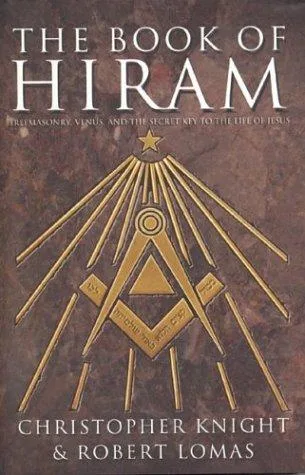
The Book of Hiram, by Christopher Knight and Robert Lomas, published in 2004, argues for a direct link between Freemasonry and the builders of King Solomon's Temple. The authors suggest that biblical stories, particularly those surrounding the construction of the Temple and the figure of Hiram Abiff, contain hidden initiatory knowledge. This knowledge, they claim, was preserved and passed down through secret societies.
The book is for readers interested in the historical and esoteric foundations of Freemasonry, biblical studies, and Western mystery traditions. It will appeal to those who enjoy speculative history and unconventional takes on religious and masonic lore. Readers looking for strict historical accounts might find its speculative nature challenging, but those drawn to the symbolic and occult aspects of ancient texts and rituals will find much to consider.
Knight and Lomas's work enters the discourse on Masonic origins, which often connects the fraternity to older traditions like the Knights Templar or Rosicrucians. Their specific focus is on the Solomonic Temple narrative as a repository of lost spiritual teachings. This approach aligns with a long tradition of seeing biblical narratives not just as historical or religious accounts, but as symbolic vehicles for deeper, initiatory truths, a practice common in various Western esoteric schools.
💡 Why Read This Book?
• Gain a new perspective on the Hiram Abiff legend by understanding its proposed role as a pre-Christian initiatory archetype, distinct from standard biblical exegesis. • Explore the theory linking the architecture of Solomon's Temple to ancient sacred geometry, offering insights into how physical structures might encode spiritual knowledge. • Understand the authors' argument for a continuous lineage of esoteric teaching from the time of the Temple builders to the formation of modern Freemasonry.
⭐ Reader Reviews
Honest opinions from readers who have explored this book.
❓ Frequently Asked Questions
What is the central argument of The Book of Hiram?
The book's central argument is that the legend of Hiram Abiff and the construction of Solomon's Temple are not merely historical or allegorical but represent a preserved, initiatory tradition dating back to ancient Egypt or earlier, passed down through secret societies.
Who were Christopher Knight and Robert Lomas?
Christopher Knight and Robert Lomas were British authors known for their speculative works on the history of Freemasonry and ancient mysteries, often linking biblical narratives to esoteric traditions.
When was The Book of Hiram first published?
The Book of Hiram was first published in 2004, contributing to a wave of popular interest in historical and esoteric interpretations of ancient religious texts and secret societies.
Does The Book of Hiram present a purely historical account?
No, while it draws on historical and archaeological evidence, the book heavily incorporates esoteric interpretations, symbolism, and speculative theories about lost traditions and secret knowledge.
What is the significance of Hiram Abiff in the book's thesis?
In The Book of Hiram, Hiram Abiff is reinterpreted as a master teacher or hierophant of an ancient mystery school, whose legend symbolically encodes profound spiritual secrets that were later transmitted through Masonic rituals.
What ancient traditions does the book connect Freemasonry to?
The book connects Freemasonry to traditions associated with the builders of Solomon's Temple, ancient Egypt, and a supposed primordial spiritual lineage that predates conventional religious history.
🔮 Key Themes & Symbolism
The Hiram Legend Reimagined
The work posits that the biblical account of Hiram Abiff, the master craftsman of Solomon's Temple, is far more than a historical or allegorical tale. Knight and Lomas present him as a custodian of ancient, sacred knowledge, a priest-king figure whose story serves as a symbolic key to initiatory rites. They argue that the legend, particularly its elements of betrayal and resurrection, encodes a sophisticated system of spiritual transmission designed to awaken the practitioner to higher realities. This interpretation places Hiram at the center of a continuous esoteric lineage stretching back to the dawn of civilization.
Solomon's Temple as a Cosmic Blueprint
Central to the authors' thesis is the idea that Solomon's Temple was not merely a physical structure but a meticulously designed microcosm reflecting the macrocosm. Its dimensions, layout, and symbolic ornamentation are analyzed as a form of sacred geometry, intended to act as a conduit for divine energy and a repository of universal wisdom. The book explores how the Temple's design principles embody a cosmic map, guiding initiates through stages of spiritual realization. This perspective elevates the Temple from a historical site to a potent symbol of divine order and human potential.
The Veil of Secrecy
Knight and Lomas investigate the persistent theme of secrecy surrounding the Hiram legend and the supposed knowledge it represents. They propose that the suppression or loss of this ancient wisdom necessitated its preservation within clandestine traditions, most notably Freemasonry. The book examines how rituals and symbols became the vehicles for transmitting this guarded knowledge across centuries, ensuring its survival despite persecution or societal change. The narrative of Hiram's death and the subsequent search for his secrets is interpreted as a metaphor for the ongoing quest for lost spiritual truths.
Ancient Roots of Western Esotericism
The Book of Hiram argues for a profound, unbroken lineage connecting the builders of the Jerusalem Temple to later Western esoteric movements. It suggests that the spiritual technology and philosophical insights embodied in the Temple narrative were foundational to traditions like Gnosticism, Hermeticism, and eventually Freemasonry itself. By tracing these roots, the authors aim to reveal a hidden history of spiritual development, suggesting that the core principles of Western mysticism have a far older and more unified origin than commonly acknowledged.
💬 Memorable Quotes
Direct passages from the work, attributed to the author.
“The Temple was not built by men, but for men, to show them the way to God.”
— This statement suggests the Temple's primary purpose was not architectural but spiritual, serving as a symbolic guide or map for human spiritual ascent and connection to the divine.
“Hiram Abiff was not merely a craftsman; he was the keeper of the sacred word.”
— This highlights the authors' view of Hiram as a master initiate or priest, responsible for safeguarding and transmitting esoteric knowledge, rather than just a skilled artisan.
“Geometry is the language of the universe, inscribed in stone and spirit.”
— This conveys the book's emphasis on sacred geometry, seeing it as a fundamental principle underlying both physical creation and spiritual understanding, bridging the material and the metaphysical.
“The search for the master's word is the search for self-realization.”
— This interpretation connects the Masonic quest for a lost 'word' or knowledge to the individual's journey of inner discovery and spiritual awakening.
💡 Key Ideas
Editorial paraphrase of the work's core concepts — not direct quotes.
The widow's son carries the secret of the lost light.
This paraphrased concept refers to the symbolic significance of Hiram's maternal lineage, interpreted as representing a primal, perhaps suppressed, source of spiritual illumination.
🌙 Esoteric Significance
Tradition
The Book of Hiram aligns itself primarily with the Western Esoteric Tradition, particularly its Masonic and Hermetic branches. It seeks to demonstrate a direct, unbroken lineage of knowledge transfer from the supposed builders of Solomon's Temple to the formation of modern Freemasonry. The work interprets biblical narratives through a Gnostic and Hermetic lens, viewing them as veiled accounts of spiritual initiation and cosmic principles rather than literal history. It departs from some traditional interpretations by emphasizing a primordial, pre-Christian spiritual lineage that predates organized religion.
Symbolism
Key symbols explored include Solomon's Temple itself, presented as a cosmic blueprint and a map for spiritual ascent. The figure of Hiram Abiff is central, symbolizing the master teacher or hierophant who holds the 'lost word' or secret knowledge. The 'widow's son' aspect is interpreted esoterically, potentially linking to matriarchal deities or a primal feminine principle of creation. Sacred geometry, as embodied in the Temple's architecture, is another crucial motif, representing the underlying divine order of the universe that can be apprehended through specific proportions and forms.
Modern Relevance
Contemporary practitioners of speculative Freemasonry, students of comparative religion, and seekers interested in the intersection of history and mysticism continue to draw inspiration from The Book of Hiram. Its theories resonate with modern occultists exploring ancient origins and the symbolic language of ritual. Thinkers investigating the historical Jesus and alternative spiritualities may find its reinterpretations of biblical figures and events provocative. The book's emphasis on sacred architecture and geometry also appeals to those exploring these concepts in contemporary spiritual or philosophical contexts.
👥 Who Should Read This Book
• Students of Western Esotericism interested in tracing the alleged origins of Masonic ritual and symbolism back to the era of Solomon's Temple. • Readers of speculative history and comparative religion who enjoy unconventional interpretations of biblical narratives and ancient structures. • Freemasons seeking a deeper, esoteric understanding of the Hiram Abiff legend and its connection to ancient wisdom traditions.
📜 Historical Context
Published in 2004, The Book of Hiram emerged at a time when popular and academic interest in the historical Jesus, Gnosticism, and the origins of Freemasonry was significant. Knight and Lomas's work positioned itself within a tradition of speculative historical inquiry that sought to uncover hidden lineages and esoteric interpretations of religious texts. Their approach, however, significantly diverged from mainstream biblical scholarship, which largely viewed the Hiram Abiff narrative as legendary or allegorical. The book built upon earlier theories linking Freemasonry to the Knights Templar and ancient mystery schools, but it focused intensely on the Solomonic Temple as the primary repository of this lost wisdom. While not directly engaging with specific academic debates of the time, it tapped into a public appetite for alternative histories, often finding a more receptive audience in esoteric circles than in rigorous historical academia. The book's reception was largely characterized by enthusiasm from those predisposed to its theories and skepticism from traditional historians and religious scholars.
📔 Journal Prompts
The Temple's blueprint as a map for spiritual ascent.
Hiram Abiff's role as keeper of the sacred word.
The significance of the 'widow's son' within esoteric traditions.
Sacred geometry as a bridge between the material and spiritual realms.
The legacy of ancient knowledge within modern secret societies.
🗂️ Glossary
Hiram Abiff
The master craftsman described in Masonic lore as the architect of Solomon's Temple, whose legend is central to the book's thesis regarding ancient initiatory knowledge.
Solomon's Temple
The biblical Temple in Jerusalem, which the authors interpret not just as a historical structure but as a symbolic representation of cosmic order and a repository of esoteric wisdom.
Sacred Geometry
The belief that geometric forms and proportions hold symbolic and spiritual meaning, used by the authors to interpret the design of Solomon's Temple and its alleged connection to universal principles.
Initiation
A process of spiritual or ritualistic awakening, which the book argues is encoded within the Hiram legend and transmitted through Masonic degrees and other ancient mystery traditions.
Esoteric Lineage
A concept suggesting a continuous, often secret, transmission of spiritual knowledge and practices from ancient times through various schools and societies, as proposed by the authors for Masonic traditions.
The Widow's Son
A descriptor for Hiram Abiff, which the authors explore for its potential esoteric meanings related to primal creation or suppressed spiritual knowledge.
The Lost Word
A symbolic representation of ultimate spiritual truth or divine knowledge, the search for which is a key theme in Masonic tradition and is explored by the authors in relation to Hiram Abiff.
🔮 Readers Also Liked
Browse all →








More by Christopher Knight, Robert Lomas
All books →


More Free Freemasonry & Secret Societies Books
View all →