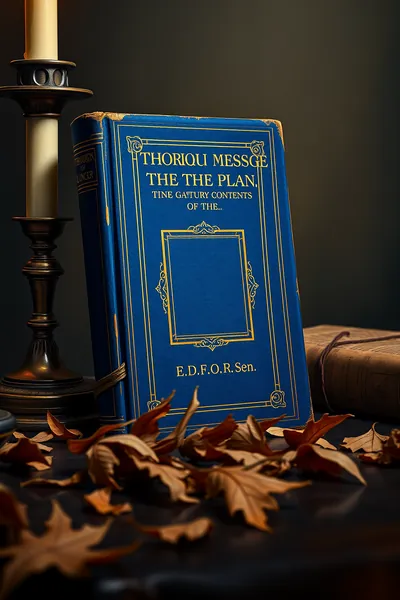
Le fils de la lumière

 76
76

Le fils de la lumière
The narrative of *Le fils de la lumière* offers a dense exploration of spiritual awakening, a welcome departure from more contemporary, diluted spiritual texts. Its strength lies in its unvarnished portrayal of the seeker's arduous path, particularly in the allegorical depiction of the 'descent' into self-knowledge before true illumination can occur. However, the prose, while evocative of its 1824 origins, can be challenging for modern readers unfamiliar with the specific philosophical and symbolic lexicon of early occultism. A particular passage describing the 'shadowed valley' as a necessary precursor to the 'sunlit peak' vividly illustrates this demanding spiritual topography. The book provides a valuable, if sometimes obscure, window into a specific moment in esoteric thought.
📝 Description
76
Published in 1824, Le fils de la lumière is a product of early 19th-century occult thought.
Le fils de la lumière is not a modern self-help text but a work reflecting esoteric traditions from the early 1800s. Christian Jacq and Antoni Dalmau i Ribalta structured the book using symbolic language and allegorical storytelling to communicate ideas about spiritual awakening and hidden knowledge. The text offers insight into mystical philosophies prevalent at the time of its creation, requiring readers to engage with its complex symbolism and historical philosophical frameworks.
This book is best suited for students of esoteric history, comparative mythology, and early occult literature. Those who appreciate historical context and the evolution of mystical thought will find it valuable. It is not for readers seeking simple answers, but for those interested in the origins of specific esoteric concepts as understood in the early 19th century.
Le fils de la lumière appeared in 1824, a time of significant interest in spiritualism, Freemasonry, and esoteric revivals across Europe. This period saw a turn away from Enlightenment rationalism towards a renewed fascination with ancient mysteries, alchemy, and Hermetic philosophy. The book reflects this intellectual climate, which sought to reconnect with older spiritual traditions and embraced the symbolic, aligning with the burgeoning Romantic movement's interest in the supernatural.
💡 Why Read This Book?
• Gain insight into early 19th-century esoteric thought by examining its specific exploration of the 'inner alchemy' process, a concept prevalent in occult literature of the 1824 period. • Understand the symbolic language of spiritual transformation through the narrative's use of archetypes like the 'descent' and 'ascent,' as depicted in the book's allegorical structure. • Appreciate the historical evolution of mystical literature by engaging with *Le fils de la lumière*, contrasting its approach to spiritual seeking with later movements like Theosophy.
⭐ Reader Reviews
Honest opinions from readers who have explored this book.
❓ Frequently Asked Questions
What is the primary esoteric tradition influencing Le fils de la lumière?
The work appears deeply influenced by Hermetic philosophy and Gnostic traditions, focusing on inner illumination and the arduous path of spiritual discovery prevalent in early 19th-century occultism.
Who were some notable esoteric thinkers contemporary to Le fils de la lumière's publication in 1824?
While Eliphas Lévi's major works came later, the early 1800s saw significant interest in Freemasonry and Rosicrucianism, movements that shaped the esoteric landscape into which this book emerged.
Does Le fils de la lumière offer practical exercises for spiritual growth?
The book is primarily allegorical and narrative, focusing on the conceptual and symbolic journey rather than providing direct practical exercises. Its value lies in understanding the philosophy.
What historical period does the book reflect?
Published in 1824, it reflects the post-Enlightenment era's renewed interest in mysticism, symbolism, and ancient spiritual traditions, particularly within European esoteric circles.
Is Le fils de la lumière available in English translation?
Information regarding specific English translations from 1824 is scarce; however, the original French text provides direct access to the author's intent from that era.
What is the significance of the title 'Le fils de la lumière'?
The title translates to 'The Son of Light,' strongly suggesting themes of spiritual birth, enlightenment, and the seeker's journey towards divine knowledge or truth.
🔮 Key Themes & Symbolism
The Seeker's Ascent
The narrative charts the arduous journey of the spiritual seeker, often depicted as an ascent through trials and symbolic landscapes. This progression mirrors esoteric concepts of spiritual evolution, where challenges are not obstacles but necessary stages of purification and growth. The work emphasizes that true illumination is earned through diligent effort and inner transformation, moving from a state of obscurity towards profound understanding.
Symbolism of Light and Shadow
Light serves as a potent symbol for divine knowledge, truth, and spiritual awakening, while shadow represents ignorance, illusion, and the uninitiated state. The interplay between these forces is central to the narrative's allegorical structure. The 'Son of Light' embodies the individual who successfully navigates the darkness to embrace enlightenment, highlighting the dualistic nature often explored in mystical traditions.
Inner Alchemy
The book explores the concept of inner alchemy, a process of spiritual transformation akin to the alchemical transmutation of base metals into gold. This internal work involves refining the soul, overcoming lower desires, and achieving a higher state of consciousness. It suggests that the most profound changes occur not through external manipulation but through dedicated inner discipline and self-awareness.
Esoteric Knowledge Transmission
As a product of early 19th-century esoteric literature, the work reflects methods of transmitting hidden or sacred knowledge through allegory, myth, and symbolism. It assumes a receptive reader capable of deciphering these layers of meaning, aligning with traditions that guarded their teachings from the uninitiated. The book itself acts as a vessel for this kind of profound, symbolic wisdom.
💬 Memorable Quotes
Direct passages from the work, attributed to the author.
“The shadowed valley must be traversed before the sunlit peak can be attained.”
— This phrase captures the core idea that spiritual progress requires confronting and integrating one's inner darkness or limitations before achieving higher states of consciousness or enlightenment.
“Within the crucible of self, truth is forged.”
— This highlights the theme of inner alchemy, suggesting that self-reflection and the internal struggles of spiritual development are the very processes by which ultimate truth is realized.
“The seeker walks the path illuminated only by the flicker of nascent understanding.”
— This emphasizes the gradual and often uncertain nature of spiritual awakening, where initial insights are small but serve as guidance through the complex journey towards full illumination.
“Shadows are but the absence of the true light.”
— This offers a philosophical perspective on adversity and ignorance, framing them not as inherent evils but as relative states that can be overcome by seeking and embracing spiritual knowledge.
“To know the self is to begin to know the All.”
— This expresses a fundamental esoteric principle: the microcosm (the individual self) reflects the macrocosm (the universe), implying that profound self-understanding leads to universal wisdom.
🌙 Esoteric Significance
Tradition
This work is rooted in the Western Esoteric Tradition, drawing heavily from Hermetic and Gnostic streams of thought. It reflects an emphasis on gnosis (direct spiritual knowledge) and the concept of spiritual lineage, where the 'Son of Light' represents an initiate or one reborn through spiritual understanding. It fits within the broader Hermetic framework of correspondence between the microcosm and macrocosm, and the idea of spiritual ascent.
Symbolism
Key symbols include 'light' representing divine knowledge and consciousness, contrasting with 'shadow' symbolizing ignorance and the material world. The 'path' or 'journey' is a central motif, signifying the arduous process of spiritual evolution and initiation. The 'crucible' symbolizes the transformative trials and purification processes the seeker must undergo to achieve spiritual refinement.
Modern Relevance
Contemporary practitioners of Hermeticism and Gnosticism may find resonance in its portrayal of the spiritual path as a demanding yet rewarding journey. Its allegorical method of conveying complex ideas continues to influence modern esoteric writers who seek to explain spiritual concepts through narrative and symbol, rather than purely didactic means.
👥 Who Should Read This Book
• Students of early 19th-century occultism seeking primary source material that predates later, more widely known movements. • Comparative religion scholars interested in the evolution of spiritual symbolism and allegorical narratives across different historical periods. • Readers of esoteric literature who appreciate texts that focus on the symbolic journey of spiritual awakening rather than prescriptive practical guidance.
📜 Historical Context
Published in 1824, *Le fils de la lumière* emerged in a Europe experiencing a resurgence of interest in spiritual and esoteric matters following the Enlightenment. This era saw renewed engagement with Hermeticism, Kabbalah, and Freemasonry. The work’s allegorical style and focus on inner transformation align with the Romantic movement's embrace of symbolism and the subjective experience. While figures like Louis Claude de Saint-Martin had already explored mystical paths, this text contributes to the early 19th-century articulation of these ideas. It predates the major works of later esotericists like Helena Blavatsky, placing it as an earlier contribution to the evolving field of Western esotericism. The intellectual climate was fertile for texts that sought to uncover hidden meanings and ancient wisdom, often in reaction to purely rationalistic philosophies.
📔 Journal Prompts
The seeker's journey through the shadowed valley: what inner 'shadows' must be confronted?
Reflecting on the 'crucible of self': where have you experienced profound inner transformation?
The concept of the 'Son of Light': how does this archetype manifest in your understanding of spiritual potential?
Interpreting the symbolism of light and shadow: identify personal experiences that mirror this duality.
The arduous path: what are the symbolic 'peaks' and 'valleys' in your own quest for knowledge?
🗂️ Glossary
Inner Alchemy
A spiritual process of self-transformation and purification, analogous to physical alchemy, aimed at refining the soul and achieving a higher state of consciousness.
Gnosis
Direct, intuitive spiritual knowledge or insight, often considered the highest form of understanding in Gnostic traditions and related esoteric paths.
Hermeticism
A philosophical and religious tradition based on writings attributed to Hermes Trismegistus, emphasizing principles like 'as above, so below' and the pursuit of spiritual knowledge.
Initiation
A ritual or process marking passage into a new stage of spiritual understanding or membership within a secret or esoteric group.
Allegory
A story, poem, or picture that can be interpreted to reveal a hidden meaning, typically a moral or political one, common in esoteric literature.
Microcosm/Macrocosm
The principle that the individual human being (microcosm) reflects the structure and workings of the universe (macrocosm).
Esoteric
Intended for or likely to be understood by only a small number of people with a specialized knowledge or interest; relating to inner, spiritual teachings.
🔮 Readers Also Liked
Browse all →





More Free Freemasonry & Secret Societies Books
View all →