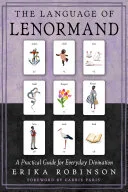
The Language of Lenormand
 80
80

The Language of Lenormand
Erika Robinson's "The Language of Lenormand" arrives as a much-needed clarification for a divination system often overshadowed by its more flamboyant Tarot cousin. Robinson demonstrates a clear mastery of the Petit Lenormand, offering explanations that are both precise and accessible. The book excels in illustrating how the seemingly simple cards of the Lenormand deck form intricate narratives when read in combination, particularly highlighting the "Great Table" technique. A notable strength is the breakdown of card combinations, providing concrete examples that move beyond rote memorization. However, the text could benefit from more extensive discussion on the historical evolution of specific card interpretations as they shifted across different European regions. Despite this minor quibble, Robinson's work provides a solid foundation for understanding this influential oracle. It is a competent and valuable addition to the Lenormand literature.
📝 Description
80
### What It Is
The Language of Lenormand offers a systematic approach to the 36-card divination system that predates Tarot's widespread adoption. This guide unpacks the origins and practical application of the Petit Lenormand, focusing on its unique pictographic language. It moves beyond simple card meanings to explore the interconnectedness of the deck, enabling readers to construct coherent narratives from card spreads.
### Who It's For
This book is intended for both newcomers to cartomancy seeking a clear entry point into a less common yet highly effective system, and for experienced diviners looking to refine their skills. Those interested in European divination traditions, historical occult practices, and developing intuitive interpretation will find value here. It is particularly suited for individuals who prefer a structured, symbolic approach to divination.
### Historical Context
Emerging in the early 19th century, the Lenormand system, attributed to Mlle Lenormand (1768-1843), gained significant traction in continental Europe. Unlike the more complex imagery of Tarot, the Lenormand deck features simpler, everyday symbols. Its popularity surged in France and Germany, with numerous deck variations appearing throughout the 1800s. This system stands apart from occult revival movements that focused on Kabbalah or Hermeticism, offering a more direct, folk-magic-oriented form of divination.
### Key Concepts
The core of this work lies in understanding the positional significance of cards, the concept of "houses" within a spread, and the interplay between significator cards and their surroundings. It emphasizes "Great Tables" or Grand Tableau readings, which utilize the entire 36-card deck. The book also details the specific symbolism of each card, from the Rider to the Lily, and how these symbols interact to form a cohesive message.
💡 Why Read This Book?
• Gain a structured method for interpreting the 36-card Lenormand system, moving beyond individual card meanings to understand symbolic interactions, as detailed in chapters discussing card combinations. • Learn the principles of "Great Table" readings, a complex but powerful technique for comprehensive divination that uses the entire deck, as explained by Robinson. • Understand the historical lineage of the Lenormand deck, tracing its origins and European popularity, providing context beyond the 19th-century emergence.
⭐ Reader Reviews
Honest opinions from readers who have explored this book.
❓ Frequently Asked Questions
What is the origin of the Lenormand card system?
The Lenormand system is named after Marie Anne Lenormand, a prominent French diviner active in the late 18th and early 19th centuries. While she did not invent the deck herself, its design and popularity are strongly associated with her influence.
How does Lenormand differ from Tarot?
Lenormand uses a 36-card deck with simpler, everyday imagery, focusing on direct, narrative-based readings. Tarot typically uses a larger deck (78 cards) with more complex archetypal symbolism, often leading to more psychological or spiritual interpretations.
What is a 'Great Table' in Lenormand divination?
A 'Great Table' or Grand Tableau is a full spread using all 36 Lenormand cards. It provides a comprehensive overview of a situation, allowing for detailed analysis of relationships between cards and their positions.
Who was Mlle Lenormand?
Mlle Lenormand was a famous French fortune-teller whose predictions influenced prominent figures of the French Revolution and Napoleonic era. Her association with the deck cemented its name and popular appeal.
Is this book suitable for complete beginners?
Yes, 'The Language of Lenormand' is designed to be accessible for novices while also offering depth for experienced diviners, clearly explaining the system's foundations and advanced techniques.
What makes this guide unique compared to other Lenormand books?
This guide emphasizes a clear, systematic approach to interpreting card combinations and the "Great Table," written by a recognized teacher in the field, providing a structured learning path.
🔮 Key Themes & Symbolism
Symbolic Language of Cards
The book meticulously decodes the individual meanings of each of the 36 Lenormand cards, from the foundational 'Rider' to the concluding 'Cross'. It emphasizes that each symbol, like the 'Tree' or the 'Fox', carries a distinct energetic signature. Robinson guides the reader to see these symbols not in isolation, but as components of a larger visual language, where their placement and proximity to other cards drastically alter their interpretation and narrative contribution to a reading.
Narrative Construction in Spreads
A central tenet of 'The Language of Lenormand' is the construction of coherent narratives through card combinations. The work moves beyond assigning single keywords to each card, instead focusing on how pairs and groups of cards interact. Concepts such as 'blocking' cards, 'supporting' cards, and the flow of energy across the spread are explored, enabling readers to weave together a story that addresses the querent's question with nuance and detail.
The Great Table Technique
This guide provides an in-depth exploration of the Grand Tableau, or 'Great Table,' a reading method that utilizes the entire 36-card deck. Robinson breaks down the complexities of this expansive spread, explaining how to identify key themes, personal significators, and the overall trajectory of a situation. The book offers practical advice on laying out the cards and interpreting the intricate web of connections they form.
Historical Roots and European Practice
The book contextualizes the Lenormand system within its historical development, noting its origins in 19th-century Europe and its distinct evolution from other cartomantic traditions. It highlights the enduring popularity of the deck in continental Europe, distinguishing its approach from later esoteric developments. This grounding provides readers with an appreciation for the system's cultural and practical heritage.
💬 Memorable Quotes
“The Lenormand deck is a language, not a guessing game.”
— This statement encapsulates the book's core philosophy: that Lenormand divination relies on understanding a structured symbolic system and its grammar, rather than relying on arbitrary intuition or disconnected guesses.
“Card combinations reveal the story the cards want to tell.”
— This highlights the importance of context in Lenormand readings. It suggests that the true meaning emerges from how cards interact, forming a narrative that is greater than the sum of its individual parts.
“The significator card acts as a lens through which the spread is viewed.”
— This emphasizes the role of specific cards chosen to represent the querent or the subject of the reading. The significator focuses the interpretation, showing how the surrounding cards illuminate that specific person or issue.
“Mastering the Great Table unlocks a panoramic view of a situation.”
— This suggests that the most comprehensive understanding of a complex query comes from utilizing the full 36-card spread, offering a detailed and expansive perspective.
“Each card has a primary meaning, but its neighbours offer crucial nuance.”
— This points to the dynamic nature of Lenormand interpretation, where the fixed meaning of a card is constantly modified and enriched by the adjacent cards in a spread.
🌙 Esoteric Significance
Tradition
The Lenormand system, while not directly tied to a specific lineage like Kabbalah or Hermeticism, functions within the broader stream of European folk magic and cartomancy traditions. It shares roots with playing card divination and offers a practical, often predictive, method distinct from the more philosophical or spiritual aims of Tarot-based systems. Its strength lies in its directness and its ability to provide clear, actionable insights into daily life and future events.
Symbolism
Central symbols like the 'House' represent stability, home, and personal domain, while the 'Fox' signifies cunning, work, and deception, often requiring careful consideration of surrounding cards. The 'Path' card, indicating choices and journeys, and the 'Stars,' representing hope, destiny, and clarity, are also pivotal. These symbols, drawn from everyday life, create a potent symbolic language that is both intuitive and structured.
Modern Relevance
Contemporary practitioners of divination, particularly those interested in European traditions, continue to engage with the Lenormand system. Its pragmatic approach appeals to modern readers seeking clear guidance. Thinkers and practitioners exploring comparative divination, historical occultism, and those who find Tarot too abstract often turn to Lenormand for its directness and narrative capabilities.
👥 Who Should Read This Book
• Aspiring diviners seeking a structured, clear system: This book provides a systematic framework for understanding the 36 cards and their combinations, perfect for those new to cartomancy. • Experienced Tarot readers looking to expand their toolkit: Individuals familiar with card interpretation can learn a distinct, narrative-focused system that complements their existing knowledge. • Students of European occult history: Readers interested in the historical development of divination practices in Europe will find valuable context and analysis of a significant 19th-century system.
📜 Historical Context
The Lenormand system emerged in the early 19th century, a period of significant intellectual ferment and popular interest in divination across Europe. While movements like Spiritualism and Theosophy would later gain prominence, the Petit Lenormand deck offered a more accessible, folk-oriented cartomantic tool. Its relatively simple imagery, derived from playing cards and everyday life, contrasted with the complex esoteric symbolism developing in other occult circles. Attributed to the influence of Madame Marie Anne Lenormand, a famed diviner of the French Revolution and Napoleonic era, the deck quickly gained popularity in France and Germany. Its widespread adoption and numerous deck variations throughout the 1800s solidified its place as a distinct European divination tradition, separate from the burgeoning Hermetic and Kabbalistic studies.
📔 Journal Prompts
Reflect on the 'House' card's placement in a past reading.
Consider the 'Fox' and 'Bear' combination: what narrative emerges?
Analyze the 'Stars' card's influence on a 'Letter' reading.
Explore the symbolism of the 'Scorpion' in your personal mythology.
How does the 'Lily' interact with cards of conflict in your spreads?
🗂️ Glossary
Petit Lenormand
The specific 36-card deck system that is the subject of this book, distinguished by its simple, everyday imagery derived from playing cards.
Grand Tableau
A full Lenormand reading utilizing all 36 cards, often referred to as the 'Great Table,' designed to provide a comprehensive overview of a situation.
Significator
A card chosen to represent the querent (the person asking the question) or the main subject of the reading, around which other cards are interpreted.
Houses
A method of arranging the Lenormand cards in a grid where each position has a specific meaning or area of life it represents.
Card Combination
The interpretation derived from two or more Lenormand cards placed next to each other in a spread, where their meanings merge and interact.
Mlle Lenormand
Marie Anne Lenormand, the influential 18th-19th century French diviner after whom the Lenormand deck is named.
Blocking Card
A card that appears in a spread to hinder, delay, or negate the influence of an adjacent card or the overall outcome.