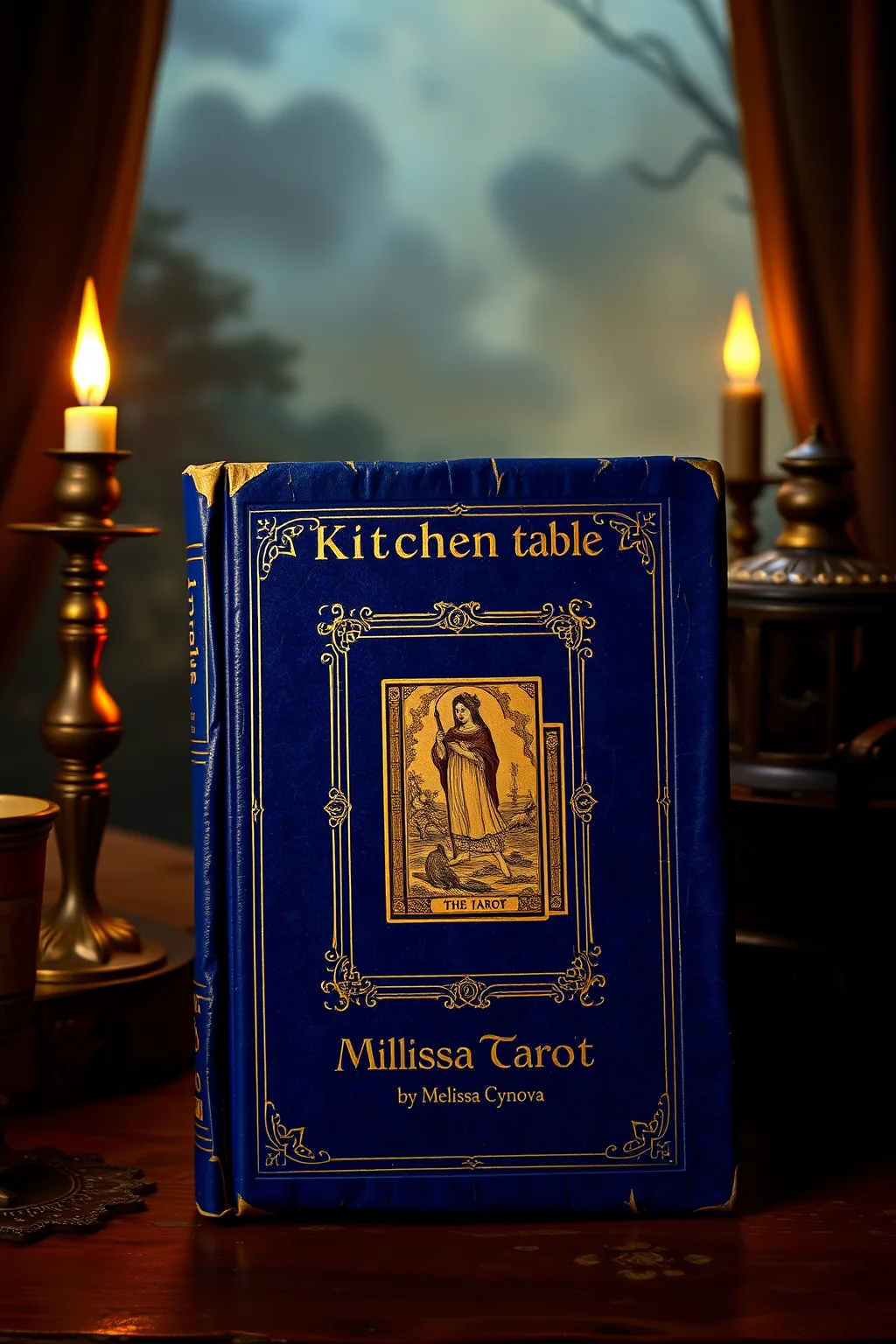
Kitchen table tarot
 72
72

Kitchen table tarot



Melissa Cynova’s Kitchen Table Tarot is a welcome antidote to the often-overwrought mystique surrounding cartomancy. Instead of arcane pronouncements, Cynova offers a pragmatic guide, grounding the reader in the simple act of pulling cards and reflecting. Her chapter on "The Question" is particularly sharp, emphasizing the clarity needed before even shuffling, a crucial step many beginners overlook. The limitation, perhaps, is that its very directness might leave those seeking deeper historical or symbolic dives wanting more. However, for its stated purpose – to make Tarot approachable – it succeeds admirably. The book rightly suggests that the most potent readings come from a place of personal connection, not rote memorization, a perspective that elevates it beyond a mere instruction manual.
📝 Description
72
### What It Is Kitchen Table Tarot offers a practical, no-nonsense approach to understanding and using the Tarot. It moves beyond esoteric jargon to present the cards as accessible tools for self-reflection and guidance. The book focuses on building a personal relationship with the Tarot deck, emphasizing intuition and lived experience over rigid interpretations. It aims to demystify the process, making Tarot reading a skill anyone can develop with consistent practice.
### Who It's For This book is ideal for individuals curious about Tarot but intimidated by its perceived complexity. It serves beginners seeking a grounded introduction and intermediate readers looking to refine their intuitive abilities. Those who prefer a direct, experiential method to learning divination, rather than purely academic or historical study, will find it particularly valuable. It’s for anyone who wants to integrate Tarot into their daily life for personal insight.
### Historical Context Published in 2017, Kitchen Table Tarot emerged during a resurgence of interest in practical spirituality and self-help modalities. While the Tarot's history spans centuries, with iconic decks like the Rider-Waite-Smith Tarot appearing in the early 20th century, Cynova's work reflects a contemporary trend toward demystifying occult practices. This period saw many authors, like Benebell Wen with her comprehensive 'Holistic Tarot', publishing extensive guides, yet Cynova carved a niche by focusing on accessibility and an anti-academic stance, contrasting with more scholarly approaches that might engage with figures like A.E. Waite himself.
### Key Concepts The core of Kitchen Table Tarot lies in demystifying the card meanings and the reading process. It champions the idea that the Tarot is not a fixed system of prediction but a symbolic language for introspection. Key concepts include developing a personal connection with one's deck, the importance of context in interpretation, and the idea that any question can be explored through the cards. The book encourages readers to trust their gut feelings and build a unique vocabulary with their chosen deck.
💡 Why Read This Book?
• Learn to build a personal, intuitive relationship with your Tarot deck, moving beyond memorized meanings as encouraged in the "Your Deck" section. • Gain clarity on formulating effective questions before a reading, a technique highlighted in the "The Question" chapter, ensuring more insightful outcomes. • Discover how to integrate Tarot into daily life for practical guidance, a core tenet demonstrated throughout the book’s accessible approach.
why_read
⭐ Reader Reviews
Honest opinions from readers who have explored this book.
❓ Frequently Asked Questions
What makes 'Kitchen Table Tarot' different from other Tarot books?
This book prioritizes a practical, intuitive approach over rigid, academic interpretations. Published in 2017, it focuses on building a personal connection with the cards, making Tarot accessible for everyday guidance rather than complex divination.
Is 'Kitchen Table Tarot' suitable for absolute beginners?
Yes, the book is designed for beginners. It demystifies the Tarot, offering a straightforward method to understand the cards and begin reading without prior knowledge or intimidation.
Does the book cover specific Tarot spreads?
While the primary focus is on understanding individual cards and developing intuition, the book guides readers toward creating their own relevant spreads based on their questions.
What is the author's background as presented in the book?
Melissa Cynova is presented as a working Tarot reader, emphasizing practical application and real-world experience rather than purely theoretical or historical expertise.
When was 'Kitchen Table Tarot' first published?
The book was first published in 2017, reflecting a contemporary wave of accessible spiritual and self-help literature.
Can I use any Tarot deck with the advice in this book?
Absolutely. Cynova encourages readers to connect with their chosen deck, regardless of its specific imagery or historical origin, emphasizing personal resonance.
🔮 Key Themes & Symbolism
Intuitive Card Interpretation
The work moves away from rote memorization of meanings, advocating for a personal connection with each card. It posits that intuition and the reader's life experience are paramount to understanding the Tarot. This approach encourages a dialogue between the querent and the cards, where symbols evoke personal resonance rather than universally prescribed definitions. Cynova stresses that a card’s meaning is fluid, influenced by the question asked and the surrounding cards in a spread.
The Art of Questioning
A central tenet is the importance of framing clear, actionable questions. The book emphasizes that the quality of the Tarot reading directly correlates with the precision of the question posed. It guides readers to move beyond vague inquiries towards specific, self-reflective prompts that allow the Tarot to offer more targeted insights. This focus reframes Tarot not as a passive fortune-telling device, but as an active tool for problem-solving and self-discovery.
Demystifying Tarot Practice
Kitchen Table Tarot aims to strip away the esoteric jargon and perceived barriers to learning Tarot. It presents the practice as accessible, grounded, and relevant to everyday life. The book advocates for a personal relationship with one's deck, treating it as a partner in exploration rather than an object of arcane mystery. This philosophy seeks to empower individuals to trust their own insights and develop their reading skills organically.
Building a Personal Deck Relationship
The book highlights the significance of a unique bond between the reader and their Tarot deck. It suggests that by spending time with the cards, observing their imagery, and engaging with them consistently, a reader develops a personalized understanding of their meanings. This intimate connection is presented as the foundation for more accurate and meaningful readings, differentiating it from generic interpretations found in many guides.
💬 Memorable Quotes
“The Tarot is a mirror for your own thoughts and feelings.”
— This paraphrase captures the book's emphasis on the Tarot as a tool for introspection. It suggests that the cards reflect the reader's inner landscape, rather than dictating external events, empowering the user to find answers within themselves.
“Ask a clear question, get a clear answer.”
— This concise concept underscores the book's pragmatic approach to Tarot. It highlights the direct correlation between the specificity of the question asked and the clarity of the insights gained from the reading.
“Your deck is your partner, not just a tool.”
— This idea emphasizes the personal relationship the book encourages with one's Tarot deck. It suggests a collaborative dynamic where the deck is a confidante and guide, fostering a deeper, more intuitive connection.
“Learn the cards by living with them.”
— This paraphrase reflects the book's methodology, which prioritizes consistent interaction and personal experience with the Tarot over academic study. It suggests that familiarity and intuition develop through ongoing engagement.
“The meaning of a card changes with its neighbors.”
— This concept points to the importance of context in Tarot readings. It signifies that a card's interpretation is not fixed but fluid, influenced by its position within a spread and the other cards present.
🌙 Esoteric Significance
Tradition
While not explicitly tied to a single esoteric lineage, Kitchen Table Tarot functions within the broader contemporary landscape of practical occultism and self-divination. It draws from the general understanding of Tarot as a symbolic system, akin to how Hermetic philosophy views correspondences, but focuses on personal interpretation rather than adherence to strict traditional doctrines. Its departure from traditional esotericism lies in its emphasis on accessibility and intuitive development over established, often complex, symbolic systems or rituals.
Symbolism
The book treats each of the 78 Tarot cards, from The Fool to The World, as a distinct symbolic entity. It encourages readers to find personal meaning in archetypal figures and situations depicted, rather than relying solely on established interpretations. For instance, the concept of 'The Question' itself becomes a symbolic filter through which the archetypes of the cards are accessed, making the querent's intention a key symbolic component of the reading.
Modern Relevance
Cynova’s work resonates with modern practitioners who seek grounded, secularized approaches to divination and self-reflection. It informs contemporary practices that integrate Tarot into mindfulness, coaching, and journaling, moving away from predictive fortune-telling towards psychological insight. Thinkers and practitioners focused on accessible spirituality and personal empowerment, often found in online communities and modern spiritual workshops, find its directness particularly valuable.
👥 Who Should Read This Book
• Absolute beginners to Tarot seeking a non-intimidating introduction to card meanings and reading practices. • Individuals interested in practical spirituality who want to use Tarot for self-reflection and personal guidance without complex esoteric study. • Intermediate Tarot readers looking to refine their intuitive skills and develop a more personal, less rigid, approach to interpreting the cards.
📜 Historical Context
Published in 2017, Melissa Cynova’s Kitchen Table Tarot arrived during a period of intensified popular engagement with divination and self-help practices. The early 21st century saw a proliferation of Tarot literature, often balancing traditional symbolism with modern psychological and self-discovery frameworks. While iconic decks like the Rider-Waite-Smith Tarot, first published in 1909, provided a visual and symbolic foundation for many contemporary readers, Cynova's work distinguished itself by deliberately sidestepping arcane traditions and academic analysis. This approach contrasted with scholarly works or those deeply rooted in specific esoteric lineages, such as Hermeticism or Kabbalah. Instead, Cynova aligned with a growing movement that sought to demystify spiritual tools, making them accessible and practical for everyday use. The book’s reception reflected a demand for straightforward, relatable guidance, diverging from the more complex theoretical texts that also populated the spiritual marketplace.
📔 Journal Prompts
Reflect on the concept of 'The Question' and how clarity impacts potential insight.
Consider your personal connection with a specific card from your deck.
Explore the idea of the Tarot as a mirror for your inner state.
How does the concept of 'living with the cards' apply to your learning style?
Analyze a recent situation using a simple three-card spread, focusing on intuitive interpretation.
🗂️ Glossary
The Question
The core principle of formulating a clear, specific inquiry before performing a Tarot reading, ensuring the cards can provide relevant and actionable guidance.
Intuitive Interpretation
The practice of understanding Tarot card meanings through personal feelings, gut instincts, and individual experiences, rather than solely relying on prescribed definitions.
Personal Deck Relationship
The unique bond and understanding a reader develops with their specific Tarot deck through consistent use and personal engagement.
Demystifying
The process of simplifying complex or arcane subjects, making them understandable and accessible to a wider audience, as applied to Tarot reading.
Querent
The person for whom a Tarot reading is being performed; the individual asking the question the cards are intended to address.
Archetypes
Universal, primal symbols or images that represent fundamental human experiences and patterns, often found in Tarot card imagery.
Rote Memorization
Learning Tarot card meanings by simply memorizing definitions without understanding their deeper context or personal relevance.








![the collection - gallery of digital art [2015-2023] Volume 5](/img/thumb/the-collection-gallery-of-digital-art-2015-2023-volume-5-rodrigo-granda.webp)