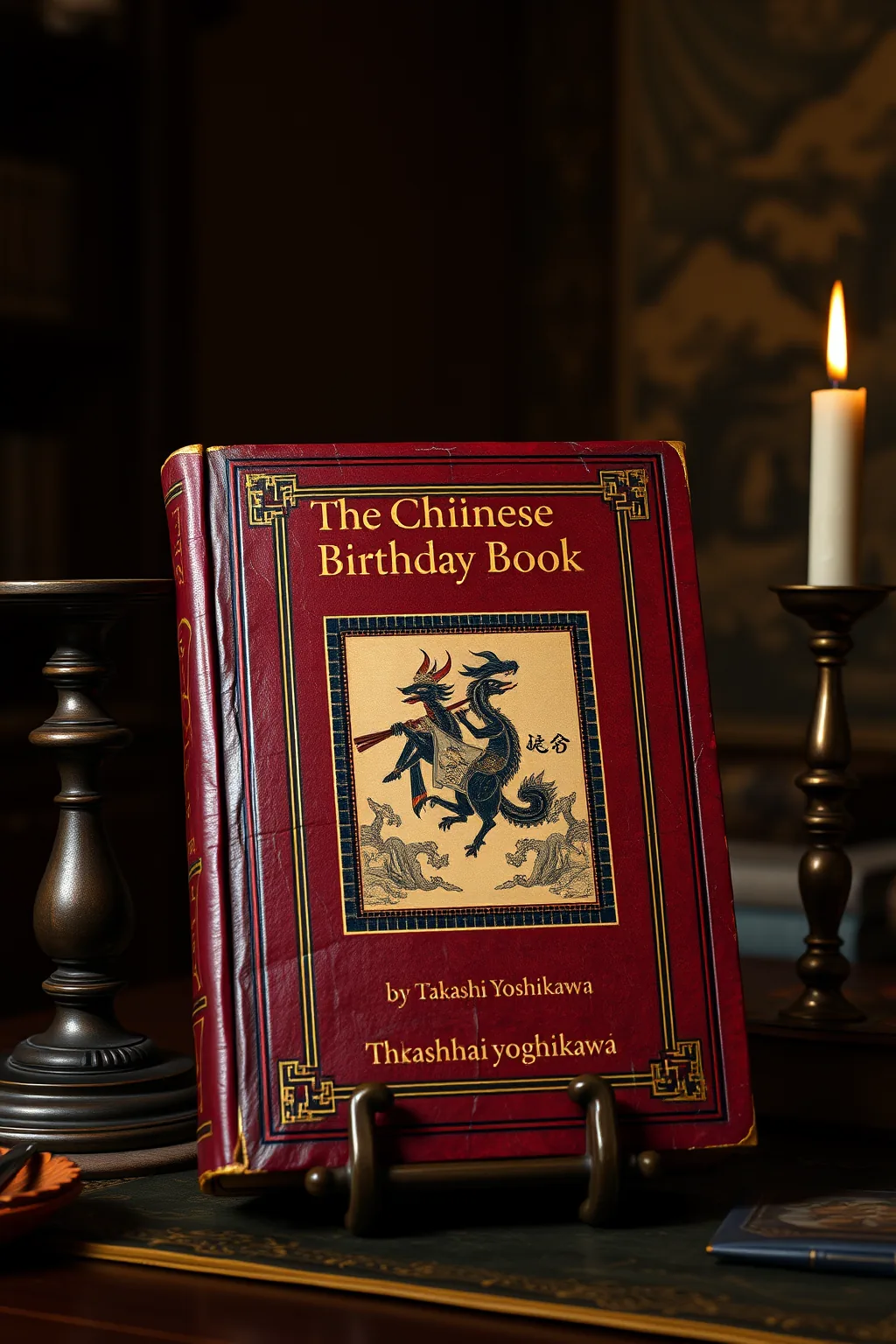
The Chinese birthday book
 82
82

The Chinese birthday book
Takashi Yoshikawa's The Chinese Birthday Book offers a structured, analytical approach to natal astrology that feels more like a rigorous system than mere fortune-telling. Its strength lies in the intricate detail of the Four Pillars of Destiny (Bazi) calculation, providing a granular map of an individual's energetic blueprint. The original publication date of 2008 situates it within a period of renewed interest in Eastern esoteric practices in the West. However, the sheer density of information, while a boon for dedicated students, might present a steep learning curve for casual readers unfamiliar with Chinese cosmology. A particularly insightful section details the interaction of the Heavenly Stems and Earthly Branches, revealing subtle dynamics beyond the commonly known zodiac animals. Yoshikawa avoids sensationalism, presenting a sober, academic-style exploration of a complex tradition. The book serves as a valuable, albeit demanding, reference for those serious about understanding the mechanics of Bazi.
📝 Description
82
Takashi Yoshikawa's 2008 "The Chinese Birthday Book" details a system of personal destiny analysis using Chinese astrology.
Published in 2008, Takashi Yoshikawa's "The Chinese Birthday Book" offers a detailed system for understanding personal destiny and character through Chinese astrology and numerology. It moves beyond common horoscopes, establishing a framework to analyze a person's life path according to their birth date. The book serves as both an explanation and a practical manual, enabling readers to calculate and interpret the specific energies connected to their birth year, month, day, and hour.
This work is for anyone interested in non-Western calendrical systems and how they apply to personal insight. It suits those seeking a more thorough astrological approach than typically found in popular media. Readers who value detailed methods, symbolic interpretation, and the combination of numerological principles with cyclical timekeeping will find it beneficial. It is appropriate for beginners curious about Chinese cosmology and for experienced practitioners aiming to broaden their analytical methods.
The framework of "The Chinese Birthday Book" draws from ancient Chinese cosmological principles, including the I Ching, Yin-Yang philosophy, and the Five Elements. Yoshikawa's approach synthesizes these classical Chinese thoughts, which historically aimed to connect human life with cosmic patterns. This method of birth date analysis aligns with a broader late 20th and early 21st century global interest in esoteric systems that seek to provide meaning and structure.
💡 Why Read This Book?
• Learn the precise method for calculating your Four Pillars of Destiny (Bazi) based on your birth year, month, day, and hour, as detailed in Yoshikawa's original 2008 framework. • Understand the interplay of Heavenly Stems and Earthly Branches, a core concept in Chinese metaphysics, to interpret the unique energetic composition of any birth chart. • Explore the influence of the Five Elements (Wu Xing) on personal characteristics and life events, gaining insight into potential strengths and challenges derived from this ancient system.
⭐ Reader Reviews
Honest opinions from readers who have explored this book.
❓ Frequently Asked Questions
What is the Four Pillars of Destiny (Bazi) system presented in The Chinese Birthday Book?
The Four Pillars of Destiny, or Bazi, is a traditional Chinese astrological method that uses the year, month, day, and hour of a person's birth to create a chart. Each pillar is composed of a Heavenly Stem and an Earthly Branch, forming a unique energetic blueprint analyzed for life interpretation.
How does The Chinese Birthday Book differ from Western astrology?
Unlike Western astrology which primarily uses the solar year and zodiac constellations, The Chinese Birthday Book employs a lunisolar calendar and a complex system of stems, branches, and elements, focusing on the intricate interplay of energies derived from the exact birth time.
When was The Chinese Birthday Book first published?
Takashi Yoshikawa's The Chinese Birthday Book was first published in 2008, reflecting a modern synthesis and presentation of ancient Chinese cosmological principles.
Can I use this book to predict future events?
While the book provides tools for understanding potential influences and tendencies based on your birth chart, its primary focus is on character analysis and understanding energetic patterns, rather than deterministic event prediction.
Is prior knowledge of Chinese philosophy required to read this book?
While some familiarity with concepts like Yin-Yang and the Five Elements can be helpful, Yoshikawa's text aims to explain the system systematically, making it accessible to dedicated newcomers willing to engage with its detailed methodology.
What are the 'Heavenly Stems' and 'Earthly Branches' mentioned in the book?
Heavenly Stems and Earthly Branches are components of the Chinese lunisolar calendar. There are 10 Heavenly Stems and 12 Earthly Branches, which combine in a 60-unit cycle. In Bazi, they represent specific energies associated with a person's birth time.
🔮 Key Themes & Symbolism
Four Pillars of Destiny (Bazi)
The core of this work revolves around Bazi, the Four Pillars of Destiny, a sophisticated system derived from ancient Chinese cosmology. It meticulously maps an individual's natal chart using the Heavenly Stems and Earthly Branches associated with their birth year, month, day, and hour. Yoshikawa explains how these pillars interact, revealing not just personality traits but also the subtle energetic currents that influence one's life path and potential. The book provides the framework for calculating and interpreting these complex interactions, moving beyond superficial astrological readings.
The Five Elements (Wu Xing)
Central to understanding Bazi is the doctrine of the Five Elements: Wood, Fire, Earth, Metal, and Water. The Chinese Birthday Book elaborates on how these elements manifest within an individual's Four Pillars, dictating cycles of generation and destruction. The balance or imbalance of these elements in a chart is crucial for interpreting an individual's inherent strengths, weaknesses, health predispositions, and interpersonal dynamics. Yoshikawa details the relationships between these elements, offering a nuanced perspective on destiny.
The Sexagenary Cycle
This book studies the Sexagenary Cycle, a recurring 60-year sequence used in traditional Chinese culture, which combines the 10 Heavenly Stems and 12 Earthly Branches. Each year within this cycle possesses a unique energetic signature. Understanding one's position within this cycle, as determined by their birth year, provides context for the broader temporal influences at play. The book illustrates how this cyclical understanding of time shapes human experience and destiny.
Chinese Calendrical Systems
The Chinese Birthday Book is rooted in the intricate lunisolar calendar system of China, which differs significantly from the solar-based Gregorian calendar common in the West. It emphasizes the importance of the birth date within this specific calendrical framework, where lunar phases and solar terms dictate astrological significance. Yoshikawa's work highlights how this system offers a unique lens through which to view personal destiny, character, and the flow of time.
💬 Memorable Quotes
Direct passages from the work, attributed to the author.
“The birth hour pillar is often considered the most critical.”
— This highlights the profound importance placed on the precise moment of birth within Bazi, suggesting that the energetic configurations at the time of waking or entering the world hold significant weight for one's life trajectory.
“An imbalance of elements indicates areas requiring attention.”
— This interpretation points to the practical diagnostic aspect of Bazi, where the analysis of elemental strengths and weaknesses in a chart serves as a guide for self-awareness and potential self-cultivation.
“Each Heavenly Stem interacts uniquely with its corresponding Earthly Branch.”
— This emphasizes the detailed, combinatorial nature of Bazi, where the synergy between the two components of each pillar creates specific energetic dynamics beyond the individual influence of stems or branches alone.
“The year pillar reflects ancestral influences and early life.”
— This interpretation connects the Bazi system to broader cultural concepts of lineage and inherited patterns, suggesting that the birth year provides insight into foundational energies and upbringing.
“Understanding the relationships between the Five Elements is key to interpreting the chart.”
— This underscores the fundamental importance of the Wu Xing cycle (generation and control) as the interpretive engine for the complex Bazi chart, providing the rules for how different energies interact.
🌙 Esoteric Significance
Tradition
The Chinese Birthday Book is firmly rooted in the tradition of Chinese metaphysics and cosmology, particularly the principles of Yin-Yang and the Five Elements (Wu Xing). It draws heavily from the system of Bazi, or Four Pillars of Destiny, which has been a core part of Chinese astrological practice for centuries. While not strictly part of Western esoteric lineages like Hermeticism or Kabbalah, it shares a common goal of understanding cosmic influences on human life and character, offering a distinct, cyclical, and elemental approach to divination and self-knowledge.
Symbolism
Key symbols in the book include the Twelve Earthly Branches, represented by animals of the Chinese zodiac (Rat, Ox, Tiger, etc.), each embodying specific qualities and energetic signatures. The Ten Heavenly Stems are another crucial symbolic layer, representing more subtle, dynamic forces. Together, they form the Bazi chart. The Five Elements (Wood, Fire, Earth, Metal, Water) are perhaps the most central symbolic language, illustrating the fundamental forces of creation and destruction that govern interactions within the chart and the wider cosmos.
Modern Relevance
Contemporary practitioners of Chinese metaphysics, Bazi consultants, and enthusiasts of comparative astrology continue to engage with Yoshikawa's work. Its detailed methodology provides a solid foundation for those seeking to master Bazi beyond superficial interpretations. Modern schools of thought in energy healing and Eastern psychology sometimes incorporate Bazi principles to understand energetic imbalances and predispositions. The book remains a valuable resource for anyone interested in the intersection of ancient Chinese cosmology and modern applications of astrological analysis.
👥 Who Should Read This Book
• Aspiring practitioners of Chinese astrology seeking a systematic, detailed guide to calculating and interpreting Bazi charts. • Individuals interested in comparative esoteric systems who wish to understand a non-Western approach to natal analysis beyond common horoscopes. • Self-study enthusiasts of Chinese metaphysics looking for a practical framework to explore the influence of the Four Pillars, Five Elements, and Sexagenary Cycle on personal destiny.
📜 Historical Context
Published in 2008, Takashi Yoshikawa's The Chinese Birthday Book emerged during a period of heightened global interest in Eastern esoteric traditions, particularly those offering detailed systems for self-understanding. While Western astrology had long been popular, there was a growing appetite for more complex methodologies like Bazi (Four Pillars of Destiny). This era saw increased cross-cultural exchange in spiritual and philosophical ideas. Yoshikawa's work taps into the enduring legacy of Chinese cosmology, which has historically sought to harmonize human life with cosmic cycles, drawing from principles found in texts like the I Ching. At the time, competing schools of thought in Western esoteric circles included various forms of Hermeticism and Kabbalah, each offering different symbolic frameworks. Yoshikawa's contribution provided a specific, numerologically-driven system rooted in Chinese metaphysics, distinct from these Western traditions.
📔 Journal Prompts
The specific combination of Heavenly Stem and Earthly Branch in your birth day pillar.
The dominant Five Element in your Four Pillars of Destiny chart.
How the concept of the Sexagenary Cycle might frame your current life phase.
The energetic interactions between your year pillar and your day pillar.
Interpreting the balance of Yin and Yang within your complete Bazi chart.
🗂️ Glossary
Bazi
Literally 'Eight Characters,' this refers to the Four Pillars of Destiny, a Chinese astrological system using the birth year, month, day, and hour, each represented by two characters (a Heavenly Stem and an Earthly Branch).
Heavenly Stems
Ten fundamental cyclical characters (Jia, Yi, Bing, Ding, Wu, Ji, Geng, Xin, Ren, Gui) used in Chinese cosmology, representing specific energetic qualities and forces.
Earthly Branches
Twelve cyclical characters, often associated with the twelve animals of the Chinese zodiac (Zi, Chou, Yin, Mao, etc.), representing different phases and qualities of time and energy.
Wu Xing
The doctrine of the Five Phases or Five Elements (Wood, Fire, Earth, Metal, Water), which describes the dynamic interactions and cycles of generation and control between fundamental forces in the universe.
Sexagenary Cycle
A 60-year cycle formed by the combination of the 10 Heavenly Stems and 12 Earthly Branches, used for calendrical and astrological purposes in traditional China.
Pillar
In Bazi, refers to one of the four temporal components: Year Pillar, Month Pillar, Day Pillar, and Hour Pillar, each crucial for astrological interpretation.
Natal Chart
A map of the celestial bodies and energetic configurations at the precise moment of a person's birth, used in various astrological systems for interpretation.
🔮 Readers Also Liked
Browse all →







More by Takashi Yoshikawa
All books →

More Free Astrology & Cosmology Books
View all →