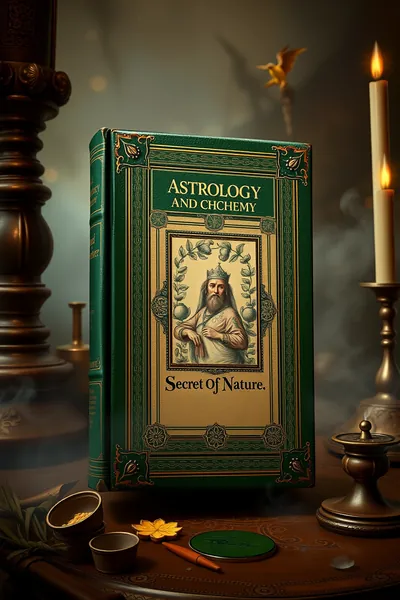
Hou nian yün cheng

 71
71

Hou nian yün cheng
Shaoguang Song's Hou nian yün cheng offers a dense, academic examination of esoteric principles that distinguishes itself from more popularized metaphysical fare. The book excels in its meticulous dissection of interconnected concepts, particularly its treatment of energetic flows within spiritual systems, which feels thoroughly researched. However, the prose can be quite abstract, occasionally obscuring practical application behind layers of theoretical discourse. A passage detailing the seven stages of spiritual ascent, while intellectually stimulating, lacks concrete examples that would aid a novice practitioner. Despite this occasional opacity, Song provides a valuable, if demanding, resource for advanced students.
Ultimately, Hou nian yün cheng serves as a challenging but rewarding academic text for dedicated esoteric scholars.
📝 Description
71
Shaoguang Song's Hou nian yün cheng, published in 1991, connects philosophical inquiry with metaphysical practice.
Published in 1991, Shaoguang Song's Hou nian yün cheng addresses concepts that bridge philosophical inquiry and practical application in the metaphysical field. The book systematically organizes ideas to help readers grasp complex spiritual principles. This text is for students of esoteric sciences interested in the overlap between Eastern philosophy and Western occultism. It aims to take readers beyond introductory material, presenting a more thorough view of spiritual growth and cosmological ideas. A basic grasp of metaphysical concepts is needed to fully appreciate its content.
The early 1990s saw a rise in interest in esoteric traditions, with many people trying to link different global spiritual systems. Works like Hou nian yün cheng appeared when the internet was new, making specialized knowledge harder to share. This period featured a rise in comparative mysticism, influenced by scholars like Mircea Eliade and studies of Gnosticism and Hermeticism. The book discusses spiritual energetics, the nature of consciousness, and how symbolic language helps understand universal laws. It looks at the connection between visible and invisible worlds, suggesting that understanding these links aids personal change. The book also discusses the repeating patterns of existence and ways to harmonize with these cosmic rhythms.
Hou nian yün cheng emerged in the early 1990s, a time of growing interest in connecting diverse global spiritual systems. This era saw increased comparative mysticism, influenced by academic study of traditions like Gnosticism and Hermeticism, and figures such as Mircea Eliade. The book itself examines spiritual energetics, consciousness, and the use of symbols to understand universal principles, linking the seen and unseen worlds for personal transformation.
💡 Why Read This Book?
• Gain a structured understanding of spiritual energetics, as explored through Song's detailed framework, offering insights not commonly found in introductory esoteric texts. • Learn about the seven stages of spiritual ascent, a specific concept discussed in the book, which provides a unique map for personal development. • Understand the interplay between visible and invisible realms as presented in the book, enhancing your perception of cosmological dynamics beyond conventional frameworks.
⭐ Reader Reviews
Honest opinions from readers who have explored this book.
❓ Frequently Asked Questions
What is the primary focus of Hou nian yün cheng?
Hou nian yün cheng primarily focuses on the systematic exploration of esoteric principles, bridging Eastern philosophical traditions with Western occult thought, particularly concerning spiritual energetics and consciousness.
Who is the author, Shaoguang Song?
Shaoguang Song is the author of Hou nian yün cheng, a significant work in esoteric studies first published in 1991, known for its academic approach to metaphysical concepts.
Is this book suitable for beginners in esoteric studies?
The book is best suited for those with a foundational understanding of metaphysical concepts, as it delves into complex theories and requires focused study rather than offering introductory overviews.
When was Hou nian yün cheng first published?
Hou nian yün cheng was first published in 1991, positioning it within a period of renewed academic and popular interest in esoteric traditions.
What kind of concepts does the book explore?
The book explores concepts such as spiritual energetics, the nature of consciousness, symbolic language in understanding universal laws, and the cyclical nature of existence.
Does the book offer practical exercises?
While rich in theory and conceptual frameworks, Hou nian yün cheng leans towards academic exploration. Its practical applications are often implied through understanding its detailed theoretical structures rather than explicit step-by-step guidance.
🔮 Key Themes & Symbolism
Spiritual Energetics
The book systematically examines the concept of spiritual energetics, detailing how these subtle forces influence both individual consciousness and the broader cosmos. Song illustrates the interconnectedness of energetic currents, positing that understanding and harmonizing them is fundamental to spiritual growth. This exploration often involves intricate diagrams and theoretical models that map these invisible flows, distinguishing it from simpler discussions of 'energy work'.
Consciousness Dynamics
Hou nian yün cheng offers a rigorous analysis of consciousness, not merely as a passive recipient of experience, but as an active force shaping reality. It investigates the various states and levels of consciousness, proposing methods for their refinement and expansion. The work links the evolution of consciousness to the understanding of universal laws and symbolic structures, providing a framework for self-awareness and transformation.
Symbolic Cosmology
A significant theme is the exploration of cosmology through the lens of symbolism. Song argues that universal principles are encoded within symbolic language, which acts as a bridge between the material world and higher spiritual truths. The book explores the interpretation of these symbols, suggesting that their mastery unlocks deeper comprehension of existence and one's place within it, moving beyond literal interpretations.
Cyclical Existence
The work presents a view of existence as inherently cyclical, encompassing personal lives, historical epochs, and cosmic processes. It discusses the patterns and rhythms governing these cycles, offering insights into how individuals can align themselves with these natural flows for greater harmony and efficacy. This perspective challenges linear notions of progress, emphasizing instead a dynamic, recurring pattern of manifestation and dissolution.
💬 Memorable Quotes
Direct passages from the work, attributed to the author.
“The energetic currents are the unseen architecture of reality.”
— This statement highlights the book's foundational premise that subtle energies are not mere phenomena but the very structure upon which all existence is built, guiding the reader toward a deeper energetic understanding.
“Symbols are the language of the soul, speaking across dimensions.”
— This idea underscores the book's focus on symbolic interpretation as a vital tool for esoteric understanding, suggesting symbols possess a universal and transdimensional communicative power.
“The path of ascent is not a ladder, but a spiral.”
— This metaphorical statement, likely inspired by the book's content, suggests spiritual progress is not linear but involves revisiting themes and lessons at increasingly profound levels.
💡 Key Ideas
Editorial paraphrase of the work's core concepts — not direct quotes.
Consciousness is not a mirror, but a sculptor of experience.
This paraphrased concept emphasizes the active role of consciousness in shaping perceived reality, a core tenet of the book's sophisticated approach to metaphysics and self-awareness.
Alignment with cosmic cycles is the key to effective action.
This paraphrased concept points to the book's emphasis on living in accordance with natural, cyclical rhythms as a means to achieve greater personal power and spiritual harmony.
🌙 Esoteric Significance
Tradition
Hou nian yün cheng fits within the broader lineage of esoteric philosophy that seeks to map the relationship between the microcosm (human) and the macrocosm (universe). While not strictly aligned with a single tradition like Hermeticism or Gnosticism, it draws upon and synthesizes elements found across various systems, particularly those emphasizing energetic principles and consciousness studies. It departs from purely devotional or ritualistic approaches by focusing on a systematic, almost scientific, dissection of metaphysical laws and their application.
Symbolism
Key symbols within the work often include geometric forms representing cosmic order and the stages of spiritual development. The spiral motif, for instance, likely symbolizes cyclical existence and progressive evolution, a departure from linear models. Energetic diagrams, perhaps illustrating the flow of vital force (prana or chi), serve as visual representations of the book's core concepts, translating abstract principles into comprehensible, albeit complex, visual language.
Modern Relevance
Contemporary practitioners of consciousness studies and advanced Western esotericists often engage with works like Hou nian yün cheng for their rigorous theoretical frameworks. Thinkers exploring the intersection of neuroscience and spirituality, or those developing complex models of energetic anatomy, may find Song's systematic approach valuable. The book's detailed exploration of consciousness dynamics and symbolic cosmology continues to inform discussions in advanced metaphysical circles and comparative religion studies today.
👥 Who Should Read This Book
• Advanced students of Western Esotericism seeking to integrate Eastern philosophical concepts into their understanding of magic and cosmology. • Comparative religion scholars interested in texts that bridge diverse metaphysical traditions and offer systematic analyses of spiritual principles. • Practitioners of advanced meditation or energy work looking for theoretical underpinnings to their practice, particularly concerning consciousness and energetic flows.
📜 Historical Context
Published in 1991, Shaoguang Song's Hou nian yün cheng emerged during a period of significant cross-pollination in esoteric thought. The early 1990s saw a growing academic and popular fascination with comparative mysticism, influenced by scholars like Mircea Eliade whose work on shamanism and myth gained traction. Simultaneously, Western esoteric traditions like Hermeticism and Kabbalah were undergoing revivals, with practitioners and researchers actively seeking to synthesize diverse global spiritual systems. This era was marked by the nascent stages of widespread internet adoption, making specialized texts like Song's crucial for those engaged in deep study. The intellectual climate favored explorations that bridged Eastern philosophy with Western occultism, a space where Hou nian yün cheng made its contribution, offering a structured counterpoint to more New Age-oriented publications of the time.
📔 Journal Prompts
The energetic architecture of reality: how do unseen forces shape your daily experiences?
Mapping consciousness: reflect on the 'sculptor' role of your awareness.
Symbolic language: identify a personal symbol and its 'soul-speak'.
Cyclical patterns: analyze a personal or historical cycle you observe.
Spiritual ascent: consider the 'spiral' nature of your own growth.
🗂️ Glossary
Spiritual Energetics
The study and application of subtle energy systems that are believed to underlie physical reality and influence consciousness, health, and spiritual development.
Consciousness Dynamics
The exploration of the nature, states, levels, and active role of consciousness in shaping perception, experience, and the material world.
Symbolic Cosmology
A framework for understanding the universe and existence through the interpretation of symbols, which are seen as carrying profound metaphysical truths.
Cyclical Existence
The philosophical concept that time, events, and life processes occur in recurring patterns or cycles, rather than in a purely linear fashion.
Microcosm/Macrocosm
The principle that the smaller world of the individual (microcosm) reflects the larger universe (macrocosm), and vice versa, suggesting interconnectedness.
Metaphysical Laws
Fundamental principles believed to govern the nature of reality, consciousness, and the interaction between the spiritual and material realms.
Spiritual Ascent
The process or journey of evolving consciousness and spiritual awareness, often depicted as stages or levels of attainment.
🔮 Readers Also Liked
Browse all →









More by Shaoguang Song
All books →
More Free Astrology & Cosmology Books
View all →