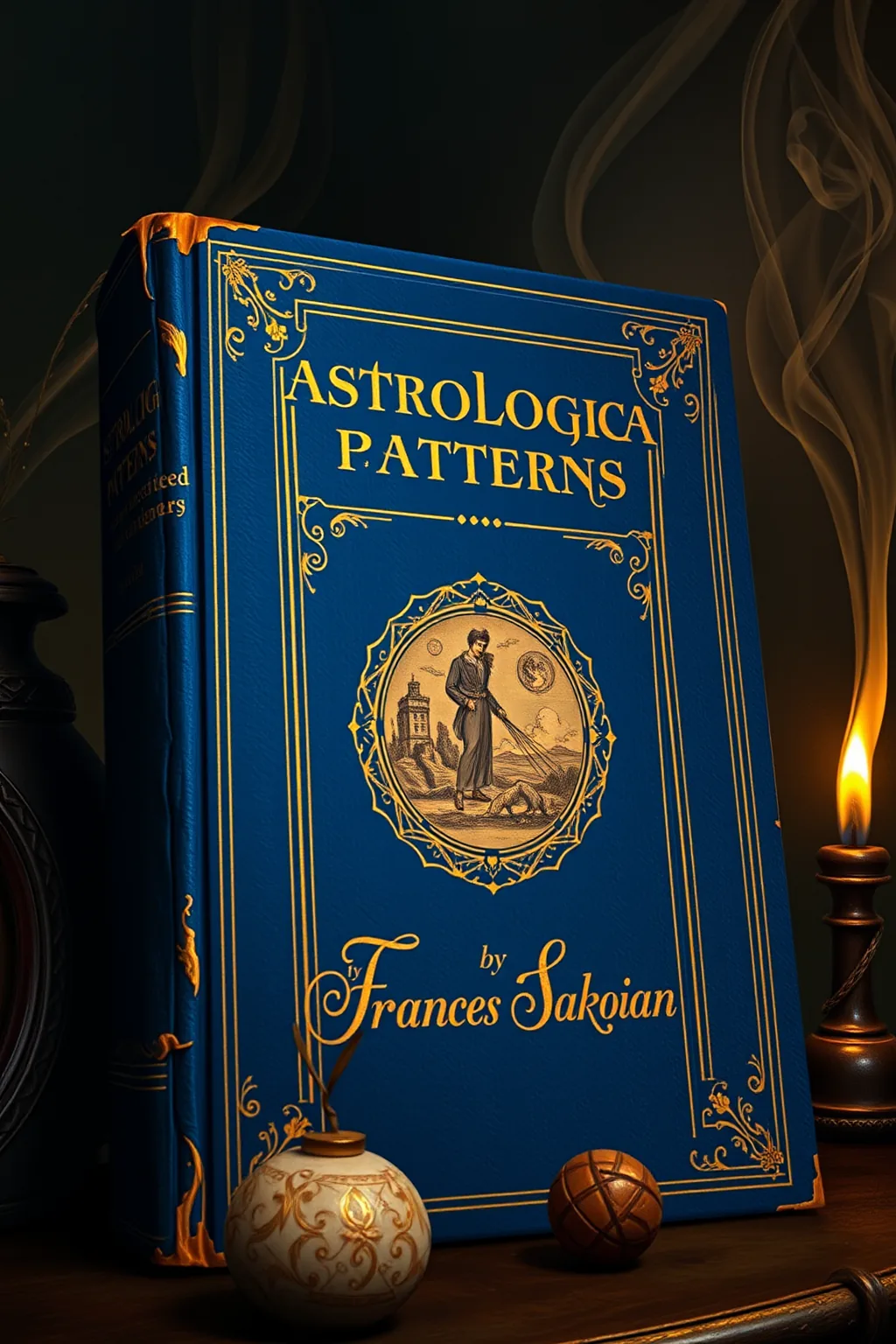
Astrological patterns
 84
84

Astrological patterns
Frances Sakoian's Astrological Patterns offers a solid, if somewhat dated, compendium of astrological theory. The strength lies in its methodical presentation of planetary, sign, and house significations, providing a clear structural grammar for chart interpretation. However, the prose, while clear, occasionally feels dry, lacking the evocative flair found in some contemporary astrological works. A particularly useful section details the nodal axis, explaining its karmic implications with admirable directness. While the 1980 publication date is evident in its approach, the core principles remain a valuable resource. It is a functional guide for those prioritizing systematic knowledge over poetic embellishment.
📝 Description
84
Frances Sakoian's Astrological Patterns, published in 1980, provides a systematic guide to celestial influences.
Astrological Patterns offers a structured method for understanding how celestial bodies affect human lives and the Earth. Frances Sakoian breaks down astrological principles into manageable parts, concentrating on the core elements that form individual birth charts and influence collective events. The book aims to give readers a practical way to interpret planetary positions, their relationships (aspects), and their placement within the houses of the horoscope.
This book is intended for dedicated students of astrology. It suits those new to natal chart interpretation and experienced practitioners looking to sharpen their analytical abilities. Readers interested in the psychological dimensions of astrological symbolism and individuals seeking a methodical approach to analyzing birth charts will find value here. It is for the committed student of celestial patterns.
Published in 1980, Astrological Patterns arrived during a resurgence of interest in esoteric studies and psychological astrology. It builds on the work of figures like Dane Rudhyar and Carl Jung, who explored the symbolic and archetypal dimensions of astrology. The 1970s saw astrology move beyond simple sun-sign readings towards more detailed chart analysis. Sakoian's text contributed to this development with a comprehensive, almost textbook style, focusing on astrological mechanics rather than purely predictive or mystical methods.
💡 Why Read This Book?
• Learn to interpret the foundational elements of a natal chart, including the distinct meanings of the twelve zodiac signs and their interaction with the ten planets as detailed by Sakoian. • Understand the mechanics of astrological aspects, grasping how angular relationships between celestial bodies influence personality and life paths, as explained from the 1980 publication's perspective. • Gain insight into the significance of the Ascendant and Midheaven, key angular points in a horoscope, and how they frame an individual's outward expression and life direction within Sakoian's framework.
⭐ Reader Reviews
Honest opinions from readers who have explored this book.
❓ Frequently Asked Questions
When was Astrological Patterns first published and by whom?
Astrological Patterns was first published in 1980 by Frances Sakoian, marking its emergence during a period of significant resurgence in astrological study and interpretation.
What are the primary components of an astrological chart discussed in the book?
The book systematically covers the twelve zodiac signs, the ten planets, the twelve houses, and the crucial angular relationships known as aspects, providing a comprehensive interpretive framework.
Does the book focus on psychological astrology or predictive astrology?
While rooted in traditional astrological principles, Sakoian's work emphasizes understanding the psychological underpinnings and structural influences of celestial patterns rather than solely focusing on predictive techniques.
Is this book suitable for absolute beginners in astrology?
Yes, the structured approach and clear explanations make it accessible for beginners, while its depth offers continued value for more experienced practitioners seeking a systematic review.
What is the significance of the nodal axis according to Sakoian?
Sakoian interprets the nodal axis as representing karmic themes, outlining the soul's past tendencies (South Node) and its evolutionary direction or future potential (North Node).
How does Astrological Patterns fit into the history of astrological literature?
Published in 1980, it represents a mid-point in the modern resurgence of astrology, offering a detailed, systematic approach that synthesized earlier psychological and traditional interpretations.
🔮 Key Themes & Symbolism
The Twelve Houses System
The book meticulously details the twelve houses of the astrological chart, explaining each as a distinct sphere of life experience. From the Ascendant (1st House) representing self and appearance to the Imum Coeli (10th House) concerning career and public standing, Sakoian offers a thorough breakdown. Understanding these houses is presented as crucial for contextualizing planetary energies and their manifestation in an individual's life, providing a map of experiential territory.
Planetary Dignities and Debilities
Sakoian explores the concept of planetary dignity, where planets are considered strong or weak depending on their placement within a zodiacal sign. For instance, Mars is considered in its 'domicile' in Aries, suggesting potent expression, while its placement in Cancer might be considered a 'fall,' indicating weakened or challenged energy. This analysis is vital for understanding the quality and ease with which a planet's function operates within a natal chart.
The Nature of Aspects
Astrological Patterns elaborates on the geometric relationships between planets, known as aspects. These angles—such as conjunctions, oppositions, trines, squares, and sextiles—are presented as the dynamic forces that connect and interact planetary energies. The book explains how harmonious aspects (trines, sextiles) tend to facilitate expression, while challenging aspects (squares, oppositions) indicate tension and require conscious integration.
The Ascendant and Midheaven
The work places significant emphasis on the Ascendant (Rising Sign) and the Midheaven (MC), the two most personal points in the astrological chart. The Ascendant governs the outward persona, initial impressions, and physical body, while the Midheaven relates to one's highest aspirations, career, and public reputation. Sakoian details how these points act as crucial framing elements for the entire chart.
💬 Memorable Quotes
Direct passages from the work, attributed to the author.
“The Ascendant is the most important point in the chart.”
— This statement highlights the important role of the Rising Sign in defining personal identity, physical appearance, and the initial approach to life's experiences, serving as the lens through which all other planetary influences are filtered.
“Planets in their domicile or exaltation are considered strong.”
— This principle underscores the idea that celestial bodies express their core energies most effectively when positioned in zodiacal signs that are traditionally considered their rulership (domicile) or exaltation, indicating a harmonious and potent manifestation.
“Aspects create dynamic relationships between the planets.”
— This emphasizes that the angles formed between planets are not static but represent active connections and interactions that shape the interplay of different psychological functions and life themes within an individual's chart.
“The houses represent the stages of life and areas of experience.”
— This interpretation frames the twelve houses as distinct sectors of life, from personal identity and relationships to career and spiritual matters, providing a map for understanding where and how planetary energies will play out.
“The nodal axis points to karmic patterns and soul direction.”
— This concept suggests that the Moon's Nodes delineate past tendencies and ingrained habits (South Node) and the soul's evolutionary path or destiny (North Node), offering insights into lessons to be learned and potentials to be realized.
🌙 Esoteric Significance
Tradition
This work aligns primarily with the Western Esoteric tradition, specifically drawing from Hermetic principles and modern psychological astrology. It departs from purely predictive or fatalistic interpretations by emphasizing the symbolic language of the cosmos as a map for self-understanding and conscious development. It fits within the lineage that seeks to decode divine order through celestial mechanics, viewing astrology as a sacred science.
Symbolism
Key symbols include the twelve zodiac signs, each representing a distinct archetypal energy or stage of consciousness, and the planets, viewed as personifications of fundamental forces within the psyche and the universe. The aspects, or geometric relationships between planets, symbolize the dynamic interplay and integration of these forces, revealing patterns of harmony and tension.
Modern Relevance
Contemporary practitioners of evolutionary astrology and psychological astrology frequently reference Sakoian's systematic approach. Thinkers exploring the intersection of astrology and depth psychology, as well as modern occultists seeking structured frameworks for natal interpretation, continue to find value in its methodical presentation of core astrological concepts.
👥 Who Should Read This Book
• Aspiring astrologers seeking a structured foundation: Individuals new to astrology will benefit from the clear, methodical breakdown of signs, planets, houses, and aspects, providing a comprehensive interpretive grammar. • Students of Western Esotericism interested in symbolic systems: Those exploring Hermeticism, Kabbalah, or other esoteric traditions will find astrology a key symbolic language, and Sakoian offers a practical entry point. • Individuals on a path of self-discovery through astrology: Anyone looking to understand their natal chart for personal growth will gain tools to interpret their unique celestial blueprint and life patterns.
📜 Historical Context
Astrological Patterns, released in 1980, emerged during a vibrant period for esoteric studies. The preceding decade had seen a surge in popular interest in astrology, moving beyond simple horoscopes to more complex chart analysis, influenced by figures like Dane Rudhyar and the burgeoning psychological exploration of archetypes. Sakoian’s work contributed a systematic, almost academic, approach to astrological mechanics, differentiating itself from more purely intuitive or devotional texts. It arrived in a landscape where authors like Liz Greene were also integrating psychological depth with traditional astrology. While not facing overt censorship, the book engaged with the intellectual currents of the time, offering a structured counterpoint to more mystical or less empirical astrological traditions, solidifying its place as a foundational text for serious students.
📔 Journal Prompts
The placement of your natal Moon in a specific house: How does this position color your emotional expression?
Reflection on the ruling planet of your Ascendant: What does its sign and house placement reveal about your core drives?
The nature of the aspects formed by Mars in your chart: How do these dynamics manifest in your actions and assertiveness?
Consider the Midheaven sign and its ruler: What is the core aspiration indicated for your public life?
Analyze the relationship between your Sun and Moon signs: How do these fundamental energies interact within your personality?
🗂️ Glossary
Ascendant
The zodiac sign rising on the eastern horizon at the moment of birth. It represents the outward personality, physical appearance, and initial approach to life.
Midheaven (MC)
The highest point in the astrological chart at birth, representing career, public image, ambition, and life direction.
Aspects
The angular relationships between planets in a birth chart, indicating how their energies interact and influence each other. Key aspects include conjunctions, oppositions, squares, trines, and sextiles.
Domicile
A zodiac sign ruled by a particular planet, where that planet is considered to be in its own sign and therefore strong and comfortable in its expression.
Fall
The zodiac sign in which a planet is considered to be in a state of debility or weakness, often indicating challenges in expressing that planet's energies.
Nodal Axis
The line connecting the North Node and South Node of the Moon, representing karmic themes, past life tendencies (South Node), and future evolutionary direction (North Node).
Natal Chart
A snapshot of the heavens at the exact moment and location of a person's birth, used to interpret personality, life patterns, and potential.
🔮 Readers Also Liked
Browse all →








More by Frances Sakoian
All books →



More Free Astrology & Cosmology Books
View all →