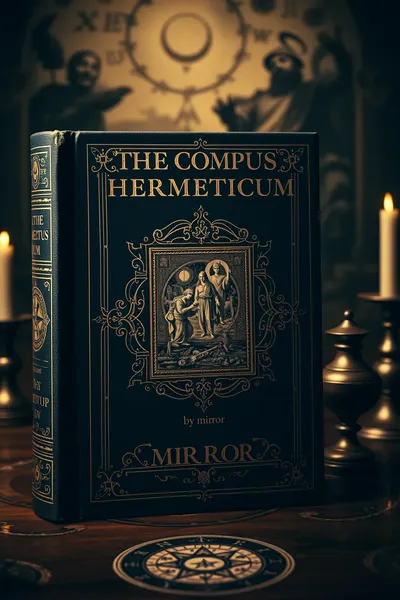
Yeats and alchemy

 83
83

Yeats and alchemy
William T. Gorski's "Yeats and Alchemy" tackles a subject often relegated to the footnotes of literary analysis, demonstrating the profound impact of alchemical thought on W. B. Yeats's oeuvre. Gorski's strength lies in his meticulous tracing of specific alchemical motifs through Yeats's poetry and prose, avoiding vague generalizations. The detailed exploration of how Yeats integrated concepts like the *coniunctio oppositorum* into his understanding of psychic unity is particularly illuminating. However, the book sometimes feels more like a scholarly catalog than a flowing argument. While the analysis of the symbolism in 'A Vision' is thorough, it occasionally bogs down in its own erudition, demanding significant prior knowledge from the reader. The real triumph is Gorski's success in showing that Yeats's alchemical pursuits were not mere eccentricities but central to his poetic project. It is an indispensable resource for dedicated Yeats scholars.
📝 Description
83
William T. Gorski's 1996 book examines W. B. Yeats's deep engagement with alchemical philosophy.
Published in 1996, William T. Gorski's "Yeats and Alchemy" investigates the Nobel laureate poet's complex relationship with alchemical thought and symbolism. Gorski moves past simple readings to show how esoteric traditions shaped Yeats's creative work and intellectual framework. He details how alchemical ideas of transformation, purification, and the joining of opposites influenced Yeats's poetry and prose.
The book targets serious students of W. B. Yeats, scholars of literary modernism, and those curious about the connection between poetry and esoteric philosophy. It aims to illuminate the intellectual foundations of a major 20th-century poet, particularly his involvement with groups like the Hermetic Order of the Golden Dawn. This is not an introduction to alchemy itself, but a critical look at its literary application.
Yeats's immersion in alchemy occurred during a period of heightened interest in spiritualism and secret societies in late Victorian and Edwardian England. His membership in the Hermetic Order of the Golden Dawn from 1888 provided a structured environment for his symbolic and ritualistic explorations. Gorski situates Yeats's alchemical studies within this historical moment, a time when medieval mysticism and Renaissance Hermeticism saw renewed attention, distinguishing it from literary analysis that often ignored such influences.
💡 Why Read This Book?
• Understand the direct influence of alchemical symbolism on W. B. Yeats's major poetic cycles, moving beyond superficial interpretations of his esoteric interests. • Gain insight into the specific alchemical concepts like the *Magnum Opus* and *coniunctio oppositorum* that informed Yeats's theories of consciousness and art. • Appreciate how Yeats's membership in the Hermetic Order of the Golden Dawn from 1888 shaped his symbolic language and his quest for spiritual unity.
⭐ Reader Reviews
Honest opinions from readers who have explored this book.
❓ Frequently Asked Questions
Did W. B. Yeats actually practice alchemy?
While W. B. Yeats was deeply immersed in alchemical philosophy and symbolism, the evidence suggests his engagement was primarily intellectual and symbolic, influencing his poetry and esoteric writings rather than involving literal laboratory practice.
What is the 'Great Work' in relation to Yeats?
The 'Great Work' (*Magnum Opus*) in alchemy refers to the process of spiritual transformation and enlightenment. Gorski's work explores how Yeats applied this concept to his own psychological and artistic development, seeking a unified self.
Which esoteric order was W. B. Yeats a part of?
W. B. Yeats was a prominent member of the Hermetic Order of the Golden Dawn, joining in 1888. This order was crucial in exposing him to ceremonial magic, Kabbalah, and alchemical teachings.
How did alchemy influence Yeats's poetry?
Alchemy provided Yeats with a rich symbolic vocabulary for themes of transformation, purification, and the integration of opposites. Gorski details how these symbols appear in poems exploring consciousness, spirituality, and the human condition.
When was 'Yeats and Alchemy' by William T. Gorski first published?
William T. Gorski's 'Yeats and Alchemy' was first published in 1996, offering a scholarly examination of the poet's engagement with alchemical traditions.
What is the 'coniunctio oppositorum' in Gorski's analysis of Yeats?
The *coniunctio oppositorum* is the alchemical union of opposites (e.g., male/female, Sun/Moon). Gorski shows how Yeats used this concept to explore psychic integration and the reconciliation of dualities in his personal life and art.
🔮 Key Themes & Symbolism
Alchemical Transformation
Gorski meticulously details how Yeats perceived the alchemical process not as mere metallurgy but as a metaphor for spiritual and psychological evolution. The stages of the Great Work—calcination, dissolution, separation, conjunction, fermentation, distillation, and coagulation—are presented as parallels to Yeats's own quest for self-knowledge and artistic wholeness. This theme is central to understanding Yeats's persistent exploration of rebirth and renewal in his poetry, reflecting an alchemical desire to transmute the lead of ordinary experience into the gold of spiritual insight.
The Coniunctio Oppositorum
A core alchemical concept, the union of opposites, is examined as fundamental to Yeats's worldview. Gorski demonstrates how Yeats applied this to reconcile perceived dualities: mind and body, spirit and matter, the masculine and feminine principles. This is often symbolized through the union of the Sun and Moon or King and Queen. The book explores how this symbolic marriage reflects Yeats's attempts to achieve psychic integration and a balanced perception of reality, influencing his dramatic theories and his personal relationships.
Symbolic Language of Alchemy
This study unpacks the specific symbolic vocabulary Yeats derived from alchemical texts and traditions, particularly those encountered through the Hermetic Order of the Golden Dawn. Gorski analyzes the significance of colors (e.g., black for nigredo, white for albedo, red for rubedo), metals (gold, silver, mercury), and planetary correspondences as they are integrated into Yeats's poems and plays. The work highlights how these symbols function not as mere decoration but as vehicles for conveying complex philosophical and psychological states.
Yeats's Esoteric System
Gorski situates Yeats's alchemical interests within his broader engagement with esoteric philosophy, including theosophy, Kabbalah, and magic. The book addresses how alchemical principles informed Yeats's main work, 'A Vision,' his complex system of gyres and cones. It argues that alchemy provided a framework for Yeats's understanding of cosmic cycles, historical patterns, and the individual's place within the universe, shaping his unique vision of spiritual and artistic creation.
💬 Memorable Quotes
Direct passages from the work, attributed to the author.
“Alchemy offered Yeats a comprehensive symbolic language for the transformation of the self.”
— This statement captures the essence of Gorski's argument: that Yeats didn't just dabble in alchemical symbols but found in them a structured system for articulating his deepest concerns about personal growth and spiritual attainment.
“The *coniunctio oppositorum* became a central metaphor for Yeats's search for psychic wholeness.”
— This highlights a key alchemical concept, the union of opposites, and its direct application by Yeats. It underscores Gorski's point that Yeats sought integration not only in his poetry but also in his understanding of human psychology.
“Yeats viewed the alchemical process as a parallel to artistic creation.”
— This interpretation emphasizes the link between the 'Great Work' of alchemy and the poet's own endeavor. Gorski suggests that for Yeats, the transformative processes in alchemy mirrored the artistic act of bringing forth new forms and meanings.
“The Golden Dawn provided Yeats with a structured introduction to alchemical lore.”
— This points to the specific context of Yeats's involvement with the Hermetic Order of the Golden Dawn around 1888. It signifies that his study of alchemy was not isolated but part of a systematic esoteric education.
💡 Key Ideas
Editorial paraphrase of the work's core concepts — not direct quotes.
Alchemical imagery in Yeats’s work signifies stages of psychological purification.
This paraphrase suggests that the symbols and processes described in alchemy, such as distillation or coagulation, served for Yeats as metaphors for inner purification and the refinement of consciousness.
🌙 Esoteric Significance
Tradition
This work is firmly rooted in the Western Esoteric Tradition, specifically examining the Hermetic and alchemical streams that influenced W. B. Yeats. It connects his pursuits to a lineage that includes Renaissance Hermeticism and the ceremonial magic practiced by groups like the Hermetic Order of the Golden Dawn. Gorski demonstrates how Yeats synthesized these traditions, particularly alchemy, into a personal system that informed his poetic philosophy and his understanding of consciousness.
Symbolism
Key alchemical symbols analyzed include the *prima materia* (the base substance from which all things are made), the *Main work* (the Great Work of transformation), and the *coniunctio oppositorum* (the union of opposites). Gorski shows how Yeats employed these not just literally but as metaphors for psychological integration, spiritual enlightenment, and the reconciliation of earthly and divine realms, often represented through contrasting images like the Sun and Moon.
Modern Relevance
Contemporary scholars of modernism and esoteric studies continue to draw on Gorski's foundational work. His meticulous analysis of Yeats's alchemical vocabulary remains a benchmark for understanding how esoteric ideas can permeate artistic expression. Modern practitioners of Hermeticism and comparative religion scholars also find value in this study for its clear exposition of how ancient alchemical concepts were reinterpreted and applied in the early 20th century.
👥 Who Should Read This Book
• Scholars of W. B. Yeats and literary modernism seeking to understand the deep esoteric underpinnings of his work. • Students of comparative literature and religion interested in how esoteric traditions influence artistic output. • Practitioners and enthusiasts of Western Esotericism looking for concrete examples of alchemical philosophy as applied by a major literary figure.
📜 Historical Context
William T. Gorski's "Yeats and Alchemy" emerged in 1996, a period when literary scholarship was increasingly open to exploring the influence of esoteric traditions on modernist writers. This followed decades where such interests were often dismissed as mere biographical curiosities. Yeats's own immersion began in the late 19th century, notably after joining the Hermetic Order of the Golden Dawn in 1888, an organization that synthesized Kabbalah, Hermeticism, and ceremonial magic. His contemporaries, like Aleister Crowley, also engaged deeply with occultism, though often with different methodologies. Gorski's work situates Yeats's alchemical studies within this broader fin-de-siècle and early 20th-century revival of interest in Western esotericism, a counterpoint to the rising tide of scientific rationalism and a departure from purely materialist interpretations of existence. The reception of such studies has varied, but Gorski's detailed analysis provides a crucial scholarly anchor for understanding Yeats's complex symbolic universe.
📔 Journal Prompts
The *coniunctio oppositorum* as a symbol for integrating personal dualities.
Yeats's interpretation of the *Main work* in his own life and art.
The role of specific alchemical colors or metals in Yeats's poetry.
Reflecting on the Hermetic Order of the Golden Dawn's influence on Yeats's worldview.
The transmutation of the 'base metal' of ordinary experience into poetic 'gold'.
🗂️ Glossary
Main work
Latin for 'Great Work,' referring to the primary alchemical process of creating the Philosopher's Stone, often interpreted as a metaphor for spiritual perfection and enlightenment.
Prima Materia
The fundamental, undifferentiated substance from which all matter is believed to originate in alchemical theory. It represents potentiality and the starting point of transformation.
Coniunctio Oppositorum
The alchemical union of opposites, such as the Sun and Moon, King and Queen, or masculine and feminine principles. It symbolizes the achievement of psychic wholeness and balance.
Nigredo
The first stage of the alchemical process, often associated with blackness, putrefaction, dissolution, and chaos. It represents the necessary breakdown of the old before new creation.
Albedo
The second stage of the alchemical process, associated with whiteness, purification, and illumination. It follows the *nigredo* and signifies a cleansing or washing away of impurities.
Rubedo
The final stage of the alchemical process, associated with redness, the achievement of the Philosopher's Stone, and the integration of spirit and matter. It signifies completion and the realization of the Great Work.
Hermetic Order of the Golden Dawn
A late 19th-century secret society focused on magical training and the study of esoteric subjects, including alchemy, Kabbalah, and Hermetic philosophy. Yeats was a prominent member.
🔮 Readers Also Liked
Browse all →







More by William T. Gorski
All books →
More Free Alchemy & Hermeticism Books
View all →