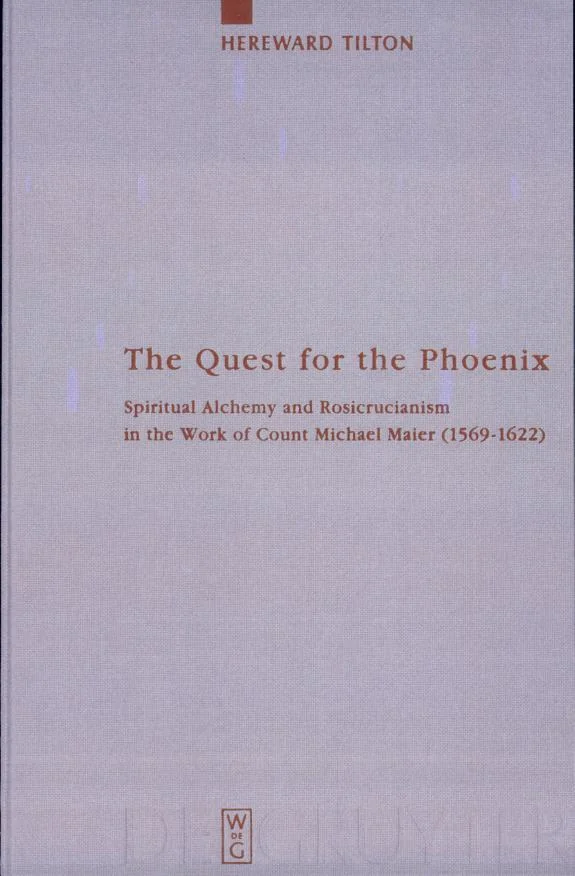
The Quest for the Phoenix
 78
78

The Quest for the Phoenix
Hereward Tilton’s study of Michael Maier, *The Quest for the Phoenix*, offers a much-needed scholarly examination of a pivotal esoteric figure. The strength of the book lies in its detailed archival research, particularly in situating Maier within the courts of Emperor Rudolf II and Moritz of Hessen-Kassel. Tilton’s careful charting of Maier’s intellectual development, moving from his Lutheran background to his embrace of Hermeticism, provides a compelling narrative. However, the book’s dense academic prose, while precise, can occasionally obscure the more speculative aspects of Maier's thought, making it a challenging read for those not already steeped in the subject. A particularly illuminating section is the analysis of Maier's *Atalanta Fugiens*, where Tilton dissects the intricate interplay between its alchemical emblems, musical fugues, and philosophical exegesis. While the work admirably clarifies Maier's historical role, it sometimes struggles to fully capture the experiential dimension that drew adherents to his teachings. Ultimately, *The Quest for the Phoenix* is an essential, if demanding, resource for understanding the historical underpinnings of Western esotericism.
📝 Description
78
Hereward Tilton's 2012 study examines Count Michael Maier's life and alchemical thought.
Published in 2012, The Quest for the Phoenix offers an intellectual biography of Count Michael Maier, a notable figure in early modern Western esotericism. Tilton's academic study places Maier's life and writings within the historical currents of alchemy and Rosicrucianism. It traces the development of Maier's Hermetic philosophy, detailing his service at the imperial court of Emperor Rudolf II and his associations with Moritz of Hessen-Kassel. The book also engages with scholarly discussions about the origins of Rosicrucianism, arguing for Maier's significant role in promoting these ideas.
This work is aimed at scholars and dedicated students of Western esotericism interested in alchemy, the Rosicrucian movement, and the intellectual climate of the late Renaissance and early Baroque. Readers who desire a detailed, evidence-based account of Michael Maier's biography and his philosophical contributions will find it useful. It is suited for those who value rigorous historical research applied to complex spiritual and philosophical traditions.
This book is situated within the history of Western esotericism, specifically focusing on the period of the late 16th and early 17th centuries. This era was marked by significant interest in Hermetic philosophy, Kabbalah, and alchemy, often patronized by figures like Emperor Rudolf II. Maier's work emerged during a time of intellectual change, coinciding with the beginnings of the scientific revolution and the enduring influence of Renaissance Neoplatonism. The publication of the Rosicrucian manifestos around 1614 further cemented Maier's position within a developing esoteric discourse.
💡 Why Read This Book?
• Learn about Count Michael Maier's specific contributions to Hermetic philosophy and alchemy, understanding his intellectual journey from his Lutheran roots to his courtly service in Prague under Emperor Rudolf II. • Gain clarity on the historical debate surrounding early Rosicrucianism, recognizing Maier's pivotal role in promoting its ideas and understanding the context of its emergence around 1614. • Explore the symbolic meanings of the Phoenix in alchemical traditions and how this motif functions within Maier's broader Hermetic worldview, as detailed in the book's thematic analysis.
⭐ Reader Reviews
Honest opinions from readers who have explored this book.
❓ Frequently Asked Questions
What is the primary focus of The Quest for the Phoenix?
The book is an intellectual biography of Count Michael Maier, examining his life and work within the context of Western esotericism, particularly alchemy and Rosicrucianism. It details his Hermetic worldview and his service at the courts of Emperor Rudolf II and Moritz of Hessen-Kassel.
Who was Michael Maier?
Michael Maier (1569–1622) was a German physician, alchemist, and writer. He served Emperor Rudolf II and later Moritz of Hessen-Kassel, becoming a significant figure in the promotion and dissemination of Hermetic philosophy and early Rosicrucian ideas.
What is the historical significance of Emperor Rudolf II's court in Prague?
Emperor Rudolf II's court in Prague during the late 16th and early 17th centuries was a major center for alchemy, astrology, and other occult sciences. It attracted many esoteric scholars and practitioners, including Michael Maier, fostering an environment for intellectual exchange.
How does the book address the Rosicrucian movement?
The book delves into the problem of the nature of early Rosicrucianism, exploring Maier's significant role in promoting these ideas. It examines his writings and activities in relation to the Rosicrucian manifestos that appeared around 1614.
What is the 'Phoenix' referred to in the title?
The 'Phoenix' in the title symbolizes rebirth and transformation, a potent motif in alchemical traditions. It serves as a central metaphor for the spiritual and philosophical quest undertaken by Michael Maier and explored throughout the book.
Is this book suitable for beginners in esoteric studies?
The Quest for the Phoenix is an academic study geared towards scholars and serious students. While it provides essential historical context, its depth and scholarly approach make it more suitable for those with some existing knowledge of Western esotericism.
🔮 Key Themes & Symbolism
Michael Maier's Hermeticism
This theme centers on the intellectual biography of Count Michael Maier, charting the evolution of his Hermetic worldview. The work meticulously details how Maier synthesized elements of Lutheran theology with ancient Hermetic philosophy, Kabbalah, and alchemical principles. His service at the imperial court of Emperor Rudolf II in Prague provided a unique environment for such syncretic thought, exposing him to a diverse array of occult and philosophical traditions. The book explores how Maier's personal journey and scholarly pursuits shaped his unique interpretation of these esoteric systems, making him a key figure in their early modern articulation.
The Nature of Early Rosicrucianism
The book critically examines the historical and philosophical dimensions of the early Rosicrucian movement. It addresses the contentious debate surrounding the authenticity and aims of the Rosicrucian manifestos, particularly the *Fama Fraternitatis* and *Confessio Fraternitatis* published around 1614. Hereward Tilton highlights Michael Maier's significant role as a promoter and interpreter of these ideas. The study analyzes Maier's writings and activities in the context of his courtly service, seeking to clarify his position within and influence upon this nascent and often secretive spiritual fraternity.
Alchemy as Spiritual Discipline
Beyond its proto-chemical aspects, *The Quest for the Phoenix* investigates alchemy as a profound spiritual and philosophical discipline. It situates Maier's alchemical pursuits within the broader Hermetic tradition, where the Great Work symbolized not just material transmutation but also spiritual purification and enlightenment. The book explores how Maier integrated alchemical symbolism, often drawn from classical myths and esoteric imagery, into his worldview. The concept of the Phoenix, representing cyclical renewal and ultimate transformation, serves as a key emblem for this spiritual quest.
Courtly Patronage and Esotericism
This theme investigates the crucial role of courtly patronage in the development and dissemination of esoteric knowledge during the late Renaissance and early Baroque periods. The book details Michael Maier's career at the courts of Emperor Rudolf II and Moritz of Hessen-Kassel. It illustrates how these imperial and princely courts, particularly Rudolf II's in Prague, became centers for alchemists, astrologers, and other esoteric scholars. The work shows how the protection and resources offered by such patrons enabled figures like Maier to pursue their research and publish their complex philosophical works.
💬 Memorable Quotes
Direct passages from the work, attributed to the author.
“Maier's Hermetic worldview developed in the context of his service at the courts of Emperor Rudolf II and Moritz of Hessen-Kassel.”
— This statement highlights the crucial link between Michael Maier's intellectual and spiritual development and his professional life within powerful European courts. It suggests that his exposure to these environments, with their inherent political intrigue and intellectual currents, was formative for his esoteric philosophy.
“The book addresses the problem of the nature of early Rosicrucianism with reference to Maier's role in its promotion.”
— This points to the academic rigor of the study, focusing on a specific historical puzzle: the true identity and aims of the early Rosicrucian movement. It emphasizes Maier's significance not just as a participant but as an active proponent, whose work offers clues to understanding this elusive fraternity.
“The Quest for the Phoenix presents an intellectual biography of the Lutheran alchemist Count Michael Maier.”
— This concise summary defines the book's core subject: an in-depth exploration of Michael Maier's life, focusing on his intellectual journey. It also specifies his dual identity as both a follower of Lutheranism and a practitioner of alchemy, hinting at the complex spiritual landscape he navigated.
“The study offers an academic examination of Western esotericism in general, and alchemy and Rosicrucianism in particular.”
— This emphasizes the book's scholarly nature and its broader relevance. It positions Maier's story as a case study that illuminates larger trends and debates within the history of Western esoteric traditions, making it valuable for understanding the field as a whole.
“The work charts the development of Maier's Hermetic worldview.”
— This interpretive phrase suggests a narrative progression, following how Maier's understanding and application of Hermetic principles evolved over time. It implies an analysis of influences, intellectual shifts, and the gradual formation of his unique esoteric perspective.
🌙 Esoteric Significance
Tradition
This work is firmly rooted in the Western Esoteric Tradition, specifically the Hermetic and Alchemical lineages. It examines how Michael Maier synthesized these ancient streams with his Lutheran background, creating a unique expression of early modern esotericism. Maier's approach exemplifies the syncretic tendencies of the era, wherein disparate philosophical and religious ideas were integrated to form new esoteric systems. The book fits within the scholarly study of Hermeticism, placing Maier as a key transitional figure who bridged Renaissance Neoplatonism and the later development of Rosicrucian and Masonic symbolism.
Symbolism
Central to the book is the symbolism of the Phoenix, an ancient motif representing cyclic renewal, resurrection, and the ultimate transformation achieved through the alchemical process. Another key symbol is the *Aqua Vitae* (Water of Life), often associated with the alchemical elixir and spiritual enlightenment. The book also likely explores the symbolism inherent in Maier's own alchemical works, such as the emblems in *Atalanta Fugiens*, which visually and conceptually link alchemical operations with philosophical and mystical truths, representing stages of spiritual purification and realization.
Modern Relevance
Contemporary practitioners and scholars of Hermeticism, Rosicrucianism, and alchemy continue to draw upon the historical understanding provided by studies like *The Quest for the Phoenix*. Thinkers and groups interested in the historical roots of Western esoteric traditions, the philosophy of alchemy beyond its practical applications, and the complex history of movements like Rosicrucianism find Maier’s work and Tilton’s analysis essential. It informs modern understandings of how esoteric ideas were formulated, disseminated, and integrated within historical contexts, influencing contemporary esoteric thought and practice.
👥 Who Should Read This Book
• Scholars of Western Esotericism: Researchers and academics focusing on the history of alchemy, Rosicrucianism, Hermeticism, and the intellectual history of the early modern period will find this a crucial reference. • Students of Michael Maier: Anyone specifically interested in the life, work, and philosophical contributions of Count Michael Maier will benefit from this detailed biographical and analytical study. • Comparative Religion and Philosophy Enthusiasts: Readers interested in how diverse philosophical and spiritual traditions (Lutheranism, Hermeticism, Kabbalah) were synthesized in the Renaissance era will find this book clear.
📜 Historical Context
The Quest for the Phoenix emerges from the fertile ground of late 16th and early 17th-century European intellectual life, a period marked by the transition from Renaissance humanism to the Baroque era. This was an age of fervent exploration in both the natural sciences and the occult arts, particularly within the courts of powerful rulers. Emperor Rudolf II's court in Prague (late 16th century until 1611) became a renowned haven for alchemists, astrologers, and mystics, including Michael Maier. This environment fostered a unique intellectual climate where Hermetic philosophy, Kabbalah, and alchemy were pursued with great intensity, often alongside burgeoning scientific inquiry. The concurrent rise of the Rosicrucian movement, with its manifestos appearing around 1614, created significant debate and interest, positioning figures like Maier at the center of esoteric discourse. Competing schools of thought included established Aristotelianism and emerging corpuscular philosophy, yet the allure of ancient wisdom traditions remained strong. Maier’s work thus engaged directly with the spiritual and intellectual currents that defined this transformative period.
📔 Journal Prompts
Michael Maier's synthesis of Lutheranism and Hermeticism: What tensions or harmonies emerge?
The Rosicrucian problem: How does Maier's role clarify or complicate the historical understanding?
The Phoenix symbolism: How does this motif reflect Maier's broader alchemical and spiritual quest?
Courtly patronage: Reflect on the influence of Emperor Rudolf II's court on esoteric research.
Maier's *Atalanta Fugiens*: Consider the interplay of its visual, musical, and philosophical elements.
🗂️ Glossary
Hermeticism
A religious, philosophical, and esoteric tradition based on writings attributed to Hermes Trismegistus. It emphasizes divine wisdom, the interconnectedness of all things, and the potential for human spiritual ascent through knowledge and practice.
Alchemy
An ancient tradition focused on the transformation of matter, often involving the pursuit of the philosopher's stone. Esoterically, it is understood as a spiritual discipline aimed at purifying the soul and achieving spiritual enlightenment.
Rosicrucianism
A mystical and esoteric movement that emerged in Europe in the early 17th century, associated with secret societies and symbolic spiritual teachings. Its early history and aims are subjects of considerable scholarly debate.
Count Michael Maier
A prominent German physician, alchemist, and writer (1569–1622) who served Emperor Rudolf II and Moritz of Hessen-Kassel. He was a key figure in promoting Hermetic philosophy and early Rosicrucian ideas.
Emperor Rudolf II
Holy Roman Emperor (reigned 1576–1612) whose court in Prague was a center for arts, sciences, and especially occult studies, attracting figures like Michael Maier.
Phoenix
A mythical bird that regenerates or is reborn from its own ashes. In alchemy and esotericism, it symbolizes cyclical renewal, resurrection, and the ultimate transformation of the Great Work.
Atalanta Fugiens
A significant work by Michael Maier published in 1617, featuring 50 alchemical emblems accompanied by Latin verses and musical fugues, illustrating alchemical processes and principles.