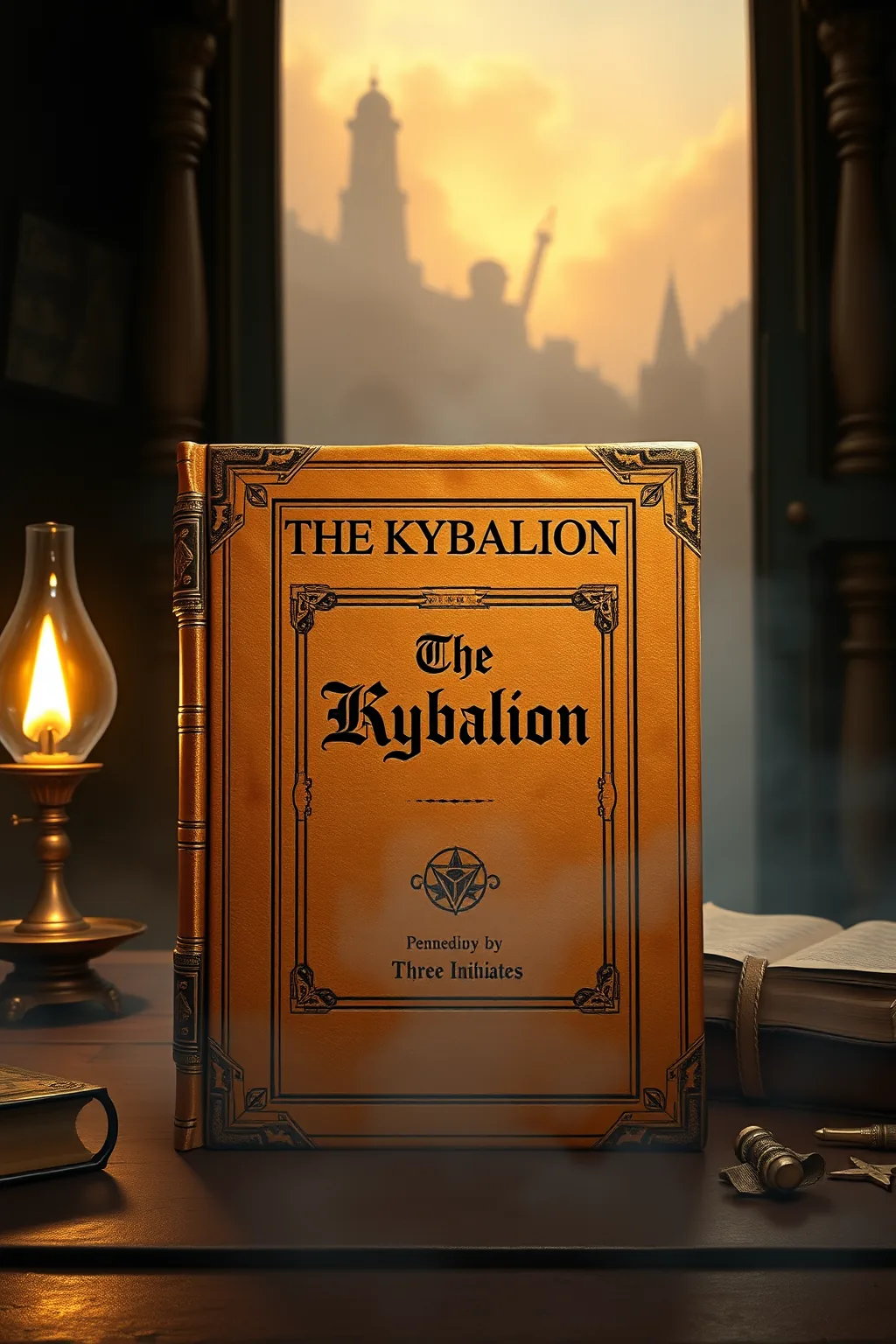
The Kybalion
 81
81

The Kybalion
The Kybalion’s enduring appeal lies in its distillation of complex Hermetic thought into seven distinct, actionable principles. The assertion that "The lips of Wisdom are closed, except to the ears of Understanding" immediately sets a tone of selective revelation, inviting the earnest student. Its strength is the elegant simplicity with which it frames universal mechanics; for instance, the Principle of Vibration, which states "Nothing rests; everything moves; everything vibrates." This concept, when applied, offers a tangible lens through which to view change and impermanence. However, the book’s primary limitation is its very anonymity. The "Three Initiates" remain elusive, making verification of its historical lineage and claimed origins a challenge for critical readers. While the text offers a coherent system, the lack of specific historical or biographical anchors can leave the reader questioning the provenance of its interpretations. Despite this, the work provides a compelling introduction to a specific Hermetic worldview, urging readers toward self-awareness and mental discipline.
📝 Description
81
Published in 1908, The Kybalion outlines seven Hermetic Principles as universal laws.
The Kybalion, authored by the anonymous "Three Initiates," presents a system of seven Hermetic Principles intended to explain the workings of the universe. First appearing in 1908, the book codifies these principles, suggesting they are fundamental laws governing all existence. Its central premise is that comprehending these laws allows for mental control and a harmonious alignment with the cosmos. The text functions as an introduction to a particular view of Hermetic philosophy, focusing on the mental and spiritual dimensions of life.
The book is directed toward individuals seeking esoteric wisdom, especially those interested in Hermeticism, occult thought, and the mechanics of mental alchemy. It will likely appeal to readers drawn to core texts that discuss universal laws and the nature of reality from a metaphysical standpoint. Those who appreciate direct, aphoristic statements and are ready to grapple with abstract ideas will find its content particularly significant.
The Kybalion appeared during a surge of interest in occultism around the turn of the 20th century. Its publication in 1908 coincided with the popularization of various esoteric traditions by figures and groups active at the time. The "Three Initiates" drew upon existing Hermetic writings and likely contemporary occult movements. The work found its audience primarily within esoteric communities, with little attention from mainstream academic circles upon its release.
💡 Why Read This Book?
• Understand the Principle of Mentalism, which posits that All is Mind, offering a unique perspective on the nature of reality and consciousness that differs from purely materialist views. • Grasp the Principle of Correspondence, illustrated by the axiom "As above, so below; as below, so above," providing a framework for seeing interconnectedness across different planes of existence. • Explore the Principle of Vibration, learning how "everything moves; everything vibrates," which can foster a deeper appreciation for change and dynamism in the universe and within oneself.
⭐ Reader Reviews
Honest opinions from readers who have explored this book.
❓ Frequently Asked Questions
What are the seven Hermetic Principles explained in The Kybalion?
The Kybalion outlines seven principles: Mentalism, Correspondence, Vibration, Polarity, Rhythm, Cause and Effect, and Gender. These are presented as fundamental laws governing the entire universe, originating from ancient Hermetic philosophy.
Who were the "Three Initiates" who authored The Kybalion?
The identities of the "Three Initiates" remain officially unknown. The book was first published in 1908, and speculation about their identities ranges from prominent occultists of the era to a single individual.
Is The Kybalion a primary source for ancient Hermeticism?
The Kybalion is a modern interpretation and codification of Hermetic philosophy, published in 1908. While it draws on ancient Hermetic traditions, it is not a direct translation or compilation of ancient texts, but rather a commentary and synthesis.
What is the concept of "Mental Alchemy" discussed in The Kybalion?
Mental Alchemy, as presented in The Kybalion, refers to the art and science of mastering one's own mind. It involves understanding and applying the Hermetic Principles to transform one's mental states, thereby influencing one's reality.
Where can I find more information about Hermeticism beyond The Kybalion?
Beyond The Kybalion, further study of Hermeticism can involve exploring the Corpus Hermeticum, the Emerald Tablet, and the writings of later Hermetic figures and schools, such as Renaissance alchemists or modern Rosicrucian orders.
Does The Kybalion discuss practical applications of its principles?
Yes, The Kybalion suggests practical applications by encouraging readers to understand and apply the seven principles to their daily lives. The goal is to achieve mastery over one's thoughts, emotions, and circumstances.
🔮 Key Themes & Symbolism
The Seven Hermetic Principles
The foundational element of The Kybalion is its codification of seven core principles: Mentalism, Correspondence, Vibration, Polarity, Rhythm, Cause and Effect, and Gender. These are presented not merely as philosophical concepts but as immutable laws of the cosmos. The work meticulously explains each principle, illustrating how they interrelate and govern all phenomena, from the subtlest mental states to the most apparent physical events. Understanding these principles is posited as the key to unlocking a deeper comprehension of reality and one's place within it, facilitating a transformation through applied knowledge.
Mentalism and the Nature of Reality
Central to the work is the Principle of Mentalism, which states "The All is Mind; The Universe is Mental." This concept radically reframes the understanding of existence, suggesting that reality is fundamentally mental in nature. The Kybalion explores the implications of this, positing that the physical world is a manifestation of a greater Universal Mind. This perspective invites readers to consider their own thoughts and beliefs not as passive occurrences but as active forces shaping their individual and collective realities, opening avenues for self-mastery and conscious creation.
Transmutation and Personal Mastery
The Kybalion presents its principles as tools for personal transmutation, often referred to as "Mental Alchemy." By understanding concepts like Polarity (the duality inherent in all things) and Rhythm (the universal pulse of action and reaction), individuals can learn to navigate life's challenges with greater wisdom and control. The text suggests that conscious application of these laws allows one to shift their mental states, overcome limitations, and achieve a higher level of personal power and alignment with the cosmic order.
The Law of Correspondence
The Principle of Correspondence, summarized by the ancient axiom "As above, so below; as below, so above," is a recurring theme. The Kybalion uses this to illustrate the interconnectedness of all planes of existence – the physical, the mental, and the spiritual. It suggests that by studying phenomena on one level, one can gain understanding of corresponding phenomena on other levels. This principle provides a lens for interpreting symbols, understanding universal patterns, and recognizing the inherent unity underlying apparent diversity.
💬 Memorable Quotes
Direct passages from the work, attributed to the author.
“The lips of Wisdom are closed, except to the ears of Understanding.”
— This aphorism suggests that true knowledge is not readily available to all but requires a specific state of consciousness—understanding—to be received and comprehended.
“Nothing rests; everything moves; everything vibrates.”
— This expresses the Principle of Vibration, asserting that motion and change are fundamental aspects of the universe at all levels, from the atomic to the cosmic.
“All duality must be resolved into a higher unity.”
— This points to the Principle of Polarity, suggesting that apparent opposites are merely different degrees of the same fundamental substance, and true mastery involves seeing beyond these divisions.
“The Principle of Cause and Effect governs all.”
— This highlights the universality of causality, implying that every event has a preceding cause and a subsequent effect, forming an unbroken chain throughout existence.
“The All is Mind; The Universe is Mental.”
— This is the core statement of the Principle of Mentalism, proposing that the ultimate reality is consciousness or mind, and the perceived physical universe is its manifestation.
🌙 Esoteric Significance
Tradition
The Kybalion is firmly situated within the Western Esoteric Tradition, specifically as a modern exposition of Hermeticism. It draws upon the philosophical and mystical currents attributed to Hermes Trismegistus, a figure central to alchemy, magic, and theology. While ancient Hermetic texts like the Corpus Hermeticum provide foundational cosmology and theology, The Kybalion focuses on codifying seven distinct principles as universal laws, presenting a more psychological and practical interpretation relevant to the modern era.
Symbolism
The work, while not overtly symbolic in its presentation of principles, embodies the Hermetic concept of "As above, so below." This principle itself functions as a symbolic key, suggesting that the microcosm (individual) reflects the macrocosm (universe). The number seven, representing the seven principles, also carries significant symbolic weight in many esoteric traditions, often denoting completion or perfection. The very act of seeking to understand these laws is presented as a symbolic journey toward spiritual enlightenment and self-realization.
Modern Relevance
The Kybalion continues to influence contemporary esoteric thought, New Thought, and self-help movements. Its principles are often referenced in discussions of manifestation, law of attraction, and consciousness studies. Thinkers and practitioners in fields ranging from spiritual psychology to modern alchemy frequently engage with its ideas, seeking practical applications for personal growth, mental discipline, and understanding the perceived interconnectedness of all things.
👥 Who Should Read This Book
• Aspiring practitioners of Hermeticism seeking a concise introduction to its core principles and metaphysics. • Students of comparative philosophy and religion interested in tracing the lineage and modern interpretations of ancient esoteric traditions. • Individuals focused on self-mastery and personal development who are drawn to frameworks that explain the mind's role in shaping reality.
📜 Historical Context
Published in 1908, The Kybalion emerged during the New Thought movement and the broader occult revival of the late 19th and early 20th centuries. This era saw a surge of interest in spiritualism, Theosophy, Rosicrucianism, and various forms of Western esotericism, often seeking to synthesize ancient wisdom with modern understanding. The anonymous "Three Initiates" presented a distillation of Hermetic philosophy, a tradition tracing its roots to Hermes Trismegistus, a syncretic Greco-Egyptian deity. While contemporary figures like Helena Blavatsky were popularizing Eastern philosophies and esoteric doctrines, The Kybalion offered a distinct, more systematized interpretation of Hermeticism focused on mental laws. Its reception was primarily within the burgeoning occult and metaphysical communities, quickly becoming a foundational text for students of Hermeticism and mental sciences.
📔 Journal Prompts
The Principle of Mentalism's assertion that 'All is Mind'—how does this challenge your perception of objective reality?
Reflect on an instance where the Principle of Correspondence ('As above, so below') manifested in your experience.
Analyze a situation using the Principle of Polarity: identify the apparent opposites and consider their underlying unity.
Consider the Principle of Rhythm. How do cycles of activity and rest influence your personal or professional life?
Apply the Principle of Cause and Effect to a recent decision. Trace the potential chain of consequences.
🗂️ Glossary
Mentalism
The first Hermetic Principle, stating that the All (the ultimate reality) is Mind, and the Universe is mental, meaning reality is fundamentally consciousness.
Correspondence
The second Hermetic Principle, summarized as 'As above, so below; as below, so above,' indicating a parallel relationship between different planes of existence.
Vibration
The third Hermetic Principle, asserting that nothing is at rest; everything moves, everything vibrates, and everything comes to you by due application of the laws of vibration.
Polarity
The fourth Hermetic Principle, stating that everything is dual; everything has poles; everything has its pair of opposites, which are identical in nature, but different in degree.
Rhythm
The fifth Hermetic Principle, describing the universal law of ebb and flow, action and reaction, advance and retreat—a pendulum-like movement inherent in all things.
Cause and Effect
The sixth Hermetic Principle, asserting that every cause has its effect, and every effect has its cause, with no escape from this universal law.
Gender
The seventh Hermetic Principle, stating that Gender exists everywhere; it is masculine and feminine principle in everything and everybody. This is not limited to physical sex.