The Kybalion
 76
76

The Kybalion
The Kybalion's enduring appeal lies in its audacious claim to distill the entirety of Hermetic wisdom into seven concise principles. Its strength is undeniable: the text offers a remarkably clear and systematic framework for understanding complex metaphysical concepts, making them digestible for a wide audience. The principle of Mentalism, for instance, is articulated with a starkness that compels contemplation on the nature of reality itself. However, the work's primary limitation is its attribution. While presented as ancient lore, its 1908 publication date and the "Three Initiates" pseudonym raise significant questions about its true origins and the authenticity of its claimed lineage to Hermes Trismegistus. The assertion that "The All is Mind" is a powerful, though not entirely novel, concept within esoteric thought. Ultimately, The Kybalion serves as a valuable, albeit modern, interpretation of Hermetic philosophy, rather than a direct transmission of ancient texts.
📝 Description
76
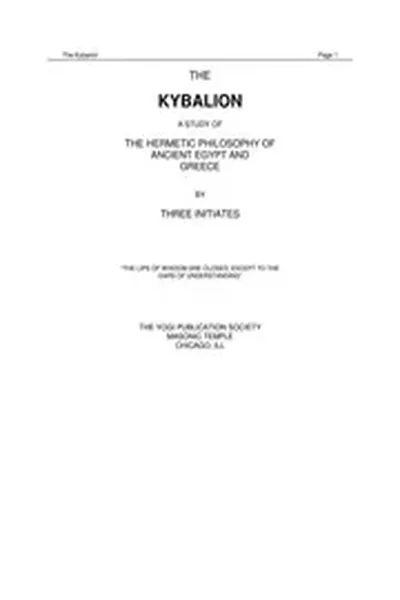
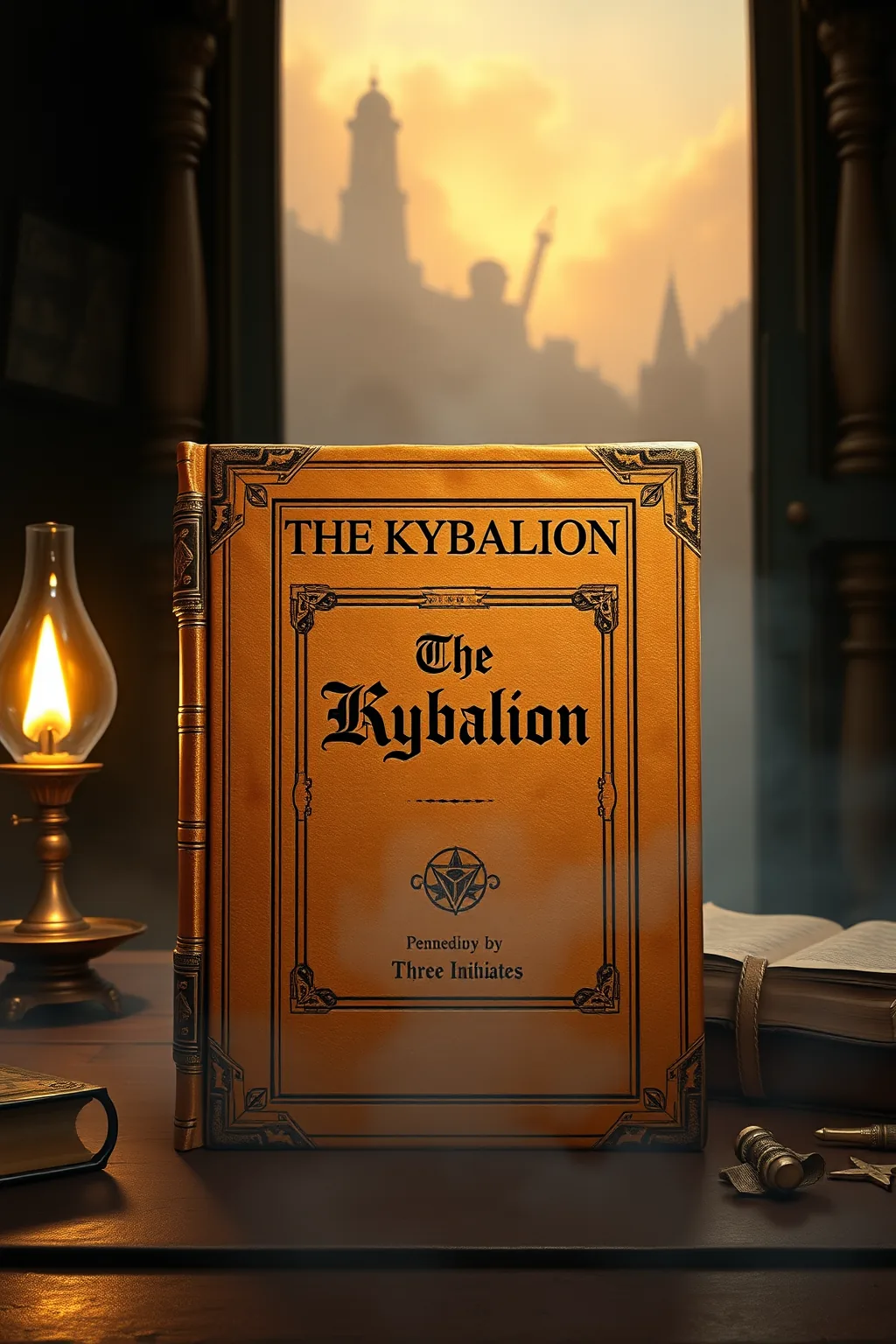
Published in 1908, The Kybalion claims to reveal seven Hermetic Principles.
The Kybalion, attributed to the "Three Initiates," presents seven core principles of Hermetic philosophy. First appearing in 1908, the book distills complex metaphysical concepts into aphorisms and explanations. It proposes a single, underlying reality from which all things emerge, stressing the influence of thought and the connection between all elements. The text functions as an introduction to a particular view of Hermetic thought, focusing on universal laws governing existence and human awareness.
This book is for individuals interested in the basics of Hermetic philosophy or the history of Western esoteric thought. It attracts students of metaphysics and occultism who study ideas of universal laws, mental creation, and spiritual transformation. Those who ponder the nature of reality, consciousness, and the mind's capabilities will find its principles relevant. It suits readers who prefer direct, axiomatic statements of complex ideas.
The book emerged in 1908 amidst widespread interest in spiritualism and occult revivals. It reflects an intellectual atmosphere influenced by figures like Helena Blavatsky and the rise of Theosophy, which also aimed to unify ancient traditions. Though presented as an ancient work, its modern language suggests a 20th-century origin, possibly from individuals associated with the Theosophical Society or similar groups. Its straightforward approach made it a popular entry point into Hermeticism.
The Kybalion situates itself within the Hermetic tradition, a body of esoteric philosophy attributed to Hermes Trismegistus. This tradition influenced Western esotericism from the Renaissance onwards, impacting alchemy, astrology, and various mystical movements. The book's "Seven Principles"—Mentalism, Correspondence, Vibration, Polarity, Rhythm, Cause and Effect, and Gender—are presented as fundamental truths about the cosmos and human existence, reflecting themes common in Neoplatonism and later occult revivalist thought.
💡 Why Read This Book?
• Gain a structured understanding of the Seven Hermetic Principles, such as Mentalism and Correspondence, which provides a unique lens for viewing universal laws. • Explore the concept of "The All" as Mind, as presented in the text's initial principle, offering a distinct metaphysical perspective on consciousness. • Grasp the practical application of the Principle of Vibration, understanding how its tenets can inform one's perception of change and movement in the world.
⭐ Reader Reviews
Honest opinions from readers who have explored this book.
❓ Frequently Asked Questions
Is The Kybalion an ancient text?
While The Kybalion presents itself as a distillation of ancient Hermetic teachings attributed to Hermes Trismegistus, it was first published in 1908 by "Three Initiates." Scholars generally consider it a modern interpretation rather than a direct translation of ancient Egyptian or Greek Hermetic texts.
Who were the 'Three Initiates'?
The identities of the "Three Initiates" remain unknown. Speculation often points to figures associated with the Theosophical Society or other esoteric orders active in the late 19th and early 20th centuries, possibly including William Walker Atkinson.
What are the seven Hermetic Principles?
The seven principles are Mentalism, Correspondence, Vibration, Polarity, Rhythm, Cause and Effect, and Gender. Each principle offers a fundamental law believed to govern the universe and human experience.
Is The Kybalion in the public domain?
The original 1908 publication of The Kybalion is in the public domain in the United States. This means its text can be freely copied and distributed, though specific annotated editions or newer translations may carry their own copyrights.
How does The Kybalion relate to Hermeticism?
The Kybalion is a key text for understanding a specific, modern interpretation of Hermetic philosophy. It popularizes concepts attributed to Hermes Trismegistus, focusing on universal laws and the power of the mind.
Where can I read The Kybalion for free?
As The Kybalion is in the public domain in the US, you can find free online versions on various esoteric and public domain text websites. Many libraries also offer access to digital or physical copies.
🔮 Key Themes & Symbolism
The Principle of Mentalism
This foundational principle asserts that "The All is Mind; The Universe is Mental." It posits that reality itself is a manifestation of a Universal Mind. This concept challenges materialist viewpoints, suggesting that thoughts, beliefs, and consciousness are the primary drivers of existence. The text elaborates on how individuals, through their own mental states, can influence their reality by aligning with or understanding the Universal Mind. This principle is crucial for understanding the creative power of thought within the Hermetic framework.
The Principle of Correspondence
Often summarized as "As above, so below; as below, so above," this principle highlights the interconnectedness and parallel nature of different planes of existence. It suggests that understanding one level, whether the physical, mental, or spiritual, can unlock insights into others. The Kybalion uses this to illustrate how universal laws operating on a cosmic scale are mirrored in the individual's life and consciousness. It provides a framework for interpreting symbols and understanding the macrocosm through the microcosm.
The Principle of Vibration
This principle states that "everything moves; everything vibrates; everything frequences." It posits that differences between manifestations of matter, energy, and mind are simply variations in vibrational rates. The text explains that even seemingly inert matter vibrates at a low frequency, while higher states of consciousness vibrate at higher rates. Understanding vibration is presented as key to mastering one's mental states and influencing the physical world through controlled mental projection and resonance.
Duality and Polarity
The Principle of Polarity explains that all things exist in pairs of opposites, which are merely different degrees of the same underlying reality. Hot and cold, light and dark, good and evil are not absolute but relative points on a spectrum. The Kybalion emphasizes that by understanding this duality, one can transmute negative states into positive ones by shifting one's mental vibration or perspective. This principle is crucial for navigating apparent contradictions and understanding the dynamic balance of the universe.
💬 Memorable Quotes
Direct passages from the work, attributed to the author.
“The lips of wisdom are closed, except to the ears of understanding.”
— This aphorism underscores the idea that true knowledge is not readily available to everyone. It requires a prepared mind, a willingness to learn, and the capacity for discernment, suggesting that the esoteric truths within The Kybalion are accessible only to those who genuinely seek and are ready to comprehend them.
“The All is Mind; The Universe is Mental.”
— This is the foundational statement of the Principle of Mentalism. It proposes that the fundamental reality of existence is consciousness or mind, and the physical universe is a manifestation or projection of this Universal Mind.
“As above, so below; as below, so above.”
— This iconic phrase, representing the Principle of Correspondence, suggests a fundamental harmony and interconnectedness between the macrocosm (the universe) and the microcosm (the individual or Earthly realm).
“Nothing rests; everything moves; everything vibrates; everything frequences.”
— This captures the Principle of Vibration, asserting that constant motion and energetic oscillation are fundamental properties of all existence, from the smallest particle to the largest celestial body.
“Duality, expressed in terms of the physical world, is but the relative manifestation of the absolute.”
— This statement from the Principle of Polarity explains that apparent opposites are merely different intensities of the same fundamental substance or energy, existing on a spectrum rather than as distinct entities.
🌙 Esoteric Significance
Tradition
The Kybalion is firmly rooted in the Western Esoteric Tradition, particularly drawing from Hermeticism, a philosophical and religious tradition based on writings attributed to Hermes Trismegistus. It synthesizes elements that echo Gnostic thought, Kabbalistic concepts of emanation, and the principles of alchemy, presenting them through a lens that significantly overlaps with the "New Thought" movement of the late 19th and early 20th centuries. It represents a modern, accessible interpretation aimed at popularizing core Hermetic tenets.
Symbolism
While not overtly symbolic in its prose, The Kybalion's core lies in its seven principles, which function as symbolic representations of universal laws. The Caduceus of Hermes Trismegistus, though not detailed within the text itself, is often associated with its teachings, symbolizing balance, duality (the two snakes), and healing (the staff). The concept of "The All" can be seen as a symbol for the ultimate, undifferentiated source from which all existence emerges, akin to the Kabbalistic Kether or the alchemical Prima Materia.
Modern Relevance
Contemporary practitioners of Hermeticism, Neopaganism, and various forms of New Age spirituality frequently reference The Kybalion. Its principles are foundational for many modern interpretations of manifestation, the law of attraction, and mental alchemy. Thinkers and authors in fields like consciousness studies and positive psychology also find resonance with its emphasis on mental causation and the power of thought, even if they approach it from a secular perspective.
👥 Who Should Read This Book
• Aspiring students of Hermeticism seeking a concise introduction to its core principles, offering a structured framework for metaphysical study. • Practitioners of New Thought and Law of Attraction philosophies looking to understand the historical and philosophical underpinnings of their beliefs. • Comparative religion scholars interested in the evolution of esoteric thought and the popularization of ancient philosophies in the early 20th century.
📜 Historical Context
The Kybalion emerged in 1908, a period ripe with spiritual and occult exploration in the West, heavily influenced by the Theosophical Society founded by Helena Blavatsky in 1875. This era saw a surge in interest in Eastern philosophies, ancient wisdom, and rediscovered mystical traditions. While The Kybalion purports to reveal ancient Hermetic secrets, its publication format and accessible prose suggest a deliberate effort to synthesize and popularize these ideas for a modern audience, likely by authors familiar with Theosophy's syncretic approach. It tapped into a broader cultural fascination with metaphysics and personal transformation that also fueled movements like New Thought. The book's anonymous authorship, attributed to "Three Initiates," and its emphasis on universal laws rather than specific deities or rituals distinguish it from earlier occult revival texts. Its relatively clear articulation of complex ideas contributed significantly to its widespread adoption as an introductory text to Hermetic philosophy.
📔 Journal Prompts
The Principle of Mentalism's assertion that 'The All is Mind'; how does this concept challenge your perception of objective reality?
Correspondence between the macrocosm and microcosm; identify one aspect of your personal life that mirrors a universal law.
The concept of Vibration; reflect on how changing your mental state might alter your experience of external circumstances.
Polarity in daily life; analyze a situation where apparent opposites are manifestations of a single underlying reality.
The Principle of Gender; consider how masculine and feminine energies manifest within your own being and interactions.
🗂️ Glossary
The All
The ultimate, boundless, and infinite reality or Universal Mind from which all things originate. It is considered the fundamental substance of the universe, encompassing everything and being everything.
Hermes Trismegistus
A legendary, syncretic figure combining the Greek god Hermes and the Egyptian god Thoth. He is considered the legendary author of the Hermetic texts, a foundational body of esoteric wisdom.
Mentalism
The First Hermetic Principle, stating that the Universe is fundamentally mental, governed by Mind. It posits that all reality is a manifestation of the Universal Mind.
Correspondence
The Second Hermetic Principle ('As above, so below'), illustrating the parallel relationship between different planes of existence, linking the macrocosm and the microcosm.
Vibration
The Third Hermetic Principle, asserting that everything in the universe is in constant motion and possesses a unique frequency. Differences are merely variations in rate.
Polarity
The Fourth Hermetic Principle, explaining that all dualities (e.g., hot/cold, light/dark) are merely two poles of the same fundamental reality, differing only in degree.
Gender
The Seventh Hermetic Principle, referring to the universal masculine (active, generative) and feminine (passive, receptive) principles present in all things, driving creation and manifestation.