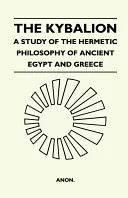
The Kybalion - A Study of the Hermetic Philosophy of Ancient Egypt and Greece
 84
84

The Kybalion - A Study of the Hermetic Philosophy of Ancient Egypt and Greece
The Kybalion's strength lies in its clear, albeit highly condensed, presentation of complex philosophical ideas. The Seven Principles are laid out with a distinct logical flow, making abstract concepts accessible. However, its primary limitation is the lack of direct scholarly engagement with primary Hermetic sources. The anonymous authorship and the 1908 publication date mean it operates as a modern synthesis rather than an ancient text itself. The concept of "The All" as the fundamental substance of reality, as described in the Principle of Mentalism, is a compelling idea, suggesting that "The Universe is Mental" – a notion that demands contemplation. While not a scholarly treatise, it serves as an effective primer on a specific interpretation of Hermetic thought.
📝 Description
84
### What It Is
The Kybalion is a concise exposition of the Hermetic philosophy, purportedly originating from Hermes Trismegistus. Published anonymously, it distills seven "Principles" said to govern the universe. This work is not a direct translation of ancient texts but rather a modern interpretation and codification of Hermetic doctrines, presented in a systematic manner for contemporary understanding.
### Who It's For
This book is intended for individuals seeking a foundational understanding of Hermeticism's core tenets. It appeals to students of esoteric traditions, metaphysics, and comparative religion who are interested in the principles that allegedly underpin all existence. Those curious about the influence of ancient Egyptian and Greek thought on Western esotericism will find it a relevant starting point.
### Historical Context
The Kybalion emerged during a period of significant interest in spiritualism, occultism, and Eastern philosophies in the West, particularly the early 20th century. The Theosophical Society, founded by Helena Blavatsky in 1875, had already popularized many esoteric concepts, creating a fertile ground for works like The Kybalion. Its anonymous authorship and the specific date of its first publication, 1908, place it within this milieu of renewed spiritual inquiry.
### Key Concepts
The text's central contribution lies in its articulation of the Seven Hermetic Principles. These are the Principle of Mentalism, Correspondence, Vibration, Polarity, Rhythm, Cause and Effect, and Gender. Each principle offers a lens through which to view the nature of reality, consciousness, and the interconnectedness of all things. The work posits these as universal laws that can be understood and applied.
💡 Why Read This Book?
• Gain a structured overview of the Seven Hermetic Principles, including Mentalism and Vibration, offering a framework for understanding universal laws that traditional philosophy often overlooks. • Explore the concept of "The All" as presented in the Principle of Mentalism, providing a unique metaphysical perspective on the nature of reality and consciousness. • Understand the historical context of its 1908 publication, recognizing how it synthesized esoteric thought for a turn-of-the-century audience interested in spiritualism.
⭐ Reader Reviews
Honest opinions from readers who have explored this book.
❓ Frequently Asked Questions
What is the primary philosophy presented in The Kybalion?
The Kybalion presents the Hermetic philosophy, a system of thought attributed to Hermes Trismegistus. It focuses on seven core principles that are believed to govern the universe and human existence.
Who were the original authors of The Kybalion?
The authors are anonymous, collectively referred to as "Three Initiates." The book was first published in 1908 and has since been widely studied in esoteric circles.
What are the Seven Principles of Hermeticism as described in The Kybalion?
The seven principles are Mentalism, Correspondence, Vibration, Polarity, Rhythm, Cause and Effect, and Gender. Each offers a unique perspective on the functioning of the cosmos.
Is The Kybalion an ancient text?
No, The Kybalion is not an ancient text itself. It is a modern interpretation and distillation of Hermetic teachings, first published in 1908, aiming to present these principles for contemporary study.
Where does the philosophy of The Kybalion originate?
The philosophy presented in The Kybalion is rooted in Hermeticism, a tradition tracing its origins to Hermes Trismegistus, a syncretic Greco-Egyptian deity. Its ideas influenced Gnosticism and alchemy.
What is the Principle of Mentalism in The Kybalion?
The Principle of Mentalism states that "The All is Mind; The Universe is Mental." It posits that the fundamental reality is consciousness, and the physical world is a manifestation of this mental universe.
🔮 Key Themes & Symbolism
The Seven Hermetic Principles
The core of The Kybalion lies in its codification of seven universal laws: Mentalism, Correspondence, Vibration, Polarity, Rhythm, Cause and Effect, and Gender. These principles are presented not as abstract theories but as fundamental operational laws of the cosmos. For instance, the Principle of Vibration explains that 'everything vibrates,' from the densest matter to the most subtle spirit, a concept that connects to modern physics' understanding of energy. The book argues that understanding and applying these principles allows for a greater mastery over one's life and circumstances.
The Principle of Mentalism
This foundational principle asserts that "The All is Mind; The Universe is Mental." It suggests that the entire universe, including all phenomena, is a manifestation of a single, infinite, unknowable Mind, referred to as "The All." This concept implies that reality is fundamentally consciousness-based, and our own minds are participants in this universal mental fabric. The Kybalion uses this to explain how our thoughts and beliefs shape our perceived reality, offering a basis for mental alchemy and the transformation of one's personal world.
Correspondence and Universal Laws
The Principle of Correspondence, "As above, so below; as below, so above," highlights the interconnectedness of all planes of existence. The Kybalion uses this to illustrate how understanding one level (e.g., the physical) can provide insight into another (e.g., the mental or spiritual). This principle is crucial for interpreting symbols and understanding the macrocosm through the microcosm. It underscores the idea that the laws governing the universe are consistent across all dimensions, offering a unified view of existence.
The Nature of "The All"
The Kybalion posits "The All" as the ultimate reality—infinite, eternal, and unknowable in its absolute essence. However, it is the source of all creation and existence. This concept is presented as the ground of being from which all phenomena emerge. The book suggests that while "The All" itself cannot be fully comprehended by the finite human mind, its principles and workings can be understood through careful study and application, leading to a form of spiritual enlightenment.
💬 Memorable Quotes
“The lips of wisdom are closed, except to the ears of Understanding.”
— This aphorism emphasizes that true knowledge is not readily available to everyone. It requires a receptive and prepared mind, an "ear of understanding," to grasp the deeper truths presented by wisdom traditions like Hermeticism.
“The Principle of Mentalism explains that the Universe is ultimately Mind.”
— This is a core tenet, suggesting that all of reality, including physical phenomena, is a manifestation of a universal consciousness or mind. It implies that our own minds play a crucial role in shaping our experience of the world.
“As above, so below; as below, so above.”
— This famous maxim, the Principle of Correspondence, illustrates the interconnectedness between different levels of reality. It suggests that understanding patterns in one realm (like the physical) can unlock insights into other realms (like the spiritual or mental).
“The All is Mind; The Universe is Mental.”
— This statement encapsulates the Principle of Mentalism, asserting the primacy of consciousness as the fundamental essence of existence. It challenges materialist viewpoints by proposing a mind-first cosmology.
“Everything flows, out and in; everything is period and cycle; everything has its tides; all things rise and fall; the swing of the pendulum is manifest in everything; the measure of the swing to the right is the measure of the swing to the left; Rhythm compensates.”
— This passage describes the Principle of Rhythm, illustrating the cyclical nature of all processes. It suggests that change is constant and follows predictable patterns, offering a way to understand and potentially work with these natural oscillations.
🌙 Esoteric Significance
Tradition
The Kybalion is firmly rooted in the Hermetic tradition, a body of knowledge attributed to Hermes Trismegistus, a syncretic figure blending Greek Hermes and Egyptian Thoth. It presents itself as a modern distillation of this ancient wisdom, aligning with its core tenets concerning the nature of reality, consciousness, and the universe's governing laws. It fits within the broader lineage of Western Esotericism, influencing later movements like New Thought and modern interpretations of alchemy and magic.
Symbolism
Key symbols, though not always explicitly detailed, are implied through the principles. "The All" represents the unmanifest, infinite source, often symbolized by a circle or an encompassing light. The concept of "As above, so below" (Principle of Correspondence) is itself a symbolic representation of interconnectedness. The inherent duality described in the Principle of Polarity (e.g., hot-cold, light-dark) is a fundamental symbolic structure through which the book explains the manifestation of phenomena from a unified source.
Modern Relevance
The Kybalion continues to be highly relevant in contemporary esoteric and self-help communities. Its principles are frequently referenced in discussions of manifestation, law of attraction, and personal development. Thinkers and practitioners in fields ranging from quantum mysticism to consciousness studies often draw upon its concepts. Its enduring appeal lies in its concise presentation of metaphysical ideas that seem to resonate with modern psychological and philosophical inquiries into the nature of mind and reality.
👥 Who Should Read This Book
• Students of Hermeticism and Western Esotericism: Individuals seeking a structured, albeit modern, introduction to the core tenets of Hermetic philosophy, including the Seven Principles. • Metaphysical and New Thought practitioners: Those interested in concepts like the power of mind, universal laws, and the interconnectedness of all things for personal transformation. • Comparative religion and philosophy researchers: Scholars looking to understand the development and popularization of esoteric ideas in the early 20th century and their lineage.
📜 Historical Context
The Kybalion emerged in 1908, a period characterized by a surge of interest in esoteric and occult philosophies in the Western world. The Theosophical Society, founded by Helena Blavatsky in 1875, had already introduced many ancient Eastern and Western mystical concepts to a broad audience. Theosophy, along with other movements like Spiritualism and Rosicrucianism, created a fertile intellectual climate for works that synthesized or claimed to reveal ancient wisdom. The anonymous "Three Initiates" likely drew upon and reinterpreted existing Hermetic traditions, presenting them in a more accessible, systematic format. While not directly engaging with academic scholarship of the time, its publication contributed to the popularization of Hermeticism, differentiating itself from the more complex, scholarly approaches to ancient texts. Its reception was largely within esoteric circles, where it became a foundational text for many aspiring practitioners.
📔 Journal Prompts
Reflect on the Principle of Mentalism and the assertion that "The Universe is Mental."
How does the Principle of Correspondence, "As above, so below," manifest in your daily life?
Consider the concept of "The All" as the ultimate source of existence.
Examine the application of the Principle of Vibration to understanding energy and matter.
Explore how the Principle of Rhythm might explain patterns you observe in your personal or external circumstances.
🗂️ Glossary
The All
The ultimate, infinite, unknowable reality that is the source of all existence. It is described as Mind, and the universe is its mental creation.
Hermes Trismegistus
A legendary, syncretic figure combining the Greek god Hermes and the Egyptian god Thoth, considered the founder of Hermetic philosophy and alchemy.
Principle of Mentalism
The first principle, stating that "The All is Mind; The Universe is Mental." It posits that reality is fundamentally consciousness-based.
Principle of Correspondence
The second principle, summarized as "As above, so below; as below, so above." It signifies the interconnectedness and parallel nature of different planes of existence.
Principle of Vibration
The third principle, stating that "Nothing rests; everything moves; everything vibrates." It explains that differences in phenomena are due to varying rates of vibration.
Principle of Polarity
The fourth principle, asserting that "Everything is dual; everything has poles; everything has its pair of opposites." Opposites are merely different degrees of the same thing.
Principle of Rhythm
The fifth principle, describing the regular "swing to the right" and "swing to the left" of all phenomena, like a pendulum. It speaks to the cyclical nature of existence.