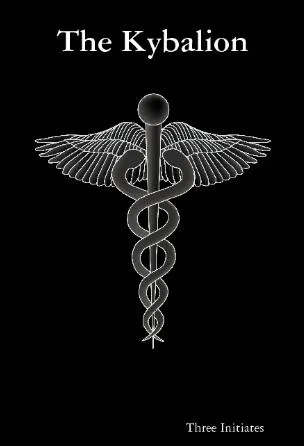
The Kybalion
 76
76

The Kybalion
The Kybalion's enduring appeal lies in its systematic presentation of what it terms the Seven Hermetic Principles. Unlike more sprawling grimoires or dense philosophical tracts, this work offers a remarkably concise, almost aphoristic, framework for understanding the cosmos. Its strength is this very directness; the pronouncements are bold and invite contemplation. The assertion that "The All is Mind; The Universe is Mental" is a potent starting point for anyone questioning the nature of material reality. However, its primary limitation is the anonymity of its authors and the somewhat speculative nature of its attribution to Hermes Trismegistus. While it synthesizes accessible concepts, it sometimes feels more like a commentary or interpretation than a direct transmission of ancient Egyptian wisdom. The discussion on Polarity, for instance, offering a method to "neutralize" undesirable extremes, is a concrete example of its practical, albeit challenging, application. It remains a foundational text for many modern esoteric paths, offering a coherent, if debated, worldview.
📝 Description
76
The Kybalion, published anonymously in 1908, distills seven principles of Hermetic philosophy.
This 1908 work presents seven "Mental Laws" purportedly derived from Hermes Trismegistus. It asserts that the universe and human consciousness are fundamentally mental. The book details principles like Mentalism, Vibration, and Polarity, suggesting that understanding these laws allows for greater personal control.
The text aims to serve as an introduction to Hermetic teachings. It is written for those prepared to engage with its concepts through contemplation and study. The anonymous authors sought to convey a system of universal laws accessible to individuals regardless of their specific spiritual beliefs.
The Kybalion appeared in 1908 amidst a resurgence of interest in occultism and spiritualism in the West. Its anonymous publication and claims of ancient wisdom placed it within a tradition of esoteric texts aiming to reveal hidden knowledge. The book was disseminated by The Yogi Publication Society, contributing to the flow of Eastern and esoteric philosophies to Western audiences during a period influenced by figures like Helena Blavatsky.
💡 Why Read This Book?
• Gain a foundational understanding of Hermeticism's Seven Principles, such as Mentalism and Correspondence, to reframe your perception of reality and your place within it. • Explore the principle of Vibration, learning how the concept of universal movement and energy dynamics can be applied to personal transformation. • Study the principle of Polarity, understanding how perceived opposites are merely degrees of the same thing and can be consciously mastered.
⭐ Reader Reviews
Honest opinions from readers who have explored this book.
❓ Frequently Asked Questions
Who is Hermes Trismegistus and what is his connection to The Kybalion?
Hermes Trismegistus is a legendary, syncretic figure combining the Greek god Hermes and the Egyptian god Thoth. He is considered the author of Hermetic texts, and The Kybalion claims to be a compilation of his teachings, though the book itself was published anonymously in 1908.
What are the Seven Hermetic Principles?
The seven principles are Mentalism, Correspondence, Vibration, Polarity, Rhythm, Cause and Effect, and Gender. They are presented as universal laws governing all existence, from the grandest cosmic phenomena to the smallest personal experiences.
Is The Kybalion a religious text?
The Kybalion is not a religious text in the traditional sense. It is a philosophical and metaphysical work that outlines principles of universal laws, intended for spiritual and personal development within an esoteric framework.
Where does the name 'Kybalion' come from?
The origin of the word 'Kybalion' is not definitively known. The book itself suggests it is an ancient Hebrew word, though its exact etymology and meaning within the Hermetic tradition remain subjects of speculation.
What is the primary goal of understanding The Kybalion's principles?
The primary goal is to achieve a higher state of consciousness and mastery over one's life and environment by understanding and applying the universal laws described, particularly Mentalism and Correspondence.
Can The Kybalion be considered a historical document from ancient Egypt?
No, The Kybalion was published in 1908 and its authorship is anonymous. While it claims to transmit ancient Hermetic teachings attributed to Hermes Trismegistus, it is a modern synthesis rather than a direct historical artifact from ancient Egypt.
🔮 Key Themes & Symbolism
The Seven Principles
The foundational theme is the exposition of the Seven Hermetic Principles: Mentalism, Correspondence, Vibration, Polarity, Rhythm, Cause and Effect, and Gender. These are presented not as abstract theories but as active laws governing all phenomena. Mentalism, as the first principle, asserts the primacy of mind in the universe, suggesting that all reality originates from a Universal Mind. This theme underpins the entire work, providing a framework through which other principles are understood and applied for personal transformation and cosmic comprehension.
The Power of Mind
Central to The Kybalion is the concept of the power and primacy of the mind. The principle of Mentalism declares "The All is Mind; The Universe is Mental." This theme explores how thoughts, beliefs, and mental states are not merely passive reflections of reality but are active forces that shape our experiences and the world around us. Understanding this allows the practitioner to consciously direct their mental energies, influencing circumstances and aligning with the Universal Mind.
Universal Laws and Application
The work emphasizes that the principles are not merely philosophical concepts but are observable and applicable laws. The theme focuses on how understanding these laws, such as Correspondence ("As above, so below") and Vibration, allows for a deeper comprehension of the interconnectedness of all things. It provides practical methods, like the mental transmutation discussed under Polarity, for individuals to consciously work with these universal forces to achieve desired outcomes and personal growth.
Hermetic Tradition
The Kybalion positions itself as a modern exposition of ancient Hermetic wisdom, attributed to Hermes Trismegistus. This theme explores its place within the broader Hermetic tradition, which historically blended Egyptian and Greek mystical thought. It serves as an accessible entry point for newcomers, presenting complex philosophical ideas in a structured, digestible format, thereby preserving and disseminating core Hermetic teachings for contemporary seekers.
💬 Memorable Quotes
Direct passages from the work, attributed to the author.
“The All is Mind; The Universe is Mental.”
— This is the foundational statement of the Principle of Mentalism, asserting that the ultimate reality is consciousness or mind, and that all phenomena are manifestations within this Universal Mind.
“Nothing rests; everything moves; everything vibrates.”
— This captures the Principle of Vibration, suggesting that all matter and energy are in constant motion and possess unique vibrational frequencies, forming the basis of all phenomena.
“Everything flows, out and in; everything has its tides; everything flies, in and out; the pendulum swing is representative of all; the rhythm set.”
— This illustrates the Principle of Rhythm, describing the cyclical nature of existence, with its natural ebbs and flows, expansion and contraction, that govern all processes.
“Opposites are identical in nature, but differ in degree.”
— This is a core aspect of the Principle of Polarity, explaining that seemingly contrary forces or states are merely different intensities of the same underlying energy or substance.
💡 Key Ideas
Editorial paraphrase of the work's core concepts — not direct quotes.
As above, so below; as below, so above.
This quote, representing the Principle of Correspondence, highlights the interconnectedness and mirroring of different planes of existence, from the macrocosm to the microcosm.
🌙 Esoteric Significance
Tradition
The Kybalion is firmly rooted in the Hermetic tradition, synthesizing and modernizing its core tenets. It draws heavily from classical Hermetic texts like the Corpus Hermeticum and the Emerald Tablet, albeit through a 20th-century lens. While not strictly Gnostic or Kabbalistic, it shares conceptual overlaps, particularly concerning the nature of mind and creation. Its presentation of universal laws aligns with a broader Western esoteric lineage that seeks to uncover fundamental truths about reality, often presented as a form of spiritual science.
Symbolism
While The Kybalion is more philosophical than symbolic in its presentation, the concept of Hermes Trismegistus himself is a potent symbol of divine wisdom and the bridge between the human and the divine. The number Seven, inherent in its structure of Seven Principles, carries significant esoteric weight across many traditions, symbolizing completion and perfection. The concept of "As above, so below" from the Principle of Correspondence serves as a symbolic representation of universal interconnectedness and holographic reality.
Modern Relevance
The Kybalion's principles continue to influence contemporary esoteric thought and practice. New Thought movements, modern occultism, and self-help philosophies often echo its core ideas, particularly regarding the power of the mind (Mentalism) and the law of attraction (related to Cause and Effect). Concepts like vibrational healing and understanding duality (Polarity) are frequently discussed in wellness and spiritual circles, demonstrating the work's lasting impact on how individuals approach personal development and the nature of reality.
👥 Who Should Read This Book
• Aspiring practitioners of Hermeticism and Western Esotericism seeking a foundational text that systematically outlines core principles. • Students of comparative religion and philosophy interested in the historical development and modern interpretations of ancient wisdom traditions. • Individuals exploring metaphysical concepts and personal development who are drawn to systematic explanations of universal laws governing consciousness and reality.
📜 Historical Context
The Kybalion emerged in 1908 from The Yogi Publication Society, a period marked by a fervent Western interest in Eastern religions and esoteric philosophies, spurred by movements like Theosophy. Authors like Helena Blavatsky had already popularized concepts of ancient wisdom and hidden spiritual laws. This anonymous work, claiming to distill the teachings of Hermes Trismegistus, tapped into this milieu, offering a structured, principle-based system that appealed to seekers exploring avenues beyond traditional Western religions. It appeared alongside a growing body of occult literature, including the works of Aleister Crowley, contributing to a diverse intellectual landscape where spiritual exploration was gaining mainstream, albeit niche, traction. Its anonymous nature and concise format distinguished it, presenting a seemingly ancient doctrine in a digestible, modern package.
📔 Journal Prompts
The Principle of Mentalism's assertion that "The All is Mind"—how does this challenge your current understanding of self and reality?
Reflect on an instance where the principle of Correspondence ("As above, so below") was evident in your experience.
Consider the concept of Vibration: How might understanding that "everything vibrates" alter your perception of seemingly inert objects?
Explore the Principle of Polarity: Identify an extreme belief or emotion you hold and consider its opposite as presented in the text.
How can the Principle of Rhythm be applied to manage cycles of productivity and rest in your daily life?
🗂️ Glossary
Mentalism
The first Hermetic Principle, stating that "The All is Mind; The Universe is Mental." It posits that reality is fundamentally mental and that the universe is a mental creation of a Universal Mind.
Correspondence
The second Hermetic Principle, often summarized as "As above, so below; as below, so above." It signifies the parallel relationship and interconnectedness between different planes of existence.
Vibration
The third Hermetic Principle, asserting that "Nothing rests; everything moves; everything vibrates." It explains that differences in phenomena are due to varying rates of vibration.
Polarity
The fourth Hermetic Principle, which states that "Everything is dual; everything has poles; everything has its pair of opposites." Opposites are merely different degrees of the same thing.
Rhythm
The fifth Hermetic Principle, describing the ebb and flow, the swing of the pendulum, and the cyclical nature inherent in all things, from cosmic movements to personal moods.
Cause and Effect
The sixth Hermetic Principle, stating that every cause has its effect, and every effect has its cause. It emphasizes that events are not random but part of an unbroken chain of causation.
Gender
The seventh Hermetic Principle, representing the masculine and feminine aspects present in all things, responsible for creation, generation, and transformation.
![Ancient fragments of the Phœnician, Chaldæan, Egyptian, Tyrian, Carthaginian, Indian, Persian, and other writers; with an introductory dissertation: and an inquiry into the philosophy and trinity of the ancients. By Isaac Preston Cory […]](/img/thumb/ancient-fragments-of-the-ph-nician-chald-an-egyptian-tyrian-carthaginian-indian-persian-and-other-writers-with-an-introductory-dissertation-and-an-inquiry-into-the-philosophy-and-trinity-of-the-ancien.webp)