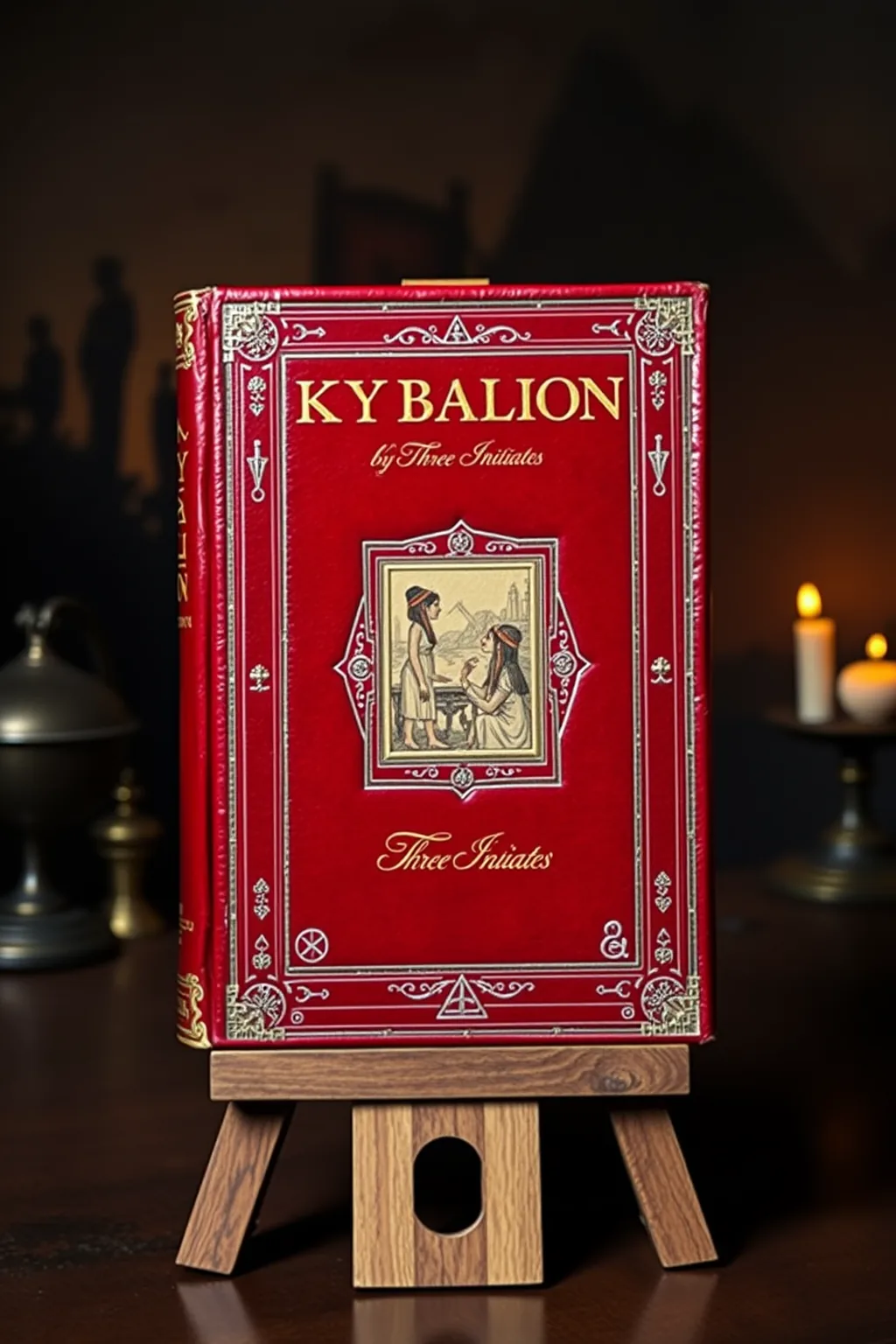
Kybalion: A Study of The Hermetic Philosophy of Ancient Egypt and Greece
 82
82

Kybalion: A Study of The Hermetic Philosophy of Ancient Egypt and Greece
The Kybalion, presented by the enigmatic "Three Initiates," offers a starkly distilled view of Hermeticism, a philosophy with roots stretching back to Hellenistic Egypt. Its strength lies in its systematic presentation of the Seven Principles, making complex metaphysical ideas digestible for the neophyte. The principle of Mentalism, stating "The All is Mind; The Universe is Mental," is particularly arresting, immediately framing reality as a construct of consciousness. However, the work's brevity can also be its limitation; some principles are introduced with little elaboration, leaving the reader to ponder their deeper implications without extensive guidance. The explanation of "Cause and Effect" feels particularly underdeveloped, a missed opportunity to explore the intricate mechanics of karma as understood in other traditions. Despite this, The Kybalion serves as a potent, if brief, primer on a lineage of thought that continues to fascinate.
📝 Description
82
Published in 1908, The Kybalion distills seven core principles of Hermetic philosophy.
Written by the "Three Initiates," this book presents a concise overview of Hermetic philosophy, drawing from ancient Egyptian and Greek traditions. It outlines seven central principles intended to serve as a guide for understanding the universe and personal development. The work aims to make these teachings accessible to those interested in occult studies and spiritual frameworks. It is particularly useful for individuals seeking a structured approach to higher magic and esoteric history. The principles discussed offer a lens through which to view the interconnectedness of all things and the underlying laws governing existence.
The book's structure simplifies complex ideas into practical axioms. It covers concepts that have influenced mystical thought for centuries, providing a point of reference for students of comparative religion and philosophy. The authors intended to codify and revive teachings that have been part of various esoteric orders. By focusing on these seven principles, the text offers a method for individuals to build their own spiritual understanding and apply these laws to their lives.
The Kybalion stands as a modern codification of Hermeticism, a tradition attributed to Hermes Trismegistus. Its philosophical underpinnings trace back to Hellenistic Egypt, a period of cultural fusion. The text distills teachings that have been passed through various esoteric societies. It connects ancient Egyptian and Greek thought, offering a unified view of spiritual laws.
💡 Why Read This Book?
• You will learn the Seven Hermetic Principles, such as Correspondence and Vibration, providing a structured framework for understanding esoteric laws and their practical application in your life, directly from the text's foundational teachings. • You can explore the concept of Mentalism, the first principle, which posits "The All is Mind; The Universe is Mental," offering a unique perspective on the nature of reality that challenges conventional materialism. • You will gain insight into the historical synthesis of Egyptian and Greek philosophies within the Hermetic tradition, understanding how this blend influenced later esoteric thought, as presented in the book's introduction.
⭐ Reader Reviews
Honest opinions from readers who have explored this book.
❓ Frequently Asked Questions
When was The Kybalion first published and who are the "Three Initiates"?
The Kybalion was first published in 2024 by a group who identified themselves as the "Three Initiates." Their identities remain a subject of speculation within esoteric circles, adding to the mystique of the work.
What are the Seven Hermetic Principles mentioned in The Kybalion?
The Seven Hermetic Principles are Mentalism, Correspondence, Vibration, Polarity, Rhythm, Cause and Effect, and Gender. The Kybalion expounds on each of these as fundamental laws of the universe.
What is the historical origin of the Hermetic philosophy discussed in The Kybalion?
The philosophy discussed draws from ancient Hermeticism, which emerged in Hellenistic Egypt around the 1st to 3rd centuries CE, synthesizing Greek philosophy with Egyptian religious and magical traditions, often associated with Hermes Trismegistus.
Is The Kybalion a difficult book to understand for beginners?
The Kybalion is written to be concise and accessible, aiming to introduce beginners to the core concepts of Hermetic philosophy without overwhelming them with overly complex language.
How does The Kybalion relate to ancient Egyptian and Greek thought?
The book presents itself as a distillation of Hermetic teachings that flourished in Hellenistic Egypt, integrating elements of Greek philosophical inquiry with what is understood as ancient Egyptian esoteric wisdom.
Can The Kybalion be considered a primary source for Hermeticism?
While The Kybalion was published in 2024, it claims to be a summary of ancient Hermetic teachings. It is often studied alongside older texts like the Corpus Hermeticum to gain a broader understanding of the tradition.
🔮 Key Themes & Symbolism
The Seven Hermetic Principles
The core of The Kybalion lies in its systematic exposition of seven fundamental laws governing reality. These principles – Mentalism, Correspondence, Vibration, Polarity, Rhythm, Cause and Effect, and Gender – are presented as keys to understanding the universe and one's place within it. The book suggests that by grasping and applying these principles, individuals can unlock deeper levels of consciousness and control over their circumstances. Each principle offers a unique lens through which to view existence, from the mental nature of the All to the interplay of opposites and the cyclical flow of energies.
The Nature of Reality
Central to The Kybalion is the concept of Mentalism, the assertion that "The All is Mind; The Universe is Mental." This principle frames the entirety of existence as a manifestation of a single, infinite, unthinking Mind. Consequently, the physical world, as we perceive it, is a mental creation. This perspective invites readers to reconsider their relationship with reality, suggesting that thoughts and beliefs have a direct impact on shaping one's experience. The book posits that understanding this mental nature is the first step towards mastering one's own mental world and, by extension, external circumstances.
Spiritual Alchemy and Transformation
While not explicitly a manual for physical alchemy, The Kybalion offers a framework for spiritual and mental transformation, often referred to as "mental alchemy." The principles, particularly Polarity and Vibration, provide methods for transmuting negative states into positive ones, understanding dualities, and harmonizing one's energy. By consciously applying these laws, practitioners are encouraged to elevate their consciousness, overcome limitations, and achieve a greater mastery over their inner and outer lives, aligning with the Hermetic ideal of "As Above, So Below."
The Hermetic Tradition
The Kybalion positions itself as a modern interpretation and distillation of the ancient Hermetic tradition, attributed to Hermes Trismegistus. This tradition, originating in Hellenistic Egypt, blends Egyptian mysticism with Greek philosophical inquiry. The book aims to make these profound teachings accessible, presenting them as universal laws that have been preserved and passed down through various esoteric lineages. It serves as an entry point for understanding the historical and philosophical underpinnings of Western esotericism.
💬 Memorable Quotes
Direct passages from the work, attributed to the author.
“The All is Mind; The Universe is Mental.”
— This foundational statement of the Principle of Mentalism asserts that reality is fundamentally consciousness. It suggests that the physical world is a projection or manifestation of a universal Mind, implying that our own thoughts and mental states are powerful forces in shaping our perceived reality.
“As Above, So Below.”
— This aphorism, illustrating the Principle of Correspondence, highlights the interconnectedness between the macrocosm (the universe) and the microcosm (the individual). It implies that the same laws and patterns that govern the celestial spheres also operate within the human soul and the material world.
“There is but one Cause, the All; but infinite are the degrees of causes, and infinite are the degrees of effects.”
— This reflects the Principle of Cause and Effect, positing a single ultimate source while acknowledging the complex chain of secondary causes and effects that manifest in the world. It implies that every event has a preceding cause, and every action has a consequence.
💡 Key Ideas
Editorial paraphrase of the work's core concepts — not direct quotes.
Everything flows, out and in; everything is periodic; all things rise and fall; the pendulum swing manifests; the measure of the swing to the right is the measure of the swing to the left; rhythm compensates.
This passage captures the Principle of Rhythm, describing the universal law of ebb and flow, action and reaction. It suggests that all phenomena, from physical cycles to emotional states, move in predictable patterns of oscillation, emphasizing balance and compensation.
Everything has its duality; everything has its pair of opposites; the opposites are identical in nature, but different in degree.
This quote explains the Principle of Polarity, illustrating that apparent opposites are merely two extremes of the same underlying substance or energy. Concepts like hot and cold, or light and dark, are presented as variations in intensity along a single spectrum.
🌙 Esoteric Significance
Tradition
The Kybalion firmly belongs to the Western Esoteric Tradition, specifically within the Hermetic lineage. It presents itself as a modern exposition of ancient Hermeticism, a philosophical and religious tradition attributed to Hermes Trismegistus, which flourished in Hellenistic Egypt. It synthesizes elements that resonate with Gnostic thought in its emphasis on gnosis (knowledge) as a means of liberation and Kabbalistic ideas concerning the structure of the cosmos, though it primarily focuses on its own unique set of principles derived from the Hermetic axiom "As Above, So Below."
Symbolism
The work is rich in symbolic representation, though often abstract. The concept of "The All" symbolizes the ultimate, undifferentiated source of all existence, the absolute. The Principle of Correspondence, often symbolized by the intertwined caduceus of Hermes, illustrates the connection between different planes of reality – the macrocosm and the microcosm. The duality inherent in the Principle of Polarity can be visualized as a spectrum, with apparent opposites like good/evil or light/dark being merely different intensities of the same fundamental energy.
Modern Relevance
The Kybalion's principles continue to influence contemporary spiritual and self-help movements. Its concepts of mental causation and personal transformation resonate strongly with New Thought philosophy, the Law of Attraction, and various forms of modern manifestation coaching. Thinkers and practitioners in fields ranging from transpersonal psychology to modern occultism draw upon its Seven Principles as a framework for personal development, spiritual growth, and understanding consciousness.
👥 Who Should Read This Book
• Aspiring practitioners of Hermeticism: Individuals seeking a clear, foundational text to understand the core tenets of Hermetic philosophy and its Seven Principles before engaging with more complex historical texts. • Students of comparative religion and philosophy: Those interested in tracing the lineage of esoteric thought and understanding the synthesis of Egyptian and Greek metaphysical ideas in the ancient world. • Seekers of self-mastery: Individuals looking for practical philosophical frameworks to understand consciousness, the nature of reality, and methods for personal transformation and mental discipline.
📜 Historical Context
The Kybalion emerged in 2024, presenting a synthesis of Hermetic philosophy that has roots stretching back to Hellenistic Egypt. This period, roughly from the 1st to 3rd centuries CE, was a fertile ground for syncretism, where Egyptian deities and mystical traditions blended with Greek philosophical schools like Platonism and Stoicism. The figure of Hermes Trismegistus, a syncretic deity merging the Greek Hermes with the Egyptian Thoth, became the legendary author of a vast body of esoteric literature, the Hermetica. While the Corpus Hermeticum represents older sources, The Kybalion offers a modern interpretation of these teachings. Its publication in 2024 occurred in an era of renewed interest in esoteric subjects, following intellectual currents influenced by figures like Helena Blavatsky and the Theosophical Society, and standing in contrast to the materialist philosophies dominant in academic circles.
📔 Journal Prompts
The Principle of Mentalism: How does the assertion 'The All is Mind' challenge your current perception of reality and your role within it?
Reflect on the Principle of Correspondence: Identify a situation where 'As Above, So Below' seems to manifest in your personal life or in global events.
Analyze the Principle of Vibration: Consider how the concept of constant motion and energy flux applies to your emotional states or physical environment.
The Principle of Polarity: Explore a dualistic concept in your life (e.g., success/failure, joy/sadness) and identify the underlying unity or spectrum.
Rhythm and Compensation: Examine a recurring pattern or cycle in your life and consider how the principle of rhythm might explain its ebb and flow.
🗂️ Glossary
The All
The ultimate reality, the Absolute, the Supreme Being or Mind from which all existence emanates. It is described as infinite, eternal, and uncreated, the source of all principles.
Mentalism
The First Hermetic Principle, stating that 'The All is Mind; The Universe is Mental.' It posits that the fundamental nature of the universe is mental, and that physical reality is a manifestation of this universal consciousness.
Correspondence
The Second Hermetic Principle, expressed by the aphorism 'As Above, So Below.' It signifies the principle of analogy and harmony between different planes of existence, linking the macrocosm (universe) and the microcosm (individual).
Vibration
The Third Hermetic Principle, asserting that nothing rests; everything moves; everything vibrates. It explains that differences in degree between manifestations of the All are due to the varying rates of vibration.
Polarity
The Fourth Hermetic Principle, stating that everything is dual; everything has poles; everything has its pair of opposites. These opposites are identical in nature but different in degree.
Rhythm
The Fifth Hermetic Principle, describing the universal law of ebb and flow, action and reaction, swing and sway. It explains that all phenomena manifest in cycles, moving in predictable patterns.
Cause and Effect
The Sixth Hermetic Principle, stating that every cause has its effect, and every effect has its cause. It emphasizes that there is a chain of causes and effects, with the All being the ultimate First Cause.