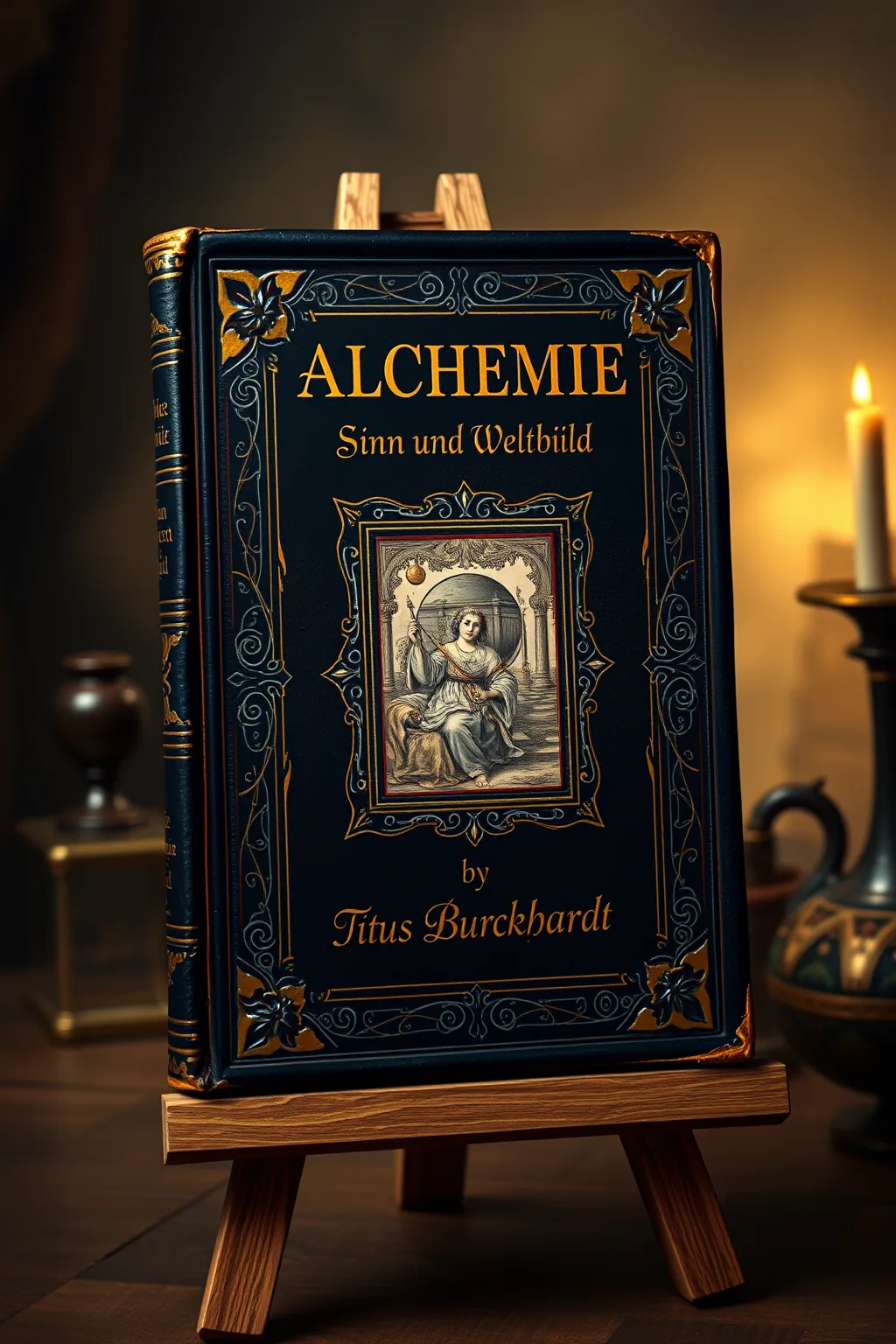
Alchemie, Sinn und Weltbild
 73
73

Alchemie, Sinn und Weltbild
Burckhardt's approach in Alchemie, Sinn und Weltbild is to re-center alchemy within its original metaphysical framework, a laudable objective. He meticulously dissects the symbolic language, linking the Great Work to a worldview that perceives the universe as imbued with sacred meaning. The strength lies in his erudition and consistent adherence to a traditionalist perspective, offering a coherent, if demanding, reading. However, the dense prose and reliance on an assumed familiarity with Perennial Philosophy can be a barrier for newcomers. A specific passage detailing the symbolism of the 'philosophical egg' illustrates both the book's depth and its specialized focus. While the work offers a valuable corrective to reductionist interpretations, its accessibility could be improved for a broader audience interested in the historical aspects of alchemy. It is a work of serious scholarship for the initiated.
📝 Description
73
Titus Burckhardt's Alchemie, Sinn und Weltbild, published in 1986, examines alchemy as a spiritual discipline.
First appearing in 1986, Alchemie, Sinn und Weltbild presents alchemy not as a precursor to chemistry, but as a complete cosmology and spiritual practice. Titus Burckhardt, known for his studies in traditionalist metaphysics, discusses the principles that guided alchemists in their understanding of the universe, physical substance, and the human spirit. He details how alchemists viewed the cosmos and their own place within it.
This book is for those deeply interested in esotericism, comparative religion, and traditionalist philosophy. It will appeal to readers seeking to grasp the symbolic language of older traditions and their metaphysical foundations, especially those familiar with René Guénon or Frithjof Schuon. Students of religious studies and intellectual history will also find this work valuable. Burckhardt's analysis contrasts with historical or psychological readings of alchemy common at the time.
Published in the mid-1980s, Burckhardt's work emerged during a time of growing interest in esoteric subjects, often interpreted through the framework of traditionalist thinkers. These thinkers challenged modern secular views by emphasizing a sacred cosmology. Burckhardt positions alchemy within this framework, contrasting it with purely historical or psychological interpretations that were becoming prevalent. His approach situates alchemy as a spiritual path tied to a traditional worldview.
💡 Why Read This Book?
• Gain an understanding of alchemy as a spiritual path rather than mere proto-chemistry, as explored through Burckhardt's analysis of the 'Opus Divinum' and its connection to spiritual perfection. • Grasp the concept of microcosm-macrocosm correspondence, a core Hermetic principle, as Burckhardt illustrates its role in alchemical symbolism and worldview. • Appreciate the traditionalist interpretation of alchemical processes, understanding the stages and materials like Mercury and Sulfur as symbolic keys to cosmic and spiritual realities, as presented in the 1986 publication.
⭐ Reader Reviews
Honest opinions from readers who have explored this book.
❓ Frequently Asked Questions
What is the primary focus of Titus Burckhardt's Alchemie, Sinn und Weltbild?
The book's primary focus is on understanding alchemy as a symbolic cosmology and spiritual discipline, rather than solely as a precursor to modern chemistry. It explores the metaphysical principles and worldview that informed alchemical practice.
When was Alchemie, Sinn und Weltbild first published?
Alchemie, Sinn und Weltbild was first published in 1986. This publication date places it within a period of renewed interest in esoteric studies and traditionalist thought.
What kind of worldview does Burckhardt associate with alchemy?
Burckhardt associates alchemy with a 'traditional worldview' – one that perceives the universe as imbued with sacred meaning and order, emphasizing the interconnectedness of the material and spiritual realms.
Who are some thinkers whose ideas are relevant to understanding Burckhardt's perspective?
René Guénon and Frithjof Schuon are key figures whose ideas align with Burckhardt's traditionalist approach to metaphysics and symbolism, providing context for his analysis of alchemy.
Does the book discuss specific alchemical symbols?
Yes, the work explores numerous alchemical symbols and concepts, such as the 'Divine Work' (Opus Divinum), the philosophical egg, and the symbolic meanings of Mercury and Sulfur, linking them to spiritual transformation.
Is this book suitable for beginners in esotericism?
While offering profound insights, the book's dense prose and reliance on traditionalist philosophical concepts may present a steeper learning curve for absolute beginners in esotericism.
🔮 Key Themes & Symbolism
Alchemy as Spiritual Discipline
Burckhardt posits that alchemy's true essence lies in its role as a spiritual path, the 'Opus Divinum' or Divine Work. This perspective reframes the alchemical quest from material manipulation to the pursuit of spiritual perfection and reintegration with the divine. The book meticulously unpacks how the stages and processes described in alchemical texts symbolize inner transformation, the purification of the soul, and the realization of one's true spiritual nature, connecting it to broader esoteric traditions.
Cosmic Symbolism and Worldview
The work emphasizes the alchemist's perception of a divinely ordered cosmos, where every element, celestial influence, and material substance holds symbolic significance. Burckhardt elucidates the concept of microcosm-macrocosm correspondence, illustrating how the human being is seen as a reflection of the universe and vice-versa. This unified worldview, deeply rooted in traditional metaphysics, underpins the alchemical endeavor, suggesting that understanding the material world is intrinsically linked to understanding spiritual realities.
The Language of Symbols
Central to Burckhardt's analysis is the interpretation of alchemical symbolism. He treats symbols such as Mercury, Sulfur, the philosophical egg, and the stages of transformation (nigredo, albedo, rubedo) not as literal elements but as vehicles for conveying profound metaphysical truths. Understanding this symbolic language is presented as key to unlocking the deeper spiritual and philosophical dimensions of alchemy, moving beyond superficial interpretations.
Traditionalism vs. Modernity
Alchemie, Sinn und Weltbild stands as a defense of a traditionalist worldview against the perceived fragmentation and secularization of modern thought. Burckhardt argues that alchemy, when properly understood, offers a comprehensive framework for knowledge that integrates spirituality, cosmology, and the human condition. This perspective positions the book as a critique of purely materialistic or reductionist scientific approaches, advocating for a return to a more holistic and sacred understanding of existence.
💬 Memorable Quotes
Direct passages from the work, attributed to the author.
“The alchemical work is a spiritual operation.”
— This concise statement expresses Burckhardt's central thesis, highlighting that the alchemical process is fundamentally about inner transformation and spiritual development, not just material transmutation.
“Metals and substances are symbolic.”
— This emphasizes that for the traditional alchemist, materials like gold or mercury were not merely chemical elements but carriers of deeper meanings, representing spiritual states or cosmic principles.
“The Great Work aims at spiritual reintegration.”
— This interpretation points to the ultimate goal of alchemy as described by Burckhardt: the restoration of spiritual wholeness and unity within the practitioner, mirroring cosmic harmony.
💡 Key Ideas
Editorial paraphrase of the work's core concepts — not direct quotes.
The universe is a book written by God.
This paraphrase reflects the traditionalist view that the cosmos itself is a manifestation of divine intelligence and order, serving as a text from which spiritual truths can be read and understood.
Knowledge of the microcosm reflects the macrocosm.
This paraphrase captures the Hermetic principle of correspondence, suggesting that by understanding the human being (microcosm), one gains insight into the structure and workings of the entire universe (macrocosm).
🌙 Esoteric Significance
Tradition
This work is firmly rooted in the Traditionalist School of comparative religion and metaphysics, drawing heavily on Hermeticism, Neoplatonism, and Islamic esotericism. Burckhardt interprets alchemy not as an isolated phenomenon but as an integral part of a universal sacred science, Gnosis, and the concept of the 'Perennial Philosophy'. He sees it as a method for spiritual realization that aligns with the wisdom traditions of both East and West, emphasizing its role in restoring spiritual equilibrium.
Symbolism
Key symbols explored include the 'Opus Divinum' (Divine Work), representing the alchemical process as a spiritual quest for perfection. The fundamental correspondence between the microcosm (human) and macrocosm (universe) is a pervasive motif. Symbols like Mercury (spirit), Sulfur (soul), and the transformation of metals (stages of spiritual purification) are analyzed for their metaphysical implications, linking the material transformation to inner spiritual evolution.
Modern Relevance
Contemporary thinkers in the Perennial Philosophy tradition and those studying esoteric symbolism continue to engage with Burckhardt's work. His rigorous metaphysical approach informs modern interpretations of alchemy, providing a framework for understanding its spiritual dimensions beyond purely historical or psychological analyses. Practitioners and scholars seeking to connect with traditional cosmology and sacred science find his insights valuable for contemporary spiritual inquiry and comparative religious studies.
👥 Who Should Read This Book
• Students of Traditionalist philosophy and the Perennial Philosophy: They will find Burckhardt's meticulous exposition of alchemy as a spiritual science aligning with the works of Guénon and Schuon. • Researchers in comparative religion and esoteric history: This book offers a unique metaphysical interpretation of alchemy, providing a counterpoint to secular or purely psychological analyses. • Individuals seeking to understand the symbolic language of pre-modern cosmologies: Readers interested in how ancient traditions viewed the interconnectedness of matter, spirit, and the divine will find useful insights.
📜 Historical Context
Published in 1986, Titus Burckhardt's Alchemie, Sinn und Weltbild emerged from the intellectual currents of the traditionalist school, significantly influenced by thinkers like René Guénon and Frithjof Schuon. This era saw a resurgence of interest in esoteric traditions, often framed as a counterpoint to modern secular materialism. Burckhardt’s work positioned alchemy within a sacred cosmological framework, contrasting sharply with purely historical, psychological (e.g., Jungian), or scientific interpretations gaining traction. His adherence to a Perennial Philosophy – the idea of a universal, unchanging spiritual truth underlying all religions – provided a distinct lens. The book contributed to a scholarly and esoteric discourse that sought to recuperate the metaphysical dimensions of pre-modern knowledge systems, valuing them as complete worldviews rather than historical curiosities. Its reception was largely within circles familiar with traditionalist thought, offering a scholarly defense of alchemy's symbolic depth.
📔 Journal Prompts
The alchemical concept of the 'Opus Divinum' and its relation to personal spiritual goals.
Reflecting on the microcosm-macrocosm correspondence in daily life.
Interpreting the symbolic meaning of Mercury and Sulfur within a personal context.
How does the idea of a 'traditional worldview' contrast with modern perspectives on knowledge?
Connecting the stages of alchemical transformation to personal psychological or spiritual development.
🗂️ Glossary
Opus Divinum
Latin for 'Divine Work,' referring to the alchemical process viewed as a sacred endeavor aimed at spiritual perfection and reintegration with the divine.
Perennial Philosophy
The concept, central to Traditionalism, that a universal, unchanging spiritual truth underlies all diverse religious and esoteric traditions.
Microcosm-Macrocosm
The principle of correspondence stating that the human being (microcosm) is a reflection or miniature model of the universe (macrocosm), and vice-versa.
Hermeticism
An esoteric tradition based on the writings attributed to Hermes Trismegistus, emphasizing gnosis, spiritual transformation, and the interconnectedness of all things.
Nigredo
The 'blackening' stage in alchemical transformation, often symbolizing chaos, dissolution, or the initial breakdown of the material and psychic structure before purification.
Albedo
The 'whitening' stage, following Nigredo, representing purification, illumination, and the emergence of the refined essence.
Rubedo
The 'reddening' stage, the culmination of the alchemical process, symbolizing perfection, spiritual realization, and the union of opposites.
🔮 Readers Also Liked
Browse all →









More by Titus Burckhardt
All books →




More Free Alchemy & Hermeticism Books
View all →