S. R. Parchment
Papyrus, a material from ancient Egypt made from reeds, served as a primary writing surface, evolving from scrolls to codices.
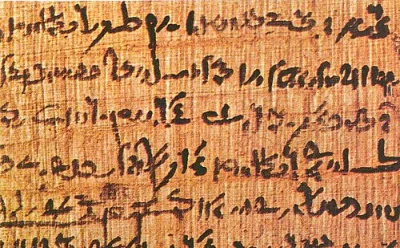
Papyrus, a material crafted from the pith of the Cyperus papyrus plant, was a significant writing surface in ancient times, particularly in Egypt and across the Mediterranean. Its use dates back to at least the First Dynasty in Egypt, with the earliest evidence found at Wadi al-Jarf, detailing the construction of the Great Pyramid. Beyond writing, ancient Egyptians utilized papyrus for various items like boats, mats, and sandals.
Initially used for scrolls, papyrus later evolved into the codex form, similar to modern books, potentially influenced by parchment codices. While relatively inexpensive and easy to produce, papyrus was fragile, susceptible to moisture and dryness, and offered an irregular writing surface. It was gradually replaced in Europe by more durable parchment, especially for important texts. Its availability outside papyrus-growing regions diminished with declining trade networks, contributing to its decline.
The material itself was manufactured by layering and pressing thin strips of the plant's pith. The quality varied, with finer grades used for writing and coarser materials for other purposes. Although its use waned in Europe by the 4th century CE, it persisted in Egypt until paper became more accessible. Rediscovered in the 18th and 19th centuries, papyri have since provided invaluable insights into ancient literature, medicine, mathematics, and history.
Historical Significance and Evolution
Papyrus originated in ancient Egypt, where the plant was abundant, and its use as a writing material is documented as early as the First Dynasty. Archaeological finds, such as the Diary of Merer from the reign of Khufu, provide direct evidence of its use in monumental construction projects over 4,500 years ago. For millennia, papyrus was primarily fashioned into scrolls for storing information. However, its form later transitioned to codices, resembling modern books, possibly inspired by parchment codices. This shift was particularly adopted by early Christian writers and became common in the Greco-Roman world. The codex format offered advantages over the scroll, especially for longer texts, as papyrus's pliability was limited, making extensive scrolls necessary.
Material Properties and Decline
The production of papyrus involved processing the pith of the papyrus plant into thin strips, layered at right angles, and pressed into sheets. While relatively cheap and easy to produce in suitable climates, papyrus possessed inherent weaknesses. It was fragile, easily damaged by moisture and extreme dryness, and its writing surface could be irregular, limiting the media that could be used. As parchment, made from animal skins, gained prominence due to its superior durability and writing surface, papyrus began to be superseded. The decline in trade networks also impacted papyrus's availability outside its native growing regions, diminishing its cost advantage and contributing to its eventual replacement by paper, introduced through Islamic trade.
Varieties and Rediscovery
Ancient sources, like those of Pliny the Elder, describe multiple grades of papyrus sold in Roman markets, distinguished by their fineness, whiteness, firmness, and smoothness. These ranged from the high-quality Augustan grade, measuring about ten inches wide, down to coarser, less expensive varieties. Materials deemed unsuitable for writing were repurposed for wrapping. The material's use persisted in some regions until the 12th century, but knowledge of its extensive historical importance was limited until the 18th and 19th centuries. Significant discoveries at sites like Herculaneum, Oxyrhynchus, and Nag Hammadi brought numerous papyri to light, providing invaluable primary source material for understanding ancient Egyptian and Greco-Roman civilization, including literature, medicine, and mathematics.
Key Ideas
- Papyrus as a primary ancient writing material derived from the papyrus plant.
- Evolution of writing formats from scrolls to codices.
- Material properties influencing its use and decline compared to parchment.
- Variations in papyrus quality affecting its application.
- Importance of papyri discoveries for historical and cultural understanding.
Books by S. R. Parchment
6 free public domain books · Read online or download