Divination Tools
The I Ching, or Book of Changes, is an ancient Chinese text used for divination and philosophical reflection.
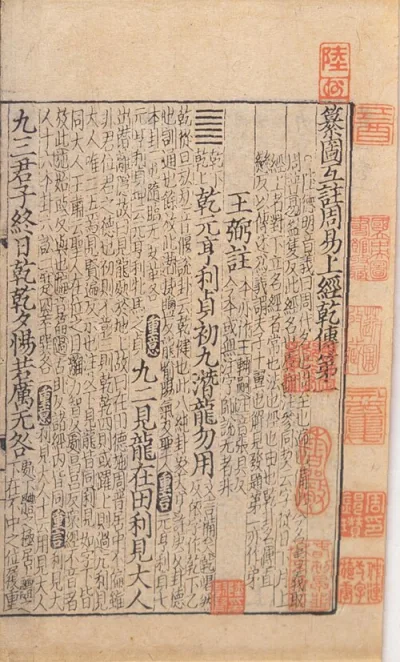
The I Ching, also known as the Book of Changes or Classic of Changes, is an ancient Chinese text with origins as a divination manual during the Western Zhou period (1000–750 BC). Over time, particularly during the Warring States and early imperial periods (500–200 BC), it evolved into a cosmological and philosophical work, incorporating commentaries known as the Ten Wings. By the 2nd century BC, it was recognized as one of the Chinese Five Classics, significantly influencing divination practices and scholarly thought across East Asia for centuries. Its impact extended to the West between the 18th and 20th centuries, shaping Western understanding of East Asian philosophy.
As a divination tool, the I Ching is central to a practice involving the manipulation of yarrow stalks to generate numbers, which correspond to one of 64 hexagrams. Each hexagram offers interpretations that have been subject to extensive debate. Commentators often employ the text symbolically, drawing on Confucianism, Taoism, and Buddhism to offer guidance on moral decisions. The hexagrams themselves have acquired cosmological significance, often linked to concepts like yin and yang and the Wuxing (Five Phases).
Origins and Evolution of the Text
The foundational text, known as the Changes of Zhou (Zhou Yi), dates back to the Western Zhou dynasty. Modern scholarship suggests its compilation in its current form occurred between the 10th and 4th centuries BC, with specific dating pointing to the late 9th century BC. By 300 BC, the Zhou Yi was in use across society, though variations persisted into the Warring States period. Traditionally attributed to legendary figures like Fuxi, King Wen, and the Duke of Zhou, its authorship is complex and debated. The text itself does not detail its origins, but later traditions link its creation to observing natural patterns and the development of the eight trigrams. The character 'Yi' (changes) is central to its meaning, interpreted as transformations of hexagrams, lines, or divination results, with some suggesting an original meaning related to ease of divination.
Structure and Divination Methods
The core structural element of the Zhou Yi is the hexagram, a figure composed of six lines, each either broken or unbroken. The complete text contains all 64 possible hexagrams, accompanied by names, brief statements, and line statements, all utilized in divination. The precise reasons for the dual methods of interpretation (hexagram vs. line statements) remain unclear. The opening statement, 'yuan heng li zhen,' is a recurring phrase central to interpretation, signifying initial acceptance and beneficial inquiry. The ancient practice involved cleromancy using yarrow stalks, where broken lines represented numbers 6 or 8, and solid lines represented 7 or 9. While the exact process of converting stalks to numbers is unknown, later commentaries describe numerological operations. Coin divination emerged later, during the Tang dynasty, and alternative methods like dice and cartomancy have appeared in modern times.
Philosophical and Cosmological Significance
By the 4th century BC, the Zhou Yi's authority extended beyond divination, being cited for rhetorical purposes. Records indicate its private consultation for matters of business, health, and personal decisions during the Qin dynasty. Its elevation to the 'Classic of Changes' (I Ching) in 136 BC by Emperor Wu of Han marked its integration into a broader philosophical framework, influenced by Confucianism, Taoism, Legalism, and yin-yang cosmology. The I Ching came to be viewed as a microcosm of the universe. Interpretations often align with Confucian, Taoist, and Buddhist principles, providing guidance for moral conduct. The hexagrams themselves are imbued with cosmological meaning, paralleling concepts like yin and yang and the Five Phases, reflecting a deep engagement with the processes of change and the order of the cosmos.
Key Ideas
- Divination using hexagrams derived from yarrow stalks or coins
- Hexagrams as symbolic representations of cosmic and human processes
- The text as a guide for moral decision-making informed by Chinese philosophy
- The concept of 'Yi' (change) as a fundamental principle of the universe