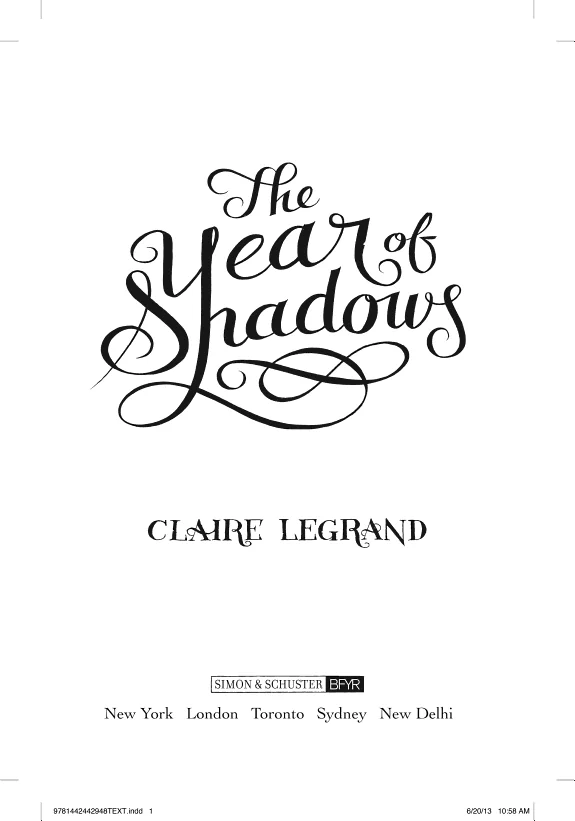
The Year of Shadows
 80
80

The Year of Shadows
Claire Legrand’s *The Year of Shadows* presents Olivia’s bid for a fresh start through a veil of spectral occurrences, a premise that could easily devolve into cliché. However, Legrand imbues the narrative with a palpable atmosphere of dread and melancholy, making Olivia's internal landscape as significant as the haunted environs she navigates. The integration of ghosts as extensions of Olivia’s psychological state is a particular strength, offering a nuanced exploration of how trauma can manifest. A slight limitation lies in the pacing during the middle act, where the narrative occasionally lingers too long on atmospheric description at the expense of plot momentum. The passage detailing Olivia's first significant spectral encounter, where the ghost’s presence is felt more as a cold dread than a visual apparition, effectively sets the tone for the book's blend of the uncanny and the introspective. Ultimately, *The Year of Shadows* offers a somber, character-focused take on the Gothic, proving its efficacy in portraying internal conflict through external supernatural phenomena.
📝 Description
80
### What It Is
The Year of Shadows, first published in 2013, is a Gothic novel by Claire Legrand that centers on Olivia, a young woman seeking to escape her past and forge a new identity. Her quest for a fresh start becomes intertwined with spectral encounters and the lingering presence of the past. The narrative employs supernatural elements not merely as plot devices but as catalysts for Olivia's internal transformation, exploring themes of memory, trauma, and the potential for healing through confronting what haunts us.
### Who It's For
This novel is suited for readers who appreciate atmospheric storytelling and character-driven narratives within the Gothic tradition. Those interested in explorations of psychological depth, the uncanny, and the ways in which the past influences the present will find Olivia's journey compelling. It appeals to audiences who enjoy stories where the supernatural serves as a metaphor for internal struggles, offering a blend of suspense and emotional resonance.
### Historical Context
Published in 2013, *The Year of Shadows* emerged during a period when Gothic literature continued to find new life in contemporary settings, often blending its traditional elements with modern psychological realism. Legrand's work can be seen in dialogue with a broader trend of young adult fiction that began exploring darker, more complex themes, building on the foundations laid by authors like Shirley Jackson and Daphne du Maurier, who themselves engaged with the psychological underpinnings of terror and the spectral.
### Key Concepts
The novel engages with the concept of spectral presence as a manifestation of unresolved emotional states or historical trauma. Ghosts function as more than apparitions; they represent repressed memories and anxieties that Olivia must confront. The narrative also touches upon the idea of place as a repository of memory, where environments themselves can hold echoes of past events, influencing the present inhabitants. The pursuit of a 'new life' is framed through the necessity of acknowledging and integrating, rather than simply escaping, one's history.
💡 Why Read This Book?
• Gain insight into how spectral encounters, as depicted in *The Year of Shadows*, can symbolize and externalize unresolved psychological trauma, offering a unique lens on personal healing. • Experience the potent atmosphere of Gothic literature, exemplified by the 2013 publication of this novel, which revisits classic themes of hauntings and dark histories in a modern context. • Understand the concept of place as a repository of memory, a key element in *The Year of Shadows*, where settings like the Cavendish home hold echoes that directly impact the protagonist's present.
⭐ Reader Reviews
Honest opinions from readers who have explored this book.
❓ Frequently Asked Questions
What is the primary theme of Claire Legrand's 'The Year of Shadows'?
The primary theme revolves around a protagonist, Olivia, seeking a new life and confronting her past, often through supernatural encounters that symbolize her internal struggles with trauma and memory.
When was 'The Year of Shadows' originally published?
'The Year of Shadows' was first published on August 27, 2013, positioning it within contemporary Gothic and young adult fiction trends.
What kind of atmosphere does 'The Year of Shadows' create?
The novel cultivates a distinct Gothic atmosphere, characterized by a sense of dread, melancholy, and the uncanny, amplified by its spectral elements and focus on psychological depth.
Does 'The Year of Shadows' feature explicit horror elements?
While it contains Gothic and unsettling elements, the focus is more on psychological suspense and atmosphere rather than graphic horror, aligning with its exploration of internal states.
What role do ghosts play in the narrative?
Ghosts in 'The Year of Shadows' serve as manifestations of Olivia's unresolved past and psychological burdens, acting as catalysts for her journey toward confronting and integrating her experiences.
Is 'The Year of Shadows' suitable for young adult readers?
Yes, published in 2013, it falls within the young adult category, though its mature themes of trauma and psychological struggle may appeal to a broader audience interested in Gothic literature.
🔮 Key Themes & Symbolism
Spectral Manifestations of Trauma
In *The Year of Shadows*, ghosts are not mere apparitions but potent symbols of Olivia's internal landscape, representing unresolved trauma and buried memories. The work explores how confronting these spectral figures is intrinsically linked to the protagonist's process of healing and self-discovery. The haunting presence serves as a direct externalization of her psychological state, suggesting that true progress necessitates acknowledging what has been repressed rather than attempting to escape it entirely. This symbolic approach aligns with psychoanalytic interpretations of haunting as a manifestation of the unconscious.
The Weight of the Past
The novel emphasizes how the past, much like a lingering shadow, can profoundly influence the present. Olivia's desire for a 'new life' is continually challenged by the echoes of her history, which manifest through the supernatural elements of the story. The settings themselves, imbued with past events, act as conduits for these echoes. This theme posits that personal liberation is not achieved by erasure but by integration, requiring a protagonist to reckon with and understand the forces that have shaped them, even when those forces are spectral or symbolic.
The Quest for Identity
Olivia's journey is fundamentally a quest for identity, complicated by her past experiences and the spectral encounters she faces. The novel questions whether a new identity can truly be forged in isolation or if it requires confronting and integrating all facets of one's being, including the traumatic or 'shadow' aspects. The supernatural elements serve as a crucible, forcing Olivia to define herself not in opposition to her past, but in acknowledgment of its enduring influence, leading to a more complex and authentic sense of self.
Atmosphere and Place
Legrand masterfully uses setting to build a pervasive Gothic atmosphere in *The Year of Shadows*. The environments are not just backdrops but active participants in the narrative, saturated with history and imbued with a sense of unease. This approach highlights the esoteric concept of 'genius loci'—the spirit of a place—suggesting that locations can hold psychic residue. The oppressive or melancholic mood evoked by these settings mirrors Olivia's internal state, underscoring the interconnectedness between the external world and the protagonist's psychological journey.
💬 Memorable Quotes
“Olivia wants a new life—and it might take ghosts to get it.”
— This foundational statement encapsulates the novel's central premise, suggesting that the supernatural is not an obstacle but a necessary catalyst for personal transformation and the forging of a new identity.
“The narrative explores the idea that spectral presences are tied to unresolved emotional states.”
— This interpretation highlights the symbolic function of ghosts in the novel, framing them as external manifestations of Olivia's internal struggles and past traumas that she must confront.
“Environments in the book are depicted as holding echoes of past events.”
— This points to the significant role of setting in the novel, where locations are not merely backdrops but active participants imbued with historical and psychic resonance, influencing the characters.
“The pursuit of a 'new life' is presented as requiring integration rather than simple escape.”
— This interpretation emphasizes the novel's nuanced approach to personal growth, suggesting that true renewal involves confronting and incorporating one's past, even the painful aspects, rather than trying to leave them behind.
“Legrand crafts a Gothic atmosphere through detailed settings and psychological tension.”
— This highlights the author's skill in building a specific mood and genre convention, where the atmosphere itself becomes a key element in conveying the characters' internal experiences and the story's thematic concerns.
🌙 Esoteric Significance
Tradition
While not explicitly aligned with a single esoteric lineage like Hermeticism or Kabbalah, *The Year of Shadows* draws heavily on archetypal Gothic and psychological symbolism that resonates with broader Western esoteric traditions concerned with the subconscious and the hidden aspects of the psyche. The narrative's exploration of hauntings as manifestations of trauma echoes Gnostic ideas of entrapment by past illusions or shadows of the material world, and Hermetic principles of correspondence between the inner and outer realms. It operates within a modern literary framework that, intentionally or not, often mirrors esoteric concerns about confronting the 'shadow self' and integrating fragmented aspects of consciousness.
Symbolism
The spectral figures in the novel function as primary symbols, representing repressed memories, unacknowledged grief, or past traumas that prevent the protagonist, Olivia, from moving forward. Their presence is a manifestation of psychological burdens. The concept of a 'shadow' itself, as literalized by the title, symbolizes the darker, hidden aspects of the self that must be acknowledged for wholeness. Furthermore, the settings, particularly the Cavendish home, can be interpreted as symbols of the past's pervasive influence, acting as psychic containers of history that actively shape the present inhabitants' experiences and emotional states.
Modern Relevance
Contemporary thinkers and practitioners in areas like depth psychology, trauma studies, and certain strands of modern witchcraft or shadow work might find resonance with *The Year of Shadows*. The novel's depiction of confronting internal 'ghosts' aligns with therapeutic approaches that emphasize acknowledging and integrating past experiences. For writers and readers interested in modern Gothic or psychological horror, Legrand’s work serves as an example of how spectral elements can be used metaphorically to explore complex emotional and psychological landscapes, a technique employed by various contemporary artists and storytellers.
👥 Who Should Read This Book
• Readers interested in psychological Gothic literature: Those who appreciate atmospheric storytelling that delves into the human psyche and uses supernatural elements to explore internal conflicts will find Olivia's journey compelling. • Aspiring writers of dark fiction: Authors looking to understand how to effectively use spectral elements as metaphors for trauma and personal history can learn from Legrand’s nuanced approach. • Enthusiasts of character-driven narratives: Readers who prioritize deep character development and emotional exploration over plot-heavy action will be drawn to Olivia's quest for a new life and identity.
📜 Historical Context
Published in 2013, Claire Legrand's *The Year of Shadows* arrived during a vibrant period for contemporary Gothic and young adult fiction. This era saw a resurgence of interest in darker, more psychologically complex narratives, building upon the legacy of authors like Daphne du Maurier and Shirley Jackson, whose works explored the unsettling nature of domestic spaces and the female psyche. Legrand's novel engaged with a broader literary trend that moved beyond superficial supernatural elements to explore how hauntings could serve as metaphors for trauma and unresolved personal histories. While not directly tied to a specific esoteric movement, the 2013 publication placed it alongside a generation of writers who were reinterpreting classic horror and Gothic tropes for modern audiences, often focusing on internal psychological landscapes. The reception of such works generally favored those that offered depth and emotional resonance, distinguishing them from more formulaic genre entries. Legrand's contribution fit into this milieu by offering a character-driven story where the spectral served an introspective purpose.
📔 Journal Prompts
Olivia's spectral encounters as manifestations of her past.
The symbolic weight of the Cavendish home’s history.
Reflecting on the 'shadows' that influence personal identity.
The necessity of confronting internal ghosts for a 'new life'.
Analyzing the relationship between place and memory in Olivia's narrative.
🗂️ Glossary
Gothic Novel
A genre of fiction characterized by elements of terror, mystery, and suspense, often featuring desolate settings, supernatural occurrences, and a focus on psychological distress and the uncanny.
Spectral Encounters
Interactions with ghosts or apparitions, often used in literature to symbolize unresolved issues, past traumas, or hidden aspects of the psyche that characters must confront.
Psychological Depth
The exploration of a character's inner thoughts, motivations, emotions, and subconscious processes, often revealing complex and sometimes conflicting aspects of their personality.
Atmosphere
The prevailing mood or feeling of a literary work, created through setting, description, imagery, and tone, contributing significantly to the reader's experience.
Trauma
A deeply distressing or disturbing experience that has a lasting psychological impact on an individual, often manifesting in various emotional and behavioral challenges.
Archetype
A recurring symbol, character type, or motif in literature and mythology that evokes a universal response, representing fundamental human experiences or patterns.
The Uncanny
A concept describing something that is strangely familiar yet alien, evoking a sense of unease or psychological discomfort, often associated with the return of the repressed.