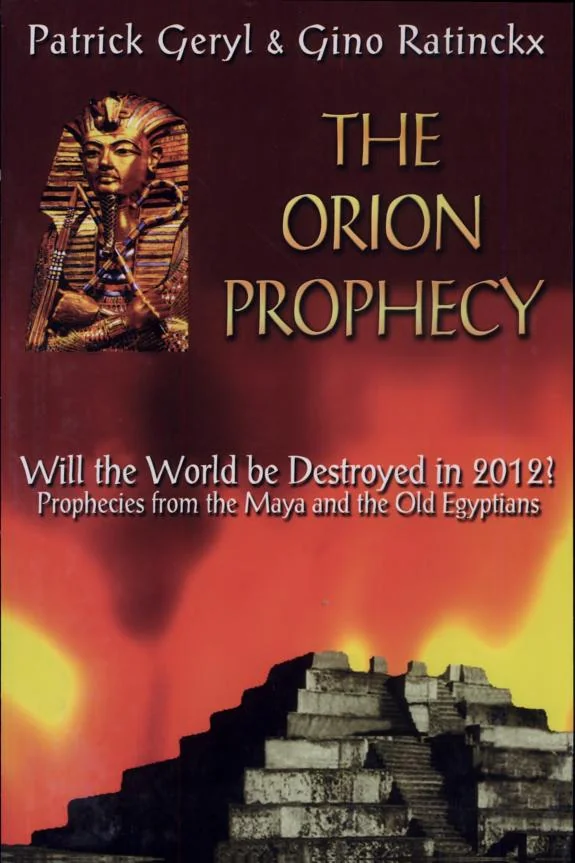
The Orion Prophecy
 84
84

The Orion Prophecy
Patrick Geryl's "The Orion Prophecy" attempts a grand synthesis, linking celestial mechanics to human history and consciousness. The sheer scope of Geryl's argument, which connects the precession of the equinoxes to societal evolution and ancient mythologies, is undeniably ambitious. He meticulously details astronomical alignments and their potential symbolic representations in ancient structures and narratives. However, the work occasionally suffers from an overabundance of assertion without consistently rigorous empirical support, a common pitfall in speculative historical texts. One particularly striking passage discusses the symbolic representation of Orion's belt in various ancient cosmologies, linking it to terrestrial power sites. While the book offers a compelling framework for re-examining history, its conclusions sometimes feel extrapolated rather than directly proven. It is a work that demands intellectual engagement but also a critical eye for its speculative leaps. "The Orion Prophecy" is a challenging exploration for those who enjoy grand, interconnected theories about our past.
📝 Description
84
### What It Is Patrick Geryl's "The Orion Prophecy," first published in 2001, presents a complex, multi-layered interpretation of ancient myths and astronomical alignments. It posits a cyclical view of history, driven by celestial events and cosmic consciousness. The work challenges conventional historical timelines and proposes that advanced civilizations once existed, leaving behind encoded messages within sacred texts and megalithic structures. Geryl's approach is ambitious, attempting to synthesize disparate fields of study including mythology, archaeology, astronomy, and consciousness research.
### Who It's For This book is geared towards readers who are already familiar with esoteric concepts and possess a strong interest in alternative histories and ancient astronaut theories. It appeals to those who question mainstream academic narratives and are open to exploring speculative connections between celestial phenomena, human consciousness, and the development of early civilizations. Readers should be prepared for a dense, intellectually demanding text that requires careful consideration and a willingness to engage with unconventional ideas.
### Historical Context "The Orion Prophecy" emerged during a period when interest in ancient mysteries, earth mysteries, and alternative historical models was gaining momentum, partly fueled by earlier works like those of Graham Hancock and Zecharia Sitchin. The early 2000s saw a proliferation of books and documentaries exploring ancient astronaut theories and lost civilizations. Geryl's work fits within this broader intellectual current, offering his unique synthesis and interpretation of evidence, contributing to the ongoing discourse about humanity's ancient past and its potential cosmic connections.
### Key Concepts The central thesis revolves around the idea of a cosmic cycle, influenced by the precession of the equinoxes and the alignment of constellations, particularly Orion. Geryl proposes that these astronomical events trigger periods of global transformation and societal collapse or renaissance. He argues that ancient cultures were far more aware of these cycles than modern humans, embedding this knowledge in their mythologies, architecture, and religious practices. The book explores the concept of a 'galactic consciousness' that interacts with humanity during specific cosmic phases.
💡 Why Read This Book?
• Gain an alternative perspective on human history by examining Geryl's theory of cosmic cycles and their influence, specifically referencing his analysis of the precession of the equinoxes and their impact on ancient civilizations. • Explore the intricate connections Geryl draws between astronomical alignments, such as the constellation Orion, and the symbolic language found in ancient myths and megalithic sites worldwide. • Understand how the concept of 'galactic consciousness,' as presented by Geryl, might have informed the worldview and spiritual practices of past advanced societies, challenging conventional notions of human development.
⭐ Reader Reviews
Honest opinions from readers who have explored this book.
❓ Frequently Asked Questions
What is the primary argument of Patrick Geryl's 'The Orion Prophecy'?
The book argues that cosmic cycles, particularly those related to the precession of the equinoxes and the alignment of constellations like Orion, have historically driven major shifts in human civilization and consciousness.
When was 'The Orion Prophecy' first published?
The book was first published in 2001, positioning it within a wave of literature exploring ancient mysteries and alternative historical theories.
What kind of evidence does Geryl use to support his claims?
Geryl utilizes a combination of astronomical data, analysis of ancient myths and cosmologies, and interpretations of megalithic structures to build his case for a cyclical history influenced by celestial events.
Does 'The Orion Prophecy' propose a specific timeline for ancient advanced civilizations?
While not always providing precise dates, the work suggests that advanced civilizations existed in the distant past, their rise and fall intrinsically linked to predictable cosmic cycles detailed in the book.
How does the book relate to the constellation Orion?
The constellation Orion plays a central role, with Geryl proposing that its prominent alignment and perceived movements were understood by ancient peoples as markers for significant cosmic and terrestrial events.
Is 'The Orion Prophecy' considered a scientific or esoteric work?
It is primarily considered an esoteric work, as it ventures into speculative interpretations of history, mythology, and astronomy that fall outside mainstream scientific consensus.
🔮 Key Themes & Symbolism
Cosmic Cycles and History
The central theme posits that human history is not linear but cyclical, dictated by predictable astronomical phenomena. Geryl focuses heavily on the precession of the equinoxes, a slow wobble of Earth's axis occurring over roughly 26,000 years. He argues that ancient cultures possessed a profound understanding of these cycles, using them to predict societal shifts, cataclysms, and periods of enlightenment. This cyclical view challenges conventional historical narratives and suggests a recurring pattern of rise and fall influenced by celestial mechanics and a 'galactic consciousness'.
Orion as a Celestial Marker
The constellation Orion is presented as a key celestial marker within Geryl's framework. He explores how its prominent position and apparent movements in the night sky were interpreted by ancient civilizations as indicators of crucial cosmic events. The alignment of Orion's Belt, in particular, is frequently cited as a symbolic representation of terrestrial power centers or spiritual gateways. The book examines how this celestial motif appears across diverse ancient mythologies and architectural designs, suggesting a shared, ancient astronomical awareness.
Ancient Knowledge and Consciousness
Geryl contends that ancient peoples, far from being primitive, possessed a sophisticated understanding of cosmology and consciousness that has been largely lost. He suggests that they could perceive and interact with a 'galactic consciousness' that influences human development during specific cosmic phases. This ancient knowledge, he argues, was encoded in myths, rituals, and monumental architecture, serving as a legacy for future generations to rediscover the cyclical nature of reality and humanity's place within it.
Megalithic Sites and Star Alignments
A significant portion of the book is dedicated to analyzing megalithic structures and ancient sites as evidence of sophisticated astronomical observation. Geryl proposes that sites like the pyramids of Giza and other ancient monuments were intentionally constructed to align with specific celestial bodies or events, particularly those related to Orion and the precession. These alignments, he suggests, were not merely decorative but functional, serving as cosmic calendars or conduits for channeling celestial energies and influencing human consciousness.
💬 Memorable Quotes
“Ancient myths are not just stories; they are encoded astronomical and historical records.”
— This interpretation emphasizes Geryl's core belief that seemingly fantastical ancient narratives hold literal, verifiable information about celestial events and historical cycles, acting as a form of ancient data storage.
“The precession of the equinoxes dictates the rhythm of human evolution and societal transformation.”
— This highlights the book's central thesis: that the slow wobble of Earth's axis is the primary driver behind major historical shifts, from the rise of civilizations to periods of collapse or spiritual awakening.
“Orion's Belt served as a cosmic compass for ancient builders and mystics.”
— This paraphrased concept points to the significant role the constellation Orion, particularly its belt, plays in Geryl's analysis of ancient architecture and spiritual practices, suggesting it was a key reference point.
“We are awakening to a consciousness that our ancestors already knew.”
— This suggests a cyclical return to a higher state of awareness, implying that contemporary humanity is rediscovering a form of 'galactic consciousness' or cosmic understanding that was prevalent in ancient times.
“Megalithic structures are terrestrial echoes of celestial patterns.”
— This paraphrased concept illustrates the connection Geryl draws between monumental ancient architecture and astronomical alignments, proposing that these sites were built to mirror or interact with cosmic phenomena.
🌙 Esoteric Significance
Tradition
The work draws heavily from Hermetic and Gnostic traditions, particularly their emphasis on hidden knowledge, cosmic cycles, and the interconnectedness of the macrocosm and microcosm. Geryl's concept of a cyclical history driven by celestial events echoes Gnostic ideas of aeons and cosmic unfolding, while his focus on consciousness aligns with Hermetic principles of correspondence. It departs from some traditions by focusing more explicitly on astronomical mechanics as the primary driver, rather than solely divine or spiritual will, and by attempting a more direct mapping of celestial to terrestrial phenomena.
Symbolism
The constellation Orion is a primary symbol, representing a cosmic clock and a gateway to higher consciousness, often linked to divine or heroic figures in ancient myths. The precession of the equinoxes serves as a symbol of cosmic time and the cyclical nature of existence, signifying periods of renewal and collapse. Ancient megalithic sites, such as the pyramids of Giza, function as symbols of humanity's lost connection to celestial knowledge and its potential to re-establish that link.
Modern Relevance
Geryl's work continues to influence contemporary esoteric circles and alternative history enthusiasts. Thinkers exploring archaeoastronomy, sacred geometry, and consciousness research often cite "The Orion Prophecy" as a foundational text for understanding the potential astronomical basis of ancient cultures. It resonates with modern movements focused on cyclical living, rediscovering ancestral wisdom, and the idea that consciousness is intrinsically linked to cosmic rhythms, finding echoes in theories of collective consciousness and planetary awakening.
👥 Who Should Read This Book
• Students of Archaeoastronomy: Those interested in the scientific and symbolic relationships between ancient monuments and celestial bodies will find Geryl's detailed analysis of star alignments, especially concerning Orion, particularly valuable. • Explorers of Esoteric History: Readers who question mainstream historical narratives and are drawn to theories of lost civilizations and hidden knowledge will appreciate the book's ambitious attempt to reconstruct an ancient cosmology. • Consciousness and Mythology Researchers: Individuals seeking to understand how ancient myths might reflect sophisticated cosmological awareness and the potential influence of cosmic cycles on human consciousness will find Geryl's interdisciplinary approach insightful.
📜 Historical Context
"The Orion Prophecy" was published in 2001, a period marked by growing public fascination with alternative history, ancient astronauts, and earth mysteries, propelled by authors like Graham Hancock and Zecharia Sitchin. Geryl's work contributed to this discourse by offering a unique synthesis of astronomical cycles, ancient mythology, and consciousness studies. It emerged in an era where digital access to information allowed for wider dissemination of speculative theories, challenging the established paradigms presented by mainstream archaeology and history. While not directly engaging with a specific censorship event, the book's speculative nature placed it at odds with conventional academic thought. Its reception was within the broader community of esoteric and fringe historical researchers, rather than academic circles, reflecting a common trajectory for works that propose radical reinterpretations of the past.
📔 Journal Prompts
The Orion constellation's appearance in ancient myths: How does its recurring presence inform Geryl's theory?
Reflect on the concept of 'galactic consciousness' as presented by Geryl. What might this mean for human society today?
Analyze the proposed link between the precession of the equinoxes and historical societal shifts. What parallels can be drawn to contemporary global events?
Consider the symbolic meaning of megalithic sites as celestial calendars. How does this interpretation challenge conventional archaeological views?
How does Geryl's cyclical view of history differ from linear progression models, and what are the implications of this difference?
🗂️ Glossary
Precession of the Equinoxes
A slow, gradual westward drift of the Earth's vernal and autumnal equinoxes along the ecliptic, completing a full circle in approximately 26,000 years. Geryl posits this as a fundamental driver of cosmic and historical cycles.
Galactic Consciousness
A concept suggesting a form of collective or cosmic awareness, potentially transmitted or influenced by celestial phenomena, that ancient civilizations understood and interacted with.
Megalithic Sites
Ancient structures constructed from large, rough stones, such as Stonehenge or the pyramids of Giza. Geryl interprets these as astronomical observatories or energy conduits aligned with cosmic events.
Orion
A prominent constellation, frequently featured in mythology and astronomy. In Geryl's work, it serves as a critical celestial marker for cosmic cycles and ancient knowledge.
Cosmic Cycle
The theory that history and civilization unfold in repeating patterns or cycles, driven by astronomical phenomena like the precession of the equinoxes, rather than a linear progression.
Esoteric
Relating to or accessible only by the select few; intended for or understood by a small group with specialized knowledge or interest, particularly in mystical or spiritual matters.
Macrocosm/Microcosm
The principle that the universe (macrocosm) and the individual or human society (microcosm) are analogous, reflecting similar patterns and structures. Geryl applies this to celestial and terrestrial relationships.