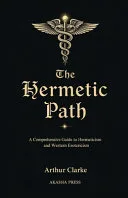
The Hermetic Path
 76
76

The Hermetic Path
Arthur Clarke’s 'The Hermetic Path' avoids the usual hagiography that often surrounds discussions of Hermeticism. Instead, it offers a refreshingly analytical approach, dissecting the core tenets with clarity. The section on the seven principles, particularly its explanation of the Principle of Vibration, is exceptionally well-articulated, moving beyond simplistic interpretations to illustrate its pervasive influence. However, the work occasionally feels overly academic, at times sacrificing the experiential aspect that many seek in Hermetic studies. The discussion of Hermeticism's influence on the Renaissance is robust, but a deeper engagement with its reception by contemporaries like Pico della Mirandola, beyond mere mention, would have strengthened this section. Despite this, Clarke provides a valuable, grounded perspective on a tradition often shrouded in mystery.
📝 Description
76
Arthur Clarke's 'The Hermetic Path' examines the *Corpus Hermeticum* and the *Emerald Tablet*.
Arthur Clarke's 'The Hermetic Path' traces the origins and principles of Hermetic philosophy through its foundational texts. The book looks at the *Corpus Hermeticum* and the *Emerald Tablet*, two key works in Western esotericism. Clarke presents Hermeticism not as a fixed set of beliefs, but as a living system for understanding reality. This system had a significant impact on later philosophical and mystical thought.
The book is written for serious students of esoteric traditions. It will particularly appeal to those interested in the historical and philosophical roots of Western magic and alchemy. Clarke offers a systematic way to grasp universal laws and how they might be applied in personal growth. Readers who prefer scholarly yet approachable discussions of complex subjects will find this work valuable. It situates Hermeticism within its historical development, noting its resurgence during the Renaissance and its connection to figures like Marsilio Ficino.
This book places Hermeticism within its historical development, noting its re-emergence during the Renaissance. It connects the philosophy to figures like Marsilio Ficino, who championed the translation and study of Hermetic texts in 15th-century Florence. The work acknowledges Hermeticism's role in shaping Renaissance thought, influencing art, science, and spirituality. This tradition often existed alongside or in dialogue with Neoplatonism and early Christian mysticism. Clarke's work examines the seven Hermetic principles as fundamental laws governing the cosmos and human consciousness.
💡 Why Read This Book?
• Gain a structured understanding of the seven Hermetic principles, like the Principle of Correspondence, as presented in the book, to reframe your perception of reality. • Explore the historical impact of Hermeticism on Renaissance thought, understanding how figures like Marsilio Ficino engaged with these ideas in the 15th century. • Learn about the practical applications of Hermetic concepts in alchemy and astrology, as detailed in Clarke's analysis, to inform your personal esoteric studies.
⭐ Reader Reviews
Honest opinions from readers who have explored this book.
❓ Frequently Asked Questions
What are the seven Hermetic principles discussed in 'The Hermetic Path'?
'The Hermetic Path' details the seven principles of Hermeticism: Mentalism, Correspondence, Vibration, Polarity, Rhythm, Cause and Effect, and Gender. These are presented as fundamental laws governing the universe and human experience.
When was 'The Hermetic Path' first published?
Arthur Clarke's 'The Hermetic Path' was first published on November 22, 2025, positioning it as a contemporary exploration of ancient wisdom.
What is the 'Corpus Hermeticum' mentioned in the book?
The *Corpus Hermeticum* is a collection of ancient Greek philosophical and religious texts, attributed to Hermes Trismegistus. 'The Hermetic Path' examines it as a foundational document for understanding Hermetic philosophy.
How does the book relate Hermeticism to alchemy?
The book explores alchemy as a symbolic and practical manifestation of Hermetic principles, focusing on transformation and the pursuit of spiritual perfection, often referred to as the Great Work.
Is 'The Hermetic Path' suitable for beginners?
While comprehensive, the book assumes some familiarity with esoteric concepts. Beginners might find it beneficial to first familiarize themselves with basic Hermetic terminology before diving into its detailed analysis.
What is the 'Emerald Tablet'?
The *Emerald Tablet* is a short, cryptic text attributed to Hermes Trismegistus, renowned in alchemy and Hermeticism. 'The Hermetic Path' analyzes its famous dictum, 'As above, so below,' and its implications.
🔮 Key Themes & Symbolism
The Seven Hermetic Principles
This theme centers on the foundational laws of Hermetic philosophy as presented in the work. It unpacks concepts like Mentalism (The All is Mind), Correspondence (As Above, So Below), and Vibration (Nothing rests, everything moves). The book treats these principles not as abstract theories but as an operational framework for understanding reality, from the smallest particle to the grandest cosmic cycles. It emphasizes how recognizing and applying these laws can lead to greater self-awareness and mastery over one's circumstances.
Hermetic Texts as Primary Sources
A significant theme is the direct engagement with seminal Hermetic literature. The book meticulously analyzes excerpts from the *Corpus Hermeticum* and the *Emerald Tablet*, treating them as essential keys to unlocking Hermetic wisdom. It discusses their historical context and philosophical content, arguing for their enduring relevance. This focus highlights the importance of returning to original sources for an authentic understanding of esoteric traditions, moving beyond secondary interpretations.
Hermeticism's Historical Influence
This theme traces the profound impact of Hermetic philosophy on Western civilization, particularly during the Renaissance. The work details how Hermetic ideas permeated fields such as alchemy, astrology, and early science, championed by scholars and mystics. It explores the intellectual climate that fostered the rediscovery and study of Hermetic texts, demonstrating how these ancient teachings shaped artistic expression, philosophical inquiry, and the burgeoning scientific worldview.
The Great Work and Personal Transformation
Central to the book is the concept of the Great Work, often associated with alchemical transmutation but understood here in a broader, spiritual sense. It explores how the application of Hermetic principles facilitates inner transformation and the realization of one's highest potential. This theme connects the cosmic laws to individual evolution, presenting Hermeticism as a path toward self-knowledge and spiritual attainment, the ultimate goal of which is the unification of the microcosm with the macrocosm.
💬 Memorable Quotes
“The seven principles are the operating system of the universe.”
— This statement frames the fundamental laws of Hermeticism as the underlying structure and operational rules that govern all existence, suggesting that understanding them is key to comprehending reality.
“Alchemy is not merely about transmuting metals, but transmuting the alchemist.”
— This highlights the spiritual and psychological dimension of alchemy within Hermeticism, emphasizing personal transformation and the purification of consciousness over material gain.
“Correspondence reveals the interconnectedness of all levels of reality.”
— This paraphrase focuses on the Principle of Correspondence, illustrating how the book explains the concept that events and patterns on one plane of existence reflect and influence those on others.
“Hermeticism offers a map for navigating the inner and outer cosmos.”
— This interpretation suggests the book presents Hermetic philosophy as a practical guide for understanding both the external world and one's internal landscape, promoting self-awareness and cosmic alignment.
“The Emerald Tablet's cryptic verse is a blueprint for spiritual realization.”
— This paraphrase emphasizes the perceived profound significance of the *Emerald Tablet*, portraying its enigmatic statements as essential instructions for achieving spiritual enlightenment and understanding.
🌙 Esoteric Significance
Tradition
This work firmly situates itself within the Western Esoteric Tradition, specifically drawing from Hermeticism, a lineage tracing back to the legendary Hermes Trismegistus. It serves as a modern exposition of this ancient philosophy, emphasizing its role as a foundational element for Gnosticism, Alchemy, Astrology, and Rosicrucianism. Clarke’s approach aims to reconnect contemporary practitioners with the philosophical underpinnings of these related disciplines, presenting Hermeticism as a coherent worldview rather than a collection of disparate practices.
Symbolism
The book extensively explores core Hermetic symbols. The Caduceus, often associated with Hermes, symbolizes balance, polarity, and the flow of universal energy. The Ouroboros, the serpent eating its tail, represents cyclical time, unity, and the eternal return. The Emerald Tablet itself is a potent symbol, embodying the condensed, fundamental truths of Hermetic philosophy, particularly its famous maxim, 'As above, so below,' signifying the principle of correspondence between different realms.
Modern Relevance
Contemporary movements in Western esotericism, New Age spirituality, and even some branches of depth psychology continue to draw from Hermetic principles. Thinkers and practitioners interested in consciousness studies, the Law of Attraction, and integrated approaches to personal development often find the seven Hermetic principles, as elucidated in texts like Clarke's, to be a useful framework. The work’s emphasis on universal laws and personal transformation resonates with those seeking structured, philosophical approaches to self-mastery and spiritual growth in the 21st century.
👥 Who Should Read This Book
• Students of Western Esotericism seeking a structured overview of Hermetic philosophy, including its historical roots and core texts like the *Corpus Hermeticum*. • Aspiring alchemists and astrologers who wish to understand the philosophical principles guiding these practices, moving beyond mere technical application. • Individuals interested in comparative religion and philosophy, particularly those exploring the influence of ancient thought on Renaissance humanism and subsequent mystical traditions.
📜 Historical Context
Arthur Clarke's 'The Hermetic Path' emerges from a long tradition of Hermetic scholarship that gained significant momentum during the Italian Renaissance. The 15th century saw a fervent revival of interest in ancient wisdom, largely catalyzed by figures like Marsilio Ficino in Florence, who translated the *Corpus Hermeticum* into Latin. This translation made the texts accessible to a wider European intellectual circle, influencing thinkers beyond Ficino, including Pico della Mirandola. Hermeticism at this time was often studied alongside Neoplatonism and Kabbalah, forming a crucial part of the *prisca theologia*, the idea of a single, ancient divine wisdom. While celebrated by many, Hermetic texts also faced skepticism; for instance, the later dating of the *Corpus Hermeticum* by scholars like Isaac Casaubon in the 17th century challenged its supposed antiquity, shifting its perception from ancient revelation to a later philosophical synthesis.
📔 Journal Prompts
The Principle of Mentalism and its implications for your daily reality.
Reflecting on the concept of 'As Above, So Below' in your personal life.
The alchemical process as described in the book and its parallel to personal growth.
Mapping the influence of Hermeticism on Renaissance art or science.
Understanding the Principle of Vibration through personal experience.
🗂️ Glossary
Hermeticism
A philosophical and religious tradition based on writings attributed to Hermes Trismegistus, emphasizing esoteric knowledge, spiritual transformation, and the understanding of universal laws.
Corpus Hermeticum
A collection of ancient Greek religious and philosophical treatises that are attributed to Hermes Trismegistus, considered a foundational text of Hermeticism.
Emerald Tablet
A cryptic and highly influential ancient text, attributed to Hermes Trismegistus, central to alchemy and Hermetic philosophy, known for its concise pronouncements on universal principles.
Alchemy
An ancient tradition focused on the transformation of matter, often understood metaphorically as the purification and perfection of the human spirit (the Great Work).
Astrology
The study of the movements and relative positions of celestial bodies interpreted as having an influence on human affairs and the natural world, viewed through a Hermetic lens of correspondence.
The Great Work (Magnum Opus)
In alchemy and Hermeticism, the process of spiritual transformation and perfection, often symbolized by the transmutation of base metals into gold.
Principle of Correspondence
One of the seven Hermetic principles, stating that there is a harmony between the macrocosm (universe) and the microcosm (individual), often summarized as 'As Above, So Below'.