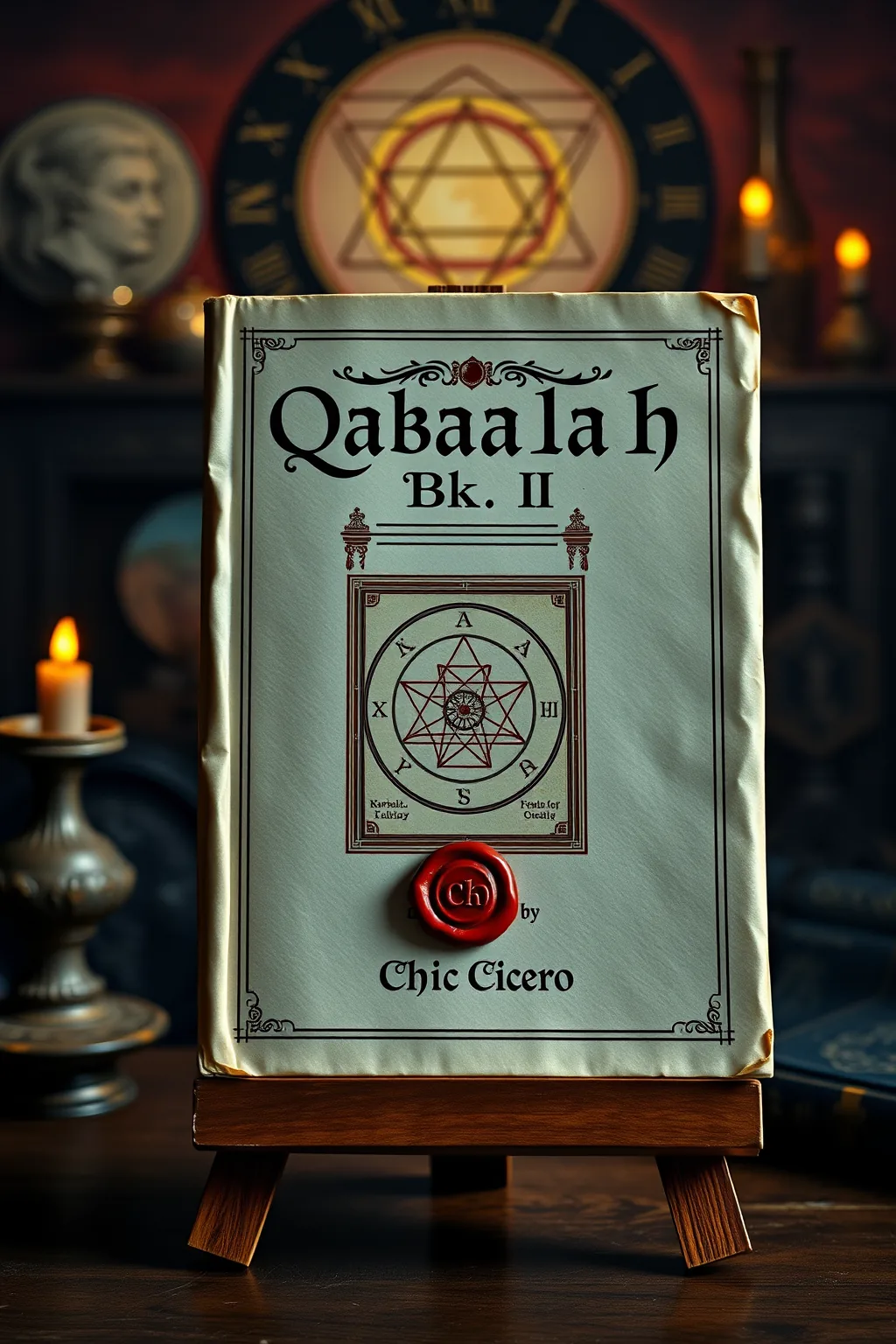
Qabalah Bk. II
 71
71

Qabalah Bk. II
The Ciceros’ Qabalah Bk. II moves beyond mere theory, offering a dense, operational guide to Qabalistic magic. Their meticulous cross-referencing of Hebrew letters, astrological correspondences, and Tarot attributions, particularly in their discussion of the Paths, provides a robust framework for practitioners. A notable strength is the detailed presentation of ritualistic applications, such as the "Lesser Ritual of the Pentagram of Qabalah," which grounds abstract concepts in actionable practice. However, the sheer density of information can be overwhelming for those without a strong prior grounding in Qabalistic or Hermetic literature; the text assumes a significant level of familiarity. The section on the 'Middle Pillar Exercise,' while essential, could benefit from more explicit guidance for absolute beginners. Ultimately, Qabalah Bk. II is an indispensable, albeit challenging, resource for serious students of the magical Qabalah.
📝 Description
71
### What It Is
Qabalah Bk. II is the second volume in Chic Cicero and Sandra Tabatha Cicero's extensive exploration of Qabalistic magic. Building upon foundational concepts, this work offers a systematic approach to understanding and applying Qabalistic principles in practical magical work. It details specific rituals, correspondences, and meditations designed to engage with the Tree of Life on a deeper level. The book serves as a manual for those seeking to integrate Qabalistic theory into their personal spiritual or magical practices.
### Who It's For
This text is intended for serious students of Western Esotericism, particularly those already familiar with basic Qabalistic frameworks or who have completed the foundational work presented in Bk. I. It requires a commitment to disciplined study and practice. Readers should possess an interest in occult philosophy, ceremonial magic, and the application of esoteric systems for personal development and spiritual attainment. It is not a casual introduction but a resource for dedicated practitioners.
### Historical Context
First published in 1994, Qabalah Bk. II emerged during a period of renewed interest in esoteric traditions, following the occult revivals of the 20th century. The Ciceros' work contributed to the ongoing effort to codify and present Western magical systems in a coherent and accessible manner, often drawing from and synthesizing earlier traditions like those of Aleister Crowley and the Hermetic Order of the Golden Dawn. This era saw a growing academic and popular engagement with Kabbalah beyond its traditional Jewish context.
### Key Concepts
The book systematically breaks down the Qabalistic system, focusing on the practical application of the Sephiroth and Paths on the Tree of Life. It details techniques for visualizing and working with divine names, angelic hierarchies, and elemental forces as they relate to each sphere. Specific correspondences for planets, Hebrew letters, Tarot trumps, and magical weapons are provided, enabling a structured approach to ritual and meditation. The Ciceros emphasize the Qabalah as a living, dynamic system for consciousness expansion and magical efficacy.
💡 Why Read This Book?
• Gain practical Qabalistic techniques for ritual and meditation, moving beyond theory to application, as demonstrated through the detailed 'Middle Pillar Exercise' described in the text. • Understand the intricate correspondences between Hebrew letters, Tarot trumps, and the Sephiroth, providing a structured system for magical work and divination as presented throughout the book. • Explore the Qabalistic cosmology as a map for consciousness, learning how to consciously engage with the energies of the Tree of Life for personal transformation, a core aim of the Ciceros' teachings.
⭐ Reader Reviews
Honest opinions from readers who have explored this book.
❓ Frequently Asked Questions
What is the primary focus of Qabalah Bk. II by Chic and Sandra Tabatha Cicero?
Qabalah Bk. II focuses on the practical application of Qabalistic principles for magical work and spiritual development. It details methods for working with the Tree of Life, divine names, and correspondences for ritual and meditation.
Is Qabalah Bk. II suitable for beginners in Qabalah?
No, this book is generally considered intermediate to advanced. It builds upon foundational Qabalistic concepts, assuming prior knowledge likely gained from Bk. I or similar introductory texts on Western Esotericism.
What year was Qabalah Bk. II first published?
Qabalah Bk. II was first published in 1994, contributing to the resurgence of interest in esoteric studies during that period.
What kind of exercises can I expect to find in this book?
The book includes detailed instructions for Qabalistic rituals, such as variations of the Lesser Ritual of the Pentagram, and meditative practices like the Middle Pillar Exercise, along with methods for working with divine names.
What esoteric tradition does this book primarily engage with?
The book primarily engages with the Western Esoteric tradition of the Qabalah, synthesizing elements from Hermeticism, ceremonial magic, and influences from figures like Aleister Crowley and the Golden Dawn.
Does the book provide historical context for Qabalistic magic?
Yes, while focusing on practical application, the book implicitly situates itself within the history of Western Esotericism, drawing from and contributing to the lineage of magical interpretation of the Qabalah prominent since the Renaissance.
🔮 Key Themes & Symbolism
The Operational Tree of Life
This volume moves the reader from theoretical understanding to practical engagement with the Qabalistic Tree of Life. The Ciceros present the Sephiroth and Paths not just as abstract concepts but as energetic centers and pathways to be consciously worked with. They provide specific techniques, including visualizations, divine names, and angelic invocations, for interacting with each sphere and connecting them through the Paths, emphasizing its use as a dynamic map for consciousness and magical operations.
Qabalistic Correspondences
A core element is the detailed mapping of correspondences across various esoteric systems. The book systematically links the Hebrew alphabet, Tarot trumps, astrological signs and planets, magical weapons, and divine names to the Sephiroth and Paths. This intricate web of associations allows practitioners to build complex magical workings and gain a multi-layered understanding of each point on the Tree of Life, facilitating deeper esoteric study.
Ritual and Meditation Techniques
Qabalah Bk. II serves as a practical manual, detailing specific rituals and meditative exercises. This includes advanced forms of the Pentagram Ritual adapted for Qabalistic work and the crucial Middle Pillar Exercise for developing inner awareness and energy circulation. These techniques are designed to directly engage the practitioner with the forces and intelligences described within the Qabalistic framework, fostering personal transformation.
The Divine Names and Angelic Hierarchy
The book explores the power and significance of the Hebrew divine names and their associated angelic orders within the Qabalistic system. Understanding and correctly invoking these names and intelligences is presented as a key method for accessing the energies of the Sephiroth and influencing the subtle planes. The Ciceros guide the reader on how to respectfully and effectively engage with these potent forces.
💬 Memorable Quotes
“The Middle Pillar is the central column of the Tree of Life, representing the path of the Christos or the divine human.”
— This highlights the central role of the Middle Pillar exercise in Qabalistic practice, framing it as a method for spiritual ascent and the realization of divine potential within the practitioner.
“Each Hebrew letter corresponds to a Path on the Tree of Life, acting as a key to understanding its unique energetic signature.”
— This emphasizes the profound connection between the Hebrew alphabet and the structure of the Qabalistic cosmos, suggesting that mastery of the letters unlocks deeper comprehension of the Tree of Life's dynamics.
“The Lesser Ritual of the Pentagram, when adapted Qabalistically, allows for the invocation and banishing of specific elemental and divine forces.”
— This points to the practical, ceremonial magic aspect of the book, showing how established rituals can be tailored to the Qabalistic framework for targeted magical results.
“True Qabalistic knowledge is not merely intellectual; it requires direct experience and inner transformation.”
— This underscores the Ciceros' emphasis on practice over theory, positioning their work as a guide for experiential learning and personal evolution through Qabalistic disciplines.
“The Sephiroth are divine emanations, but also centers of consciousness that we can consciously interact with.”
— This interpretation stresses the interactive nature of the Sephiroth in the Ciceros' system, presenting them as accessible energetic and conscious forces rather than distant, abstract concepts.
🌙 Esoteric Significance
Tradition
This work firmly belongs to the tradition of Western Esotericism, specifically the magical interpretation of Kabbalah that flourished from the Renaissance onwards. It synthesizes Hermetic principles with Qabalistic cosmology, extending the practical magical systems developed by earlier figures like Eliphas Levi and the Golden Dawn. The Ciceros' approach is less focused on the mystical or theological aspects of Jewish Kabbalah and more on its application as a framework for ceremonial magic and consciousness expansion.
Symbolism
Central to the book's symbolism is the Tree of Life itself, depicted as a map of creation, consciousness, and the path of spiritual ascent. The Hebrew letters function as potent symbols, each representing a specific divine name, sound vibration, and pathway on the Tree. Additionally, the magical weapons (wand, cup, sword, pentacle) are imbued with Qabalistic significance, representing the elements and their interaction within the practitioner's magical system.
Modern Relevance
Contemporary practitioners of ceremonial magic, Hermeticism, and Qabalistic studies frequently reference the Ciceros' work for its systematic approach and detailed operational instructions. Their methods continue to influence modern magical orders and independent practitioners seeking a rigorous framework for understanding and applying Qabalistic principles. Thinkers and groups focused on practical occultism and spiritual development often draw upon Bk. II for its codified techniques and comprehensive correspondences.
👥 Who Should Read This Book
• Serious students of Western Esotericism and ceremonial magic seeking a practical, operational guide to Qabalistic principles beyond introductory theory. • Practitioners who have already engaged with foundational Qabalistic concepts and desire a structured system for ritual, meditation, and magical application. • Researchers interested in the development of modern magical systems and how figures like the Ciceros codified and expanded upon earlier Qabalistic traditions for practical use.
📜 Historical Context
Published in 1994, Qabalah Bk. II arrived during a period when Western Esotericism was experiencing a significant resurgence, fueled by increased access to historical texts and a growing interest in alternative spiritual paths. The Ciceros' work emerged within the lineage of ceremonial magic, particularly influenced by the teachings of the Hermetic Order of the Golden Dawn and Aleister Crowley, aiming to present a systematized and practical approach to Qabalistic magic. This era saw a divergence in Qabalistic studies, with some scholars focusing on historical and textual analysis of Jewish Kabbalah, while others, like the Ciceros, continued the tradition of magical interpretation. Their approach offered a structured alternative to more eclectic or loosely defined magical practices, providing detailed correspondences and ritualistic applications that appealed to dedicated students seeking a coherent system.
📔 Journal Prompts
The symbolic meaning of the Hebrew letter Aleph as the initiator of the Paths.
The practical application of divine names within Qabalistic ritual.
How the Middle Pillar Exercise can facilitate personal energetic balance.
The relationship between astrological correspondences and the Sephiroth.
Visualizing the pathways connecting the Sephiroth during meditation.
🗂️ Glossary
Sephiroth
The ten emanations or divine attributes through which God is said to have created and sustains the universe, forming the structure of the Tree of Life.
Tree of Life
A central diagram in Kabbalah, consisting of ten spheres (Sephiroth) connected by twenty-two paths, representing the structure of the cosmos, the divine, and the human psyche.
Path
The connections or bridges between the Sephiroth on the Tree of Life, often associated with the letters of the Hebrew alphabet and specific esoteric concepts.
Kether
The first Sephirah on the Tree of Life, representing the highest point of divine emanation, often translated as 'Crown' or 'Source'.
Malkuth
The tenth and final Sephirah on the Tree of Life, representing the material world, the Earth, and the culmination of divine manifestation.
Da'ath
An 'invisible' Sephirah often depicted between Kether and Tiphareth, representing knowledge, gnosis, or the abyss, bridging the higher and lower realms.
Ain Soph Aur
Hebrew for 'Limitless Light,' representing the unmanifest, infinite divine potential that precedes and underlies the creation of the Tree of Life.