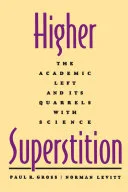
Higher Superstition
 76
76

Higher Superstition
Gross and Levitt’s *Higher Superstition* is a forceful, if sometimes polemical, intervention into the academic debates of the late 20th century. Its strength lies in its clear-eyed defense of scientific methodology against what the authors perceived as fashionable, ill-informed critiques. The directness with which they confront figures and ideas within cultural studies is bracing. However, the book’s somewhat adversarial tone can occasionally overshadow the nuance of the philosophical arguments. A particularly incisive section examines the tendency for critics to conflate the social and political contexts of science with its epistemic validity. While the book’s arguments are robust, a deeper engagement with the potential societal biases inherent in scientific practice, beyond a simple dismissal, might have broadened its appeal. Nevertheless, it remains a vital document for understanding the tensions between science and certain humanities disciplines.
📝 Description
76
Published in 1994, Higher Superstition critically assesses academic critiques of science from humanities scholars.
Paul R. Gross and Norman Levitt’s 1994 book, Higher Superstition, examines a trend in academic fields where scholars, often without scientific training, began to question established scientific methods and conclusions. The authors, both scientists themselves, challenge the intellectual foundations and motivations behind these cross-disciplinary critiques, particularly those originating from what they identify as the academic left. They argue that certain approaches, like those found in post-structuralism and cultural studies, risked undermining the pursuit of objective knowledge.
The book aims at academics, students, and engaged readers who care about the integrity of scientific discussion and the intrusion of intellectual fads into scholarly domains. It will appeal to those who prioritize empirical evidence and sound methodology, and who are skeptical of critiques lacking substantive grounding in the subjects they address. Readers interested in how knowledge is socially shaped and the philosophy behind scientific claims will find the arguments particularly pertinent. Gross and Levitt’s work emerged during a time of significant shifts in academic thought, responding directly to challenges against scientific authority and objectivity.
While not an esoteric text in the typical sense, *Higher Superstition* engages with the broader intellectual currents that sometimes influence or are influenced by esoteric thought. The book’s critique of postmodernism and its challenges to objective truth can resonate with discussions found in various esoteric traditions that often operate outside mainstream scientific paradigms. It addresses the tension between established scientific authority and alternative modes of understanding the world, a tension familiar to those who explore non-traditional belief systems.
💡 Why Read This Book?
• Understand the intellectual climate of the 1990s concerning science criticism, as the book dissects the rise of "cultural studies" and its critiques of empirical science. • Gain insight into the scientific perspective on critiques of objectivity, as Gross and Levitt challenge the relativist arguments popular in humanities scholarship of the era. • Develop critical thinking skills regarding academic discourse by examining the authors' analysis of logical fallacies and rhetorical strategies employed by science critics.
⭐ Reader Reviews
Honest opinions from readers who have explored this book.
❓ Frequently Asked Questions
When was "Higher Superstition" first published?
The original publication date for "Higher Superstition" by Paul R. Gross and Norman Levitt was November 6, 1997, though the intellectual discourse it addresses predates this.
What is the main argument of "Higher Superstition"?
The book argues that critiques of science originating from humanities and social sciences, particularly from the "academic left," often lack a rigorous understanding of scientific methodology and can be driven by ideological rather than intellectual concerns.
Who are the authors of "Higher Superstition"?
Paul R. Gross and Norman Levitt are the authors. Gross was a professor of biochemistry, and Levitt was a professor of mathematics, lending them a scientific perspective.
What is "cultural studies" as discussed in the book?
In the context of "Higher Superstition," cultural studies refers to an interdisciplinary field that emerged in the late 20th century, often examining popular culture and societal power structures, and which Gross and Levitt critique for its anti-scientific tendencies.
Does "Higher Superstition" offer a defense of science?
Yes, it functions as a defense of scientific inquiry and its epistemological foundations against what the authors perceived as unfounded attacks from certain academic disciplines.
What does the "academic left" refer to in this book?
The "academic left" in "Higher Superstition" refers to scholars, primarily in humanities and social sciences, whose political leanings influenced their critical perspectives on established institutions, including science.
🔮 Key Themes & Symbolism
Critique of Postmodern Science Studies
Gross and Levitt meticulously dissect the arguments emerging from fields like cultural studies and sociology of science that questioned the objectivity and authority of scientific knowledge. They identify a tendency to conflate the social context of science with its epistemic validity, arguing that concepts like "social construction" were being misapplied to undermine empirical truth. The authors challenge the idea that science is merely another narrative or belief system, asserting its unique claim to understanding the natural world based on evidence and method.
The "Academic Left" and Anti-Science
A central theme is the authors' concern with what they term the "academic left's" critique of science. They posit that certain ideological stances within academia led scholars, often without scientific training, to adopt positions antagonistic to scientific consensus and methodology. This section explores the perceived motivations behind such critiques, suggesting they were sometimes driven by a desire to dismantle perceived power structures rather than a genuine pursuit of knowledge, leading to what they label "higher superstition."
Defense of Scientific Methodology
The book serves as a robust defense of the scientific method itself. Gross and Levitt champion empirical evidence, logical reasoning, and peer review as the cornerstones of reliable knowledge acquisition. They contrast this with what they see as the often impressionistic and ideologically-driven analyses from critics in the humanities, arguing for the continued primacy of scientific inquiry in understanding the physical and biological world. The work champions rationalism against what it views as unfounded skepticism.
Intellectual Boundaries and Expertise
Gross and Levitt raise serious questions about scholars crossing disciplinary boundaries without sufficient expertise. They argue that a lack of foundational knowledge in natural sciences leads to misinterpretations and fallacious arguments when critiquing scientific theories or practices. The book emphasizes the importance of disciplinary rigor and the potential dangers of unqualified pronouncements on complex scientific matters, particularly when these pronouncements gain traction within academic discourse.
💬 Memorable Quotes
Direct passages from the work, attributed to the author.
“The academic left is often hostile to science.”
— This statement captures the core thesis that a significant segment of scholars, influenced by certain political ideologies, harbors an inherent distrust or opposition towards established scientific principles and practices.
“Critics often confuse the social context of science with its epistemic status.”
— This highlights the authors' argument that critics sometimes wrongly assume that understanding the societal influences on scientific discovery negates the truth claims or validity of that discovery.
“When academics stray far outside their own disciplines, they often make fools of themselves.”
— This candid assertion reflects the authors' view that interdisciplinary critiques of science are frequently superficial and ill-informed due to a lack of specialized knowledge in the sciences.
“Science is a rational enterprise, not a belief system.”
— This emphasizes the authors' commitment to the unique epistemological status of science, distinguishing it from faith or ideology, and underscoring its reliance on evidence and logic.
“The critique of science is sometimes a fashionable pose.”
— This interpretation suggests that some academic criticism of science is driven by trends and the desire for intellectual posturing rather than genuine scholarly inquiry or a pursuit of truth.
🌙 Esoteric Significance
Tradition
While not explicitly an esoteric text, *Higher Superstition* engages with the philosophical underpinnings of knowledge acquisition, a concern shared by many esoteric traditions. It operates within the broad lineage of rationalist and empiricist philosophies that seek to understand reality through systematic inquiry, a method that, in its own way, many esoteric disciplines also employ, albeit with different tools and aims. The book's critique of ungrounded speculation and its defense of verifiable truth can be seen as aligning with the Hermetic principle of "as above, so below" when interpreted as a call for internal consistency and correspondence with observable phenomena.
Symbolism
The book doesn't rely on traditional esoteric symbolism. Instead, its "symbols" are conceptual: the "academic left" functions as a symbolic adversary, representing a perceived threat to rational inquiry. "Higher superstition" itself becomes a potent symbol for the intellectual trends the authors critique – a new form of dogma disguised as advanced thought. The "scientist" is presented as a symbol of empirical pursuit, contrasted with the "humanist critic" who, in the authors' view, often operates without a comparable symbolic or practical grounding in the subject matter.
Modern Relevance
In an era still grappling with misinformation, "fake news," and the politicization of science, the core arguments of *Higher Superstition* remain relevant. Contemporary thinkers and commentators who defend scientific consensus against conspiracy theories or ideological distortions echo Gross and Levitt's concerns. While the specific academic landscape has shifted, the tension between evidence-based reasoning and ideologically-driven narratives, particularly in public discourse and online, continues to be a significant battleground where the book's perspective offers a historical anchor.
👥 Who Should Read This Book
• Students of the philosophy of science: To understand a specific historical debate about the nature of scientific knowledge and its critique from humanities perspectives. • Academics in STEM fields: To find an articulation of concerns regarding the perceived misrepresentation and dismissal of scientific methodology by scholars in other disciplines. • Critical thinkers interested in intellectual history: To examine a key text from the 1990s that engaged with postmodern critiques of science and defended Enlightenment-era rationality.
📜 Historical Context
Published in 1994, *Higher Superstition* emerged during a period of intense academic debate surrounding science and its role in society. The rise of postmodernism, social constructivism, and cultural studies had led to widespread questioning of scientific objectivity and authority. Authors like Bruno Latour and Steve Fuller were prominent in the sociology of science, offering analyses that Gross and Levitt found problematic. The book directly challenged the critiques leveled by scholars such as Sandra Harding and Donna Haraway, who advocated for feminist epistemologies that interrogated science's inherent biases. Gross and Levitt’s intervention, coming from within the scientific community, was notable for its strong defense of scientific realism and methodology against what they perceived as an "anti-science" current on the academic left, sparking considerable discussion and controversy.
📔 Journal Prompts
The concept of "higher superstition" as applied by Gross and Levitt.
Critiques of science originating from the "academic left" in the 1990s.
The authors' distinction between the social context of science and its epistemic validity.
Interdisciplinary critiques of scientific expertise.
The role of evidence-based reasoning versus ideological framing in academic discourse.
🗂️ Glossary
Academic Left
A term used by Gross and Levitt to describe scholars, primarily in humanities and social sciences, whose political leanings and critiques of societal structures extended to questioning the authority and objectivity of science.
Cultural Studies
An interdisciplinary academic field that emerged in the late 20th century, focusing on the analysis of culture, power dynamics, and societal structures, which Gross and Levitt critically examined for its anti-scientific tendencies.
Epistemic Status
Refers to the credibility, validity, and justification of knowledge claims; in this context, the authors defend the unique epistemic status of scientific knowledge.
Relativism
The philosophical position that truth or knowledge is not absolute but is relative to individual perspectives, cultural contexts, or historical periods. Gross and Levitt argue against the application of extreme relativism to science.
Social Construction of Science
The idea that scientific knowledge is shaped by social, cultural, and political factors, rather than being a purely objective reflection of reality. The authors critique what they see as an overemphasis on this aspect by some scholars.
Empirical Evidence
Information acquired through observation and experimentation, forming the foundation of scientific inquiry. The book strongly advocates for the primacy of empirical evidence.
Methodology
A system of methods used in a particular area of study or activity. The authors emphasize the rigorous methodology of science as distinct from other forms of discourse.