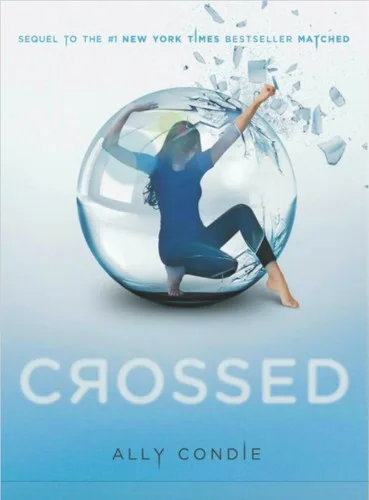
Crossed
 76
76

Crossed
Condie's 'Crossed' offers a stark vision of a future where personal autonomy is sacrificed for societal efficiency, primarily through the chillingly logical Matching system. The premise is strong: a society so determined to eliminate unhappiness that it removes the very possibility of love by decree. The pacing, particularly in the early sections, effectively builds a sense of unease as Cassia begins to question the pronouncements of the Society. However, the narrative occasionally falters in its depiction of rebellion, sometimes feeling a bit too convenient for the plot's progression. The contrast between Cassia's programmed life and her burgeoning, forbidden feelings for Ky offers the book's most compelling emotional anchor, even if the societal mechanics sometimes overshadow the individual struggle. Ultimately, 'Crossed' serves as a potent, if occasionally uneven, exploration of control and the human spirit's yearning for freedom.
📝 Description
76
### What It Is
'Crossed' is a young adult dystopian novel by Ally Condie, first published in 2009. It presents a society rigidly controlled by the Society, where every citizen's life path, including their romantic partner and career, is determined by the Matching system. The narrative follows Cassia Reyes, who believes in the system until her own Matching ceremony. The Society's absolute authority dictates all aspects of existence, from diet to employment, creating an environment where personal choice is suppressed.
### Who It's For
This novel appeals to readers interested in speculative fiction that examines societal control and the nature of free will. It is particularly suited for a younger audience grappling with themes of conformity versus individuality. Those who enjoy exploring the consequences of technological or governmental overreach in personal lives will find familiar ground here. Fans of series like 'The Hunger Games' or 'Divergent' might appreciate its exploration of rebellion against an oppressive regime.
### Historical Context
Published in 2009, 'Crossed' emerged during a period of increasing popularity for dystopian young adult literature. This genre often reflects contemporary anxieties about surveillance, government control, and the impact of technology on society, echoing concerns that gained traction in the early 21st century. The novel's exploration of a society that prioritizes collective order over individual liberty can be seen as a response to broader cultural discussions on privacy and autonomy in an interconnected world.
### Key Concepts
The Society's core mechanism is the "Matching" system, a complex algorithm designed to ensure optimal pairings for procreation and societal stability. This system, however, eradicates romantic choice, presenting individuals with a pre-selected partner. The novel also introduces the concept of "sorting," where citizens are categorized and assigned roles based on perceived societal needs. These elements serve to highlight the tension between predetermined destiny and the human desire for agency and genuine connection.
💡 Why Read This Book?
• Understand the deep-seated human need for authentic choice, as explored through Cassia's conflict with the Society's predetermined Matching system. • Examine the societal implications of algorithmic control over personal relationships and individual destiny, a theme central to the book's 2009 publication context. • Feel the tension between imposed order and emergent personal desire, particularly in Cassia's interactions with Ky, which challenge the Society's logic.
⭐ Reader Reviews
Honest opinions from readers who have explored this book.
❓ Frequently Asked Questions
What is the 'Matching' system in Ally Condie's 'Crossed'?
The Matching system is a core component of the Society's governance, using algorithms to determine ideal romantic partners and career paths for citizens to ensure societal stability and prevent unhappiness. It eliminates personal choice in relationships.
Who is Cassia Reyes in 'Crossed'?
Cassia Reyes is the protagonist of 'Crossed'. She is a young woman living in a controlled society who begins to question the system when her own Matching ceremony reveals complexities that challenge her beliefs.
When was 'Crossed' by Ally Condie published?
'Crossed' was first published in 2009, placing it within a wave of dystopian young adult fiction that explored themes of societal control and individual rebellion.
What are the main themes explored in 'Crossed'?
The novel primarily explores themes of free will versus determinism, the nature of love and choice, societal control, and the consequences of suppressing individual desires for the sake of order.
What is the role of the Society in 'Crossed'?
The Society is the overarching governing body that dictates every aspect of its citizens' lives, from their relationships and careers to their daily routines, aiming for maximum order and minimal dissent.
Does 'Crossed' have sequels?
Yes, 'Crossed' is the first book in a trilogy by Ally Condie. It is followed by 'Matched' (2010) and 'Reached' (2012).
🔮 Key Themes & Symbolism
The Tyranny of Choice Elimination
The Society in 'Crossed' believes that by eliminating choices—especially romantic ones through the Matching system—it can prevent pain and ensure happiness. This curated existence, however, stifles genuine human connection and personal growth. The novel scrutinizes the idea that a perfectly ordered society, devoid of risk and uncertainty, is truly desirable. It questions whether pre-determined happiness is authentic or merely a form of sophisticated control, forcing readers to consider the inherent value of individual agency and the often messy, unpredictable nature of love and life.
Love as Rebellion
In a world where affection is prescribed, any deviation—a lingering glance, a secret touch, a forbidden song—becomes an act of rebellion. Cassia's developing feelings for Ky, an individual deemed unsuitable by the Matching system, highlight this. Their clandestine interactions represent the resurgence of individual desire against the homogenizing force of the Society. This theme posits that true love cannot be engineered or mandated; it is an emergent, often dangerous, force that can destabilize even the most controlled environments. The novel suggests that the capacity for genuine emotional connection is a fundamental human trait that resists systematic suppression.
Individual Identity vs. Societal Mandate
The core conflict in 'Crossed' revolves around the struggle for individual identity within a society that demands absolute conformity. Citizens are defined by their assigned roles and adherence to the Society's directives, with little room for personal expression or unique aspirations. Cassia's journey is one of self-discovery, as she begins to recognize her own thoughts, feelings, and desires as distinct from what the Society dictates. The narrative explores the psychological toll of living a life that is not one's own, and the courage it takes to assert one's true self against overwhelming external pressure.
The Illusion of Perfection
The Society presents itself as a utopia, a perfect system designed to eliminate suffering. However, 'Crossed' deconstructs this facade, revealing the inherent flaws and human cost beneath the veneer of order. The absence of choice and genuine emotion leads to a sterile, unfulfilling existence. The novel critiques the pursuit of a manufactured perfection that sacrifices individuality and authentic experience, suggesting that true fulfillment lies not in the absence of struggle, but in the freedom to navigate life's challenges authentically.
💬 Memorable Quotes
“I think about the Society and its rules. I think about how it is supposed to make us happy. But I don’t think it does.”
— This internal monologue captures Cassia's dawning awareness that the Society's promise of happiness through control is a hollow one. It signifies her first major crack in faith, acknowledging the disconnect between imposed order and genuine emotional well-being.
“The Society tells us what to think, what to do, what to feel. But what if we feel something else?”
— This reflects the burgeoning internal conflict within Cassia. It directly confronts the Society's absolute authority by posing a simple yet profound question about the validity of individual, unprescribed emotions and thoughts.
“My Matching is supposed to be the best thing that ever happens to me. But it feels like the worst.”
— This statement encapsulates the central irony of the novel: the system designed for optimal happiness leads to Cassia's deepest distress. It highlights the failure of the Society's logic when confronted with genuine human emotion and individual desire.
“If you knew your life was already written, would you still try to change it?”
— This question, likely posed by Ky or contemplated by Cassia, gets to the heart of the free will versus determinism debate. It challenges the reader to consider the motivation and value of striving when destiny seems predetermined.
“They want us to be the same. But we are not.”
— This assertion underscores the theme of individuality versus conformity. It's a quiet declaration of selfhood, a refusal to be erased by the Society's attempts to homogenize its citizens into predictable units.
🌙 Esoteric Significance
Tradition
While 'Crossed' is primarily a work of secular dystopian fiction, its themes touch upon concepts found in Gnostic thought, particularly the idea of a flawed demiurge or governing system that creates an illusion of perfection while holding individuals captive. The Society functions akin to a materialist, controlling force that suppresses true spiritual or emotional liberation. The narrative implicitly critiques a system that prioritizes outward order and predictability over inner truth and authentic experience, a core concern in many esoteric traditions that seek liberation from material illusion.
Symbolism
The primary symbol is the 'Microcard' which contains an individual's entire life path, representing a form of encoded destiny or predestination. The 'Choice' itself, or rather the lack thereof, becomes a potent symbol of lost agency and the suppressed human spirit. Even something as simple as a red berry, forbidden by the Society, symbolizes a return to natural, unadulterated experience and a connection to a world beyond the Society's sterile control, representing forbidden knowledge or primal truth.
Modern Relevance
The novel's exploration of algorithmic control over personal lives, dating, and career paths resonates strongly with contemporary discussions around big data, social media algorithms, and predictive analytics. Thinkers and practitioners in fields like digital ethics, transhumanism, and even some branches of self-development that question societal conditioning might find parallels. The book serves as a cautionary tale in an era increasingly reliant on automated decision-making, prompting reflection on where human intuition and individual will should hold primacy over systemic directives.
👥 Who Should Read This Book
• Young adults questioning societal norms and the pressures of conformity, seeking relatable narratives about finding one's voice. • Readers interested in speculative fiction that critiques technological or governmental control over personal lives, offering a lens on current societal trends. • Students of comparative literature or sociology examining the evolution of dystopian themes in the 21st century and their reflection of contemporary anxieties.
📜 Historical Context
Published in 2009, Ally Condie's 'Crossed' arrived as young adult dystopian fiction surged in popularity, building on the groundwork laid by authors like Lois Lowry with 'The Giver' (1993) and later fueled by Suzanne Collins' 'The Hunger Games' (2008). This period saw a cultural fascination with speculative futures that mirrored contemporary anxieties about pervasive surveillance, governmental overreach, and the impact of technology on personal autonomy. The early 21st century was marked by increased awareness of data collection and societal algorithms, making the novel's central concept of a 'Matching' system particularly resonant. While not directly engaging with a specific intellectual movement, the book taps into a broader discourse on libertarianism versus collectivism, questioning the societal trade-offs between safety and freedom. Its reception was generally positive within the YA community, contributing to the genre's momentum, though it faced no significant censorship or controversy in its initial release.
📔 Journal Prompts
The Society's 'Matching' system and its implications for personal freedom.
Reflecting on Cassia's internal conflict between obedience and desire.
The symbolic meaning of forbidden elements, like the red berry, in the context of control.
Analyzing the Society's definition of happiness versus genuine fulfillment.
Exploring Ky's role as an agent of subtle disruption within the system.
🗂️ Glossary
The Society
The overarching governmental and social structure in 'Crossed' that dictates all aspects of citizens' lives, from relationships and careers to daily routines, prioritizing order and efficiency above all else.
Matching
The process by which the Society determines a citizen's ideal partner based on complex algorithms, aiming to create stable and productive unions, thereby eliminating personal choice in romance.
Microcard
A small data storage device given to citizens that contains all the information about their predetermined life path, including their assigned partner and career, serving as a symbol of their dictated destiny.
Sorting
The process by which citizens are categorized and assigned specific roles or professions within the Society based on perceived aptitude and societal needs, further limiting individual career choice.
Compliance
The state of adhering strictly to the rules and directives set forth by the Society. Non-compliance is met with severe consequences, reinforcing the authoritarian nature of the regime.
Rebellion
Any act of defiance against the Society's control, ranging from subtle emotional deviations to more overt actions. In 'Crossed,' rebellion often takes the form of seeking authentic connection and individual thought.
The Outer Provinces
Areas outside the direct control of the central Society, often depicted as less structured and more dangerous, representing a space where the Society's rules may not fully apply.