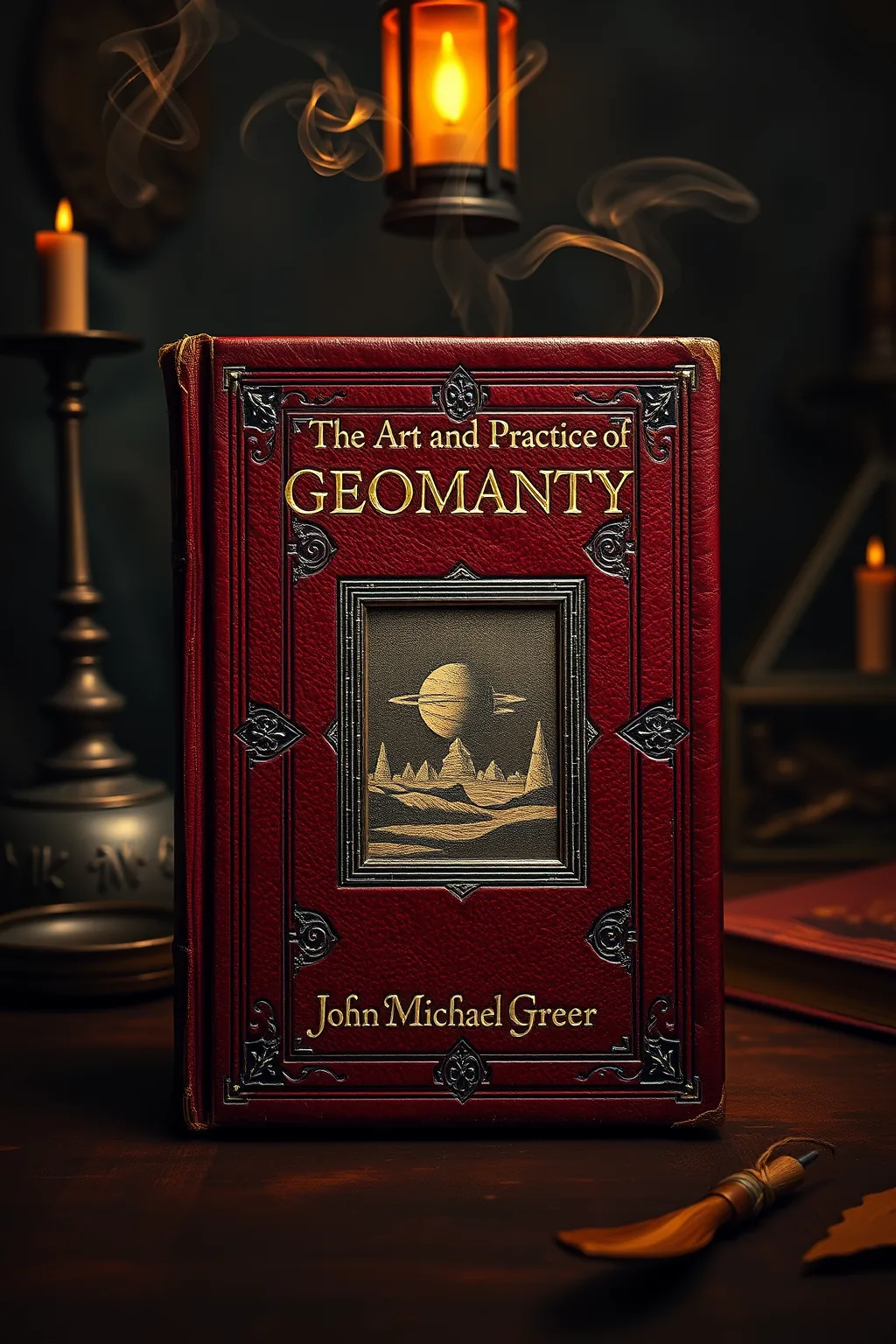
The Art and Practice of Geomancy
 81
81

The Art and Practice of Geomancy
John Michael Greer’s *The Art and Practice of Geomancy* arrives not with a fanfare of mystical pronouncements but with the quiet authority of a seasoned craftsman. Greer excels at demystifying a system often shrouded in archaic jargon. His strength lies in presenting geomancy’s mechanics—the generation of figures, the construction of the house system, and the interpretation of the resulting chart—with exceptional clarity. The chapter on the 'Shield' figure, for instance, offers a particularly cogent method for identifying obstacles. However, the book could benefit from more extensive case studies illustrating complex queries, moving beyond the foundational examples. While Greer’s methodical approach is a boon for learning, a touch more interpretive latitude in the examples might better reflect the nuanced nature of real-world divinatory work. It is a solid, practical handbook for engaging with this ancient oracle.
📝 Description
81
### What It Is John Michael Greer's *The Art and Practice of Geomancy* presents a comprehensive guide to the ancient divinatory art of geomancy. This system, which relies on interpreting patterns formed by random dots or marks, offers a structured method for seeking answers to practical life questions. Greer breaks down the complex mechanics of geomancy into accessible steps, making it suitable for novices while retaining depth for experienced practitioners.
### Who It's For This book is intended for individuals interested in practical divination and esoteric systems. Readers seeking a reliable method for understanding daily challenges—from locating lost items and assessing career changes to exploring relationships and identifying unseen obstacles—will find value here. It appeals to those who prefer structured, rule-based systems of divination over more intuitive methods.
### Historical Context Geomancy, also known as 'earth divination,' has roots stretching back to the medieval Islamic world, with figures like Ibn Khaldun noting its prevalence. By the Renaissance, it had spread throughout Europe, often integrated with astrological and alchemical studies. Greer situates his work within this long historical lineage, acknowledging its transmission through various cultures and its adaptation over centuries, contrasting with purely astrological or numerological systems of fortune-telling prevalent in the same eras.
### Key Concepts The core of geomancy involves the generation of 16 figures through a process of random marking, which are then organized into a chart. This chart is interpreted based on the relationships between the figures, the houses they occupy, and their astrological significations. Greer explains how to construct these charts, understand the elemental and astrological qualities of each figure, and apply them to specific queries.
💡 Why Read This Book?
• Learn a systematic divinatory method: Understand the 16 geomantic figures and how to construct a geomantic chart, a skill directly applicable to answering questions about finances or relationships, as detailed in the book's early chapters. • Connect with historical divination practices: Gain insight into a practice prominent in the medieval Islamic world and Renaissance Europe, enriching your understanding of esoteric traditions beyond modern interpretations. • Develop practical problem-solving skills: Acquire a tool for assessing situations and identifying potential outcomes for everyday concerns like job changes or finding lost items, a core application Greer emphasizes.
⭐ Reader Reviews
Honest opinions from readers who have explored this book.
❓ Frequently Asked Questions
What is geomancy and how does John Michael Greer explain it?
Geomancy, or 'earth divination,' is an ancient system of divination Greer explains as using random patterns of dots to form 16 figures, which are then interpreted via a chart to answer questions. He makes the system accessible for beginners.
What kinds of questions can geomancy answer according to the book?
The book suggests geomancy can answer practical questions about health, luck, career changes, relationships, finding lost objects, and even identifying secret enemies, as outlined in the original blurb.
Is prior knowledge of astrology required to learn geomancy from this book?
While geomantic figures have astrological significations, Greer's approach emphasizes understanding the figures and chart construction first. Basic astrological correlations are explained, but deep prior knowledge isn't strictly necessary to begin.
How difficult is it to learn geomancy using Greer's book?
Greer aims for accessibility. The book breaks down the process into manageable steps, making it relatively easy to learn the mechanics of generating and interpreting geomantic charts for those willing to follow the instructions.
When was John Michael Greer's 'The Art and Practice of Geomancy' first published?
John Michael Greer's *The Art and Practice of Geomancy* was first published on March 1, 2009.
Does the book cover the historical development of geomancy?
Yes, the book provides historical context, tracing geomancy's roots back to the medieval Islamic world and its spread through Europe, situating it within broader esoteric traditions.
🔮 Key Themes & Symbolism
The Sixteen Geomantic Figures
Greer meticulously details the 16 primary figures of geomancy, each derived from a unique pattern of dots. These figures—such as Puella, Fortunatus Major, and Via Combusta—are not merely abstract symbols but potent carriers of meaning, representing distinct energies and influences. The book explains their formation, elemental associations (fire, earth, air, water), and their corresponding planetary rulers, providing a foundational lexicon for interpreting the geomantic chart and understanding their application to specific queries about fortune, conflict, or obstacles.
Constructing the Geomantic Chart
Central to geomantic practice is the construction of the divinatory chart, a grid of 16 houses. Greer guides readers through the systematic process of generating the four mothers, their derived daughters, and the four witnesses (Judge and Sure/Surety). This structured methodology ensures a consistent framework for any question posed, transforming random marks into a coherent symbolic map. Understanding this process is key to unlocking geomancy’s predictive and analytical power for diverse situations.
Interpreting Geomantic Queries
Beyond mere construction, the book emphasizes the art of interpretation. Greer explains how to analyze the relationships between the figures within the chart, their positions in the houses (representing aspects of the querent's life), and their interactions with each other. This involves understanding concepts like 'perfection,' 'separation,' and 'combustion,' allowing practitioners to derive nuanced answers regarding success, failure, obstacles, and opportunities relevant to the question asked.
Geomancy in Daily Life
Greer posits geomancy as a practical tool for navigating everyday life, not just for grand prophecies. The work demonstrates its utility in finding lost objects, assessing the potential of a new job, understanding relationship dynamics, or even predicting weather patterns. This focus on practical application makes geomancy an accessible system for self-guidance and problem-solving, grounding its esoteric principles in tangible results.
💬 Memorable Quotes
“Geomancy is an oracle of the earth, a system of divination that arises from the random patterns of the ground.”
— This interpretation highlights the fundamental nature of geomancy as described by Greer, emphasizing its connection to the terrestrial realm and its reliance on chance formations as the basis for divinatory insight.
“The sixteen figures are the language of geomancy, each with its own character and meaning.”
— This captures the essence of the 16 geomantic figures as the core symbolic vocabulary of the art. Understanding these figures is presented as the primary step to engaging with and interpreting geomantic charts effectively.
“A geomantic chart provides a map of the situation, showing the forces at play and the likely outcome.”
— This paraphrased concept emphasizes the analytical and predictive function of a geomantic reading. The chart is presented not just as a prediction, but as a visual representation of the dynamics surrounding a query.
“The interpretation of a geomantic reading depends on understanding the relationships between the figures and the houses.”
— This highlights the interpretive skill required in geomancy, stressing that the meaning derived comes from the complex interplay of symbols (figures) within specific contexts (houses) of the chart.
“Geomancy can be used to answer questions ranging from the mundane, like finding a lost key, to the significant, like assessing a new venture.”
— This reflects Greer's emphasis on geomancy's practical applicability across a wide spectrum of human concerns, from everyday inconveniences to major life decisions.
🌙 Esoteric Significance
Tradition
Greer's work firmly situates geomancy within the Western Esoteric Tradition, particularly its Hermetic and divinatory branches. While geomancy originated in the medieval Islamic world, its integration into European magical and occult systems by the Renaissance aligns it with Hermeticism's broader scope. This book acts as a modern transmission of a practice that complements astrological and Qabalistic systems often found within Hermetic study, offering a practical, systematic method for inquiry distinct from, yet often interwoven with, other divinatory arts.
Symbolism
The core symbolism lies in the 16 geomantic figures, each a unique arrangement of one to four dots, representing fundamental cosmic principles. Figures like *Puer* (Boy) and *Puella* (Girl) symbolize beginnings, youth, and active or passive principles, respectively. *Fortuna Major* (Greater Fortune) signifies great success and auspicious beginnings, while *Via Combusta* (The Burned Way) represents ill-fortune and difficult passages. These figures, tied to elements and planets, form a symbolic language for interpreting the forces influencing a query.
Modern Relevance
Contemporary practitioners of Western Esotericism, particularly those involved in magical orders or solitary study focusing on divination, draw upon Greer’s accessible presentation. His work is relevant to modern astrologers seeking complementary tools, Qabalists exploring symbolic systems, and anyone interested in systematic divination practices. Thinkers and groups focused on practical occultism and historical magical techniques often reference or utilize the methods laid out in this book for personal guidance and understanding.
👥 Who Should Read This Book
• Aspiring diviners seeking a structured system: Individuals new to divination who prefer clear rules and reproducible methods will find geomancy, as taught by Greer, a logical starting point compared to more intuitive forms. • Students of Western Esotericism interested in historical practices: Those studying Hermeticism, Renaissance magic, or the history of divination will gain a practical understanding of a significant esoteric art. • Problem-solvers looking for alternative perspectives: Readers facing specific life challenges who desire a systematic method for gaining insight into potential outcomes and obstacles will benefit from geomancy's analytical framework.
📜 Historical Context
First published in 2009, John Michael Greer’s *The Art and Practice of Geomancy* arrived in an era where interest in esoteric practices was resurgent, yet often fragmented. Geomancy itself boasts a long history, flourishing in the medieval Islamic world from which it spread across continents, becoming a popular divinatory tool alongside astrology by the Renaissance. Figures like Cornelius Agrippa integrated it into his *Three Books of Occult Philosophy* in the 16th century. Greer's work engages with this lineage, offering a contemporary distillation of a system that competed with, and often complemented, astrological and numerological methods. While not a direct engagement with contemporary esoteric authors in its primary focus, Greer’s clear exposition positions geomancy as a distinct, rule-based system, contrasting with more intuitive or purely psychological approaches to divination gaining traction at the time.
📔 Journal Prompts
The generation of the four mothers in geomancy.
Interpreting the 'Shield' figure in a geomantic chart.
The elemental qualities of the figure *Acquisitio*.
How *Via Combusta* might manifest in a daily query.
The relationship between geomantic figures and planetary rulership.
🗂️ Glossary
Geomancy
An ancient system of divination ('earth divination') that uses patterns of dots, typically generated randomly, to form 16 figures interpreted through a structured chart.
Geomantic Figure
One of the 16 basic symbolic patterns derived from arranging one to four dots, forming the fundamental language of geomantic divination.
House
In a geomantic chart, one of the 16 positions or categories into which the figures are placed, each representing a specific aspect of the question or situation.
Mother Figures
The first four geomantic figures generated in a chart, from which all subsequent figures are derived through specific rules.
Derived Figures
The figures in a geomantic chart that are produced by combining the lines of the Mother figures according to established mathematical relationships.
Witnesses
The final three figures in a geomantic chart (Judge, Sure, Surety), which often provide a summary or ultimate outcome of the reading.
Via Combusta
A specific geomantic figure representing misfortune, difficulty, and dangerous paths; literally 'the burned way'.