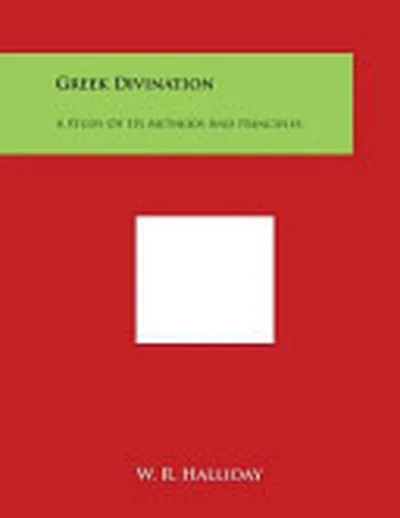
Greek Divination
 78
78

Greek Divination
Halliday’s "Greek Divination" offers a sober, almost anthropological, account of ancient Greek divinatory practices. It is commendable for its systematic approach, detailing methods from interpreting bird flight (augury) to the casting of dice. The strength lies in its thoroughness and its grounding in classical sources, avoiding the sensationalism that often plagues works on similar topics. However, this very restraint can feel like a limitation; the book often stops short of exploring the deeper psychological or even spiritual resonance these practices might have held for the Greeks themselves. A notable passage on the interpretation of dreams, while detailed, could have benefited from a more speculative exploration of their perceived efficacy. This is a scholarly resource, not a guide to ecstatic prophecy.
📝 Description
78
### What It Is Greek Divination presents a scholarly examination of the diverse methods of seeking divine knowledge and foretelling the future prevalent in ancient Greece. It moves beyond simple descriptions to analyze the social, religious, and psychological underpinnings of these practices. The work meticulously details various techniques, from the interpretation of omens and dreams to more complex forms like cleromancy (casting lots) and divination through natural phenomena.
### Who It's For This volume is intended for serious students of classical antiquity, comparative religion, and the history of esoteric thought. It will appeal to academics, researchers, and dedicated practitioners interested in the origins and evolution of divinatory systems. Those seeking a rigorous, evidence-based understanding of ancient Greek beliefs about fate and divine communication will find it particularly valuable.
### Historical Context First published in 1913, W. R. Halliday's Greek Divination emerged during a period of intense academic interest in ancient religious practices and folklore. This era saw scholars like Sir James Frazer publishing his monumental "The Golden Bough" (1890-1915), which explored comparative mythology and ritual. Halliday's work contributed to this burgeoning field by focusing specifically on the Greek context, providing detailed ethnographic and historical analysis that distinguished it from more speculative contemporary works. It was received as a solid academic study of a specific cultural phenomenon.
### Key Concepts The book explores the fundamental Greek worldview where divine will was not inscrutable but accessible through established channels. It highlights the role of oracles, such as Delphi, as central institutions for political and personal guidance. Halliday also examines the integration of divination into daily life, demonstrating how portents and signs were interpreted by individuals and communities to navigate uncertainty and align themselves with the favor of the gods.
💡 Why Read This Book?
• Understand the social function of oracles like Delphi, learning how ancient Greeks integrated divine consultation into statecraft and personal decision-making. • Explore the mechanics of cleromancy, grasping the specific techniques and beliefs surrounding the use of lots and dice for divine revelation. • Examine the interpretation of divine signs through phenomena like bird behavior (augury) and atmospheric events, as detailed in Halliday's analysis of ancient Greek omens.
⭐ Reader Reviews
Honest opinions from readers who have explored this book.
❓ Frequently Asked Questions
What specific ancient Greek divination methods does W. R. Halliday cover?
Halliday's "Greek Divination" details numerous methods, including augury (interpreting bird flight), divination by dreams, cleromancy (using lots or dice), interpreting omens from natural phenomena, and the consultation of oracles such as Delphi.
When was the original publication of W. R. Halliday's "Greek Divination"?
The original publication date for W. R. Halliday's "Greek Divination" was 1913, making this a significant early 20th-century study.
Is "Greek Divination" suitable for beginners interested in ancient Greek religion?
Yes, while scholarly, the book provides a foundational overview of Greek divinatory practices. Its clear organization and factual approach make it accessible for beginners seeking a serious introduction to the subject.
Does the book discuss the role of professional diviners in ancient Greece?
Yes, Halliday's work touches upon the social status and methods of professional diviners, including seers (manteis) and interpreters of omens, who played a recognized role in Greek society.
What is cleromancy as described in "Greek Divination"?
Cleromancy, as examined in the book, refers to divination by casting lots, stones, or dice. The outcome was interpreted as a direct message from the gods regarding a particular question or situation.
How does Halliday connect divination to Greek social and political life?
Halliday illustrates how divination was not merely a private superstition but was integrated into public life, influencing decisions made by individuals, city-states, and military leaders, often through the pronouncements of major oracles.
🔮 Key Themes & Symbolism
The Oracle as Institution
Halliday meticulously details the function and significance of major Greek oracles, most notably Delphi. This section explores how these sacred sites served as central conduits for divine communication, influencing not only personal choices but also the political and military strategies of city-states. The book examines the rituals, priestly roles, and the very architecture that supported these divinatory institutions, revealing them as integral to the fabric of Greek society and its understanding of fate.
Interpreting Divine Signs
A core theme is the systematic interpretation of signs and omens, ranging from the flight of birds (augury) to atmospheric disturbances and unusual natural events. Halliday breaks down the logic and prevalent beliefs behind these interpretations, showing how the Greeks perceived a world filled with divine messages. This requires understanding a specific semiotics where natural occurrences were not random but encoded communications from the gods, demanding careful observation and learned exegesis.
The Role of Dreams
The book dedicates significant attention to oneiromancy, the divination derived from dreams. Halliday discusses the belief that dreams could be direct divine communications, warnings, or prophecies. He analyzes various dream interpretation techniques and the cultural context that lent authority to these nocturnal visions, highlighting how individuals and communities relied on dream analysis to navigate uncertainty and seek guidance from the divine realm.
Cleromancy and Lot Casting
This theme focuses on cleromancy, the practice of divination by casting lots, stones, or dice. Halliday explains the mechanics of these methods and the underlying assumption that the gods guided the fall of the lots. This section elucidates how simple objects could become potent tools for decision-making when imbued with religious significance, serving as a direct means of resolving disputes or choosing between courses of action.
💬 Memorable Quotes
“The gods make known their will to men by various signs.”
— This paraphrased concept underscores the fundamental Greek belief that divine intention was not hidden but actively communicated through observable phenomena, forming the basis for all divinatory practices.
“Oracles were consulted on matters of state as well as private affairs.”
— This highlights the integral role of formal divination, particularly through oracular sites, in both public policy and personal decision-making within ancient Greek society.
“Dreams were often considered direct messages from the divine.”
— This captures the ancient Greek perspective on oneiromancy, where nocturnal visions were not seen as mere psychological projections but as potent channels for divine communication or prophecy.
“The casting of lots provided a direct means of divine decision.”
— This interpretation emphasizes the perceived efficacy of cleromancy, where the random fall of chosen objects was believed to be divinely directed, offering clear answers to pressing questions.
“Interpreting the flight of birds required specialized knowledge.”
— This points to the learned nature of practices like augury, suggesting that understanding divine will through natural signs involved a specific body of knowledge and trained interpreters, not just casual observation.
🌙 Esoteric Significance
Tradition
While Halliday's work is primarily a historical and anthropological study, it provides essential source material for understanding the practical application of divinatory arts within a classical context. It informs the Hermetic and Western Esoteric traditions by detailing the precursor systems upon which later magical and occult practices were often built or referenced. The book grounds esoteric studies in verifiable historical methods, offering a scholarly counterpoint to purely speculative approaches to ancient wisdom.
Symbolism
The book implicitly explores the symbolism inherent in divination. For example, the flight patterns of birds (augury) were imbued with symbolic meaning, where direction, number, and species conveyed specific divine messages. Similarly, the fall of lots in cleromancy transformed mundane objects into symbols of divine will, representing fate or divine preference in a tangible form accessible to all.
Modern Relevance
Contemporary practitioners of Hellenistic magic and Reconstructionist Paganism draw heavily on Halliday's meticulous research. His detailed accounts of oracular practices, dream interpretation, and omen reading provide foundational knowledge for those seeking to revive or understand ancient Greek religious and divinatory techniques in modern practice.
👥 Who Should Read This Book
• Students of Classical Studies and Ancient History: Gain a comprehensive understanding of religious practices beyond mythology, focusing on how Greeks sought divine guidance. • Researchers in Comparative Religion: Acquire detailed case studies on divinatory systems, useful for comparing practices across different cultures and historical periods. • Aspiring practitioners of Hellenistic Magic: Discover the foundational techniques and beliefs that underpin ancient Greek divinatory arts, essential for authentic reconstruction.
📜 Historical Context
W. R. Halliday's "Greek Divination" emerged in 1913, a period when classical scholarship was deeply engaged with comparative mythology, folklore, and the scientific study of religion. This era was marked by influential works like Sir James Frazer's "The Golden Bough" (first published 1890), which sought broad anthropological patterns in ritual and belief. Halliday’s contribution focused specifically on the Greek world, offering a more detailed, source-based analysis than some of his contemporaries. He navigated a scholarly landscape where evolutionary theories of religion were prevalent, often contrasting 'primitive' belief systems with developing rationalism. His work provided a grounded, empirical approach to understanding Greek divination, distinguishing it from more speculative philosophical treatises on fate and divine will.
📔 Journal Prompts
The mechanics of cleromancy and its perceived divine direction.
Halliday's analysis of the oracle at Delphi.
The symbolic meaning attributed to bird flight in augury.
Interpreting dreams as divine communication in ancient Greece.
The social role of the seer (manteis) in Greek society.
🗂️ Glossary
Augury
A form of divination practiced by the ancient Romans and Greeks, involving the observation and interpretation of the flight, calls, and behavior of birds.
Cleromancy
Divination by casting lots, dice, stones, or other small objects, the arrangement or selection of which was believed to reveal the will of the gods.
Manteis
The Greek term for diviners or seers, individuals believed to possess the ability to interpret divine signs and predict future events.
Oneiromancy
The practice of divination through dreams, where dreams were interpreted as messages, warnings, or prophecies from the gods.
Oracle
A person or agency considered to be a source of divine wisdom or prophecy, often associated with a specific sacred site like Delphi, where pronouncements were delivered.
Omen
An event or circumstance believed to be a sign or indication of future good or bad fortune; a portent.
Delphi
An ancient Greek sanctuary located on the slopes of Mount Parnassus, famous for its oracle of Apollo, considered the most authoritative oracle in the ancient world.