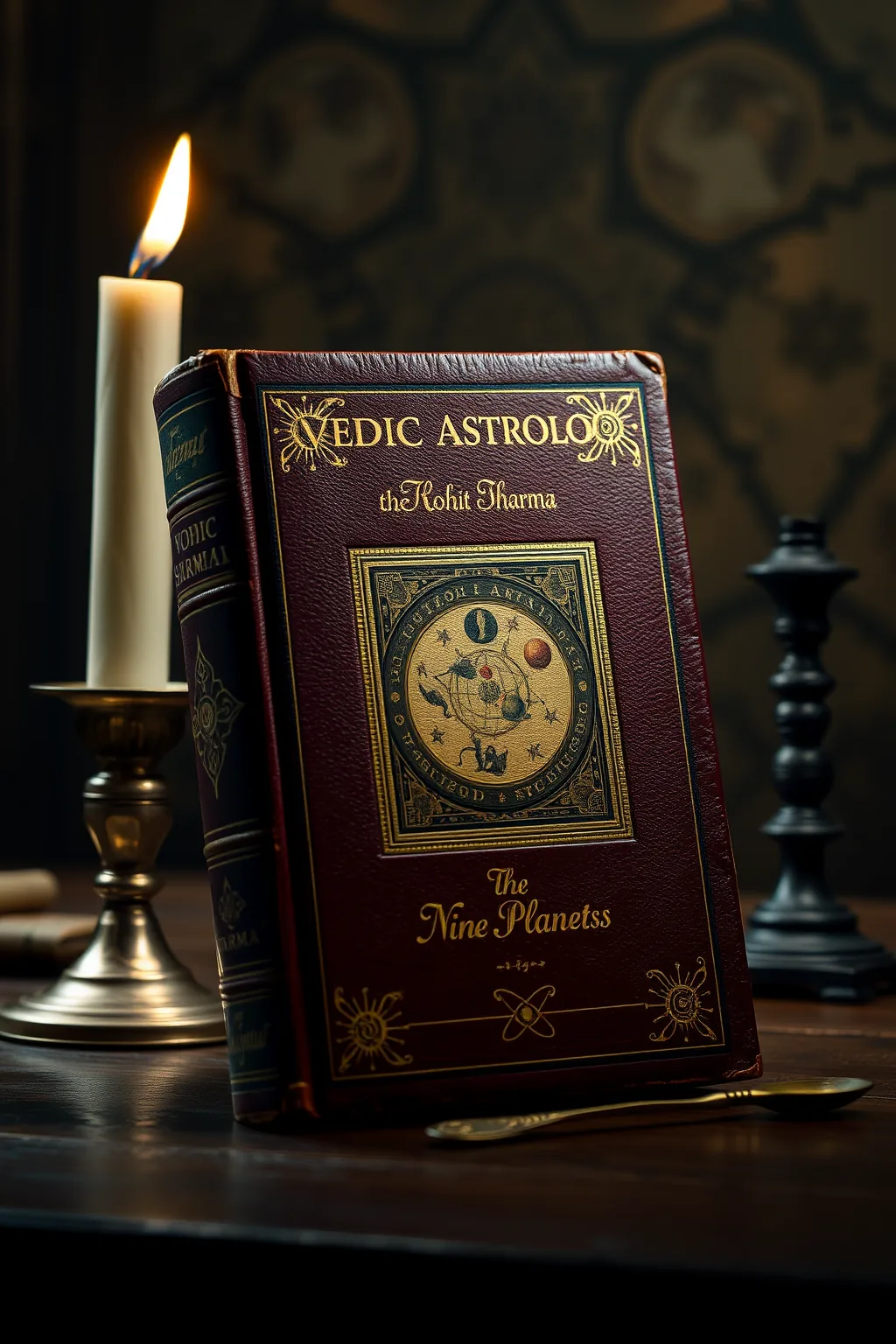
Vedic Astrology - The Nine Planets
 72
72

Vedic Astrology - The Nine Planets
Rohit Sharma's "Vedic Astrology - The Nine Planets" tackles a foundational aspect of Jyotish with commendable clarity. The book’s strength lies in its consistent framing of planets as extensions of consciousness, a perspective that elevates the study beyond mere predictive mechanics. Sharma's explanation of why specific planets represent certain psychological traits, particularly his detailed analysis of Rahu and Ketu, offers a valuable reframing for practitioners. A limitation, however, is the book's somewhat academic tone in parts, which might deter absolute beginners seeking immediate practical application. The section connecting astronomy to astrology, while informative, could benefit from more visual aids for complex orbital mechanics. Nevertheless, the work provides a solid, rationale-driven understanding of planetary symbolism. It serves as a competent guide for those wishing to grasp the psychological underpinnings of Vedic astrological principles.
📝 Description
72
Rohit Sharma's 2023 book details the nine grahas as components of human consciousness.
Rohit Sharma's "Vedic Astrology - The Nine Planets" approaches the celestial bodies within the Indian astrological tradition. The book examines the influence and symbolic meaning of each of the nine grahas, viewing them as integral parts of human consciousness. This perspective frames astrological study as a tool for self-understanding.
Sharma presents each planet as a facet of the psyche, explaining their associations with specific qualities and emotions. The work gives particular attention to Rahu and Ketu, the lunar nodes, and includes a substantial chapter on retrograde planets. The author also connects astronomical observation with astrological interpretation, explaining the relationship between celestial movements and their symbolic meanings in Vedic astrology. The book aims to establish a logical framework for astrological efficacy.
Beyond description, the text explores how planetary archetypes manifest in individual lives and collective consciousness. It examines the interplay of planets, providing a structure for understanding karma, destiny, and life events.
This work is situated within the Vedic astrological tradition, also known as Jyotish. This system, originating in ancient India, views celestial bodies not merely as physical objects but as carriers of karmic influences and psychological archetypes. Unlike Western astrology, which often uses a sidereal zodiac, Jyotish typically employs a sidereal zodiac and places significant emphasis on the lunar nodes (Rahu and Ketu) and planetary periods (dashas). Sharma's interpretation aligns with the tradition's focus on astrology as a science of self-knowledge and spiritual development, connecting cosmic patterns to individual consciousness.
💡 Why Read This Book?
• Gain a deeper understanding of planetary symbolism by exploring the specific psychological archetypes assigned to each of the nine grahas, as detailed in Sharma's foundational chapters, allowing for a more nuanced self-analysis. • Clarify the complex astrological significance of Rahu and Ketu, the lunar nodes, through dedicated explanations that offer insights into shadow aspects and karmic patterns unique to Vedic cosmology. • Reconcile astronomical facts with astrological interpretations by examining the chapter explaining how celestial movements correlate with planetary influences, providing a logical basis for astrology's accuracy.
⭐ Reader Reviews
Honest opinions from readers who have explored this book.
❓ Frequently Asked Questions
What is the primary focus of Rohit Sharma's "Vedic Astrology - The Nine Planets"?
The book focuses on elaborating the symbolic meanings and psychological correlations of the nine planets (grahas) in Vedic astrology, explaining why each planet represents specific facets of human consciousness and mental makeup.
Does "Vedic Astrology - The Nine Planets" explain Rahu and Ketu?
Yes, the book features a detailed description of Rahu and Ketu, the lunar nodes, exploring their significance within the Vedic astrological framework.
How does the book relate astronomy to astrology?
Sharma connects astronomical phenomena with astrological interpretations, aiming to demonstrate the logical basis and accuracy of Vedic astrology by showing how celestial mechanics inform planetary symbolism.
What is the significance of retrograde planets according to this book?
The book includes an elaborate chapter on retrograde planets, offering a detailed perspective on their influence that moves beyond simplistic interpretations and integrates them into the broader planetary dynamics.
Who would benefit most from reading "Vedic Astrology - The Nine Planets"?
Students of Vedic astrology, individuals interested in the psychological dimensions of celestial influences, and those seeking a rational explanation for astrological accuracy will find this book particularly beneficial.
When was "Vedic Astrology - The Nine Planets" first published?
The book was first published on July 28, 2014, offering a contemporary yet foundational perspective on Vedic astrological principles.
🔮 Key Themes & Symbolism
Planets as Consciousness Facets
The central thesis posits that the nine planets (grahas) in Vedic astrology are not external forces but rather distinct elements or parts of human consciousness. Sharma elaborates on how each planet corresponds to specific psychological tendencies, emotional patterns, and mental structures. This framing encourages a view of astrological charts as maps of the inner self, where planetary placements reveal the intricate workings of an individual's psyche and karmic blueprint.
Rahu and Ketu's Karmic Role
A significant portion of the book is dedicated to Rahu and Ketu, the shadow points of the Moon. Sharma elucidates their role as indicators of karma, past-life influences, and the soul's trajectory. Their influence is presented as crucial for understanding areas of obsession, illusion, spiritual detachment, and karmic resolution, offering a profound lens through which to examine life's challenges and opportunities.
The Logic of Astrological Accuracy
Sharma addresses the question of why astrology works with such precision by linking astrological principles directly to observable astronomical phenomena. The book explains the correlation between celestial movements and their symbolic representation in Vedic astrology, aiming to explain the practice and provide a rational foundation for its efficacy. This approach bridges the gap between empirical science and esoteric wisdom.
Retrograde Planets Re-examined
The work offers an elaborate chapter on retrograde planets, challenging conventional negative interpretations. Sharma presents a more nuanced view, suggesting that retrogradation indicates an internalization or a different mode of expression for the planet's energy. This perspective encourages readers to see retrogrades not as malefic influences but as opportunities for introspection and deeper integration of planetary energies.
💬 Memorable Quotes
Direct passages from the work, attributed to the author.
“Planets are not external forces; they are constituent parts of our consciousness.”
— This interpretation highlights the book's core premise: astrology as an internal psychology. It suggests that celestial bodies symbolically represent aspects of our own minds and inner states, making astrological study a path to self-understanding.
“Rahu and Ketu represent the soul's karmic path and its areas of intense focus or detachment.”
— This interpretation focuses on the significant role of the lunar nodes. It frames Rahu and Ketu as key indicators of where an individual's karmic lessons and spiritual evolution are most intensely engaged.
“Understanding each planet's connection to consciousness unlocks the deeper meanings of an astrological chart.”
— This interpretation underscores the book's psychological approach to astrology. It posits that by grasping the consciousness-based symbolism of the planets, one can achieve a more profound interpretation of natal charts.
💡 Key Ideas
Editorial paraphrase of the work's core concepts — not direct quotes.
The accurate functioning of astrology stems from its direct correlation with observable astronomical events.
This paraphrased concept emphasizes Sharma's effort to ground astrological efficacy in scientific observation. It suggests that the precision of astrology is not arbitrary but is rooted in the predictable movements of celestial bodies.
Retrograde planets signify an inward turn or a unique expression of their inherent energies.
This paraphrased concept reframes retrograde motion. Instead of viewing it as a purely negative influence, it suggests an introspective quality, prompting deeper personal engagement with the planet's archetype.
🌙 Esoteric Significance
Tradition
This work operates within the broad tradition of Vedic astrology (Jyotish), which is deeply rooted in Hindu philosophy and cosmology. While Jyotish itself is an ancient Vedic science, Sharma's interpretation aligns with modern esoteric thought that seeks to integrate astrological principles with psychological theories. It moves beyond a purely ritualistic or divinatory application, framing Jyotish as a tool for understanding consciousness, akin to how Hermeticism or Kabbalah are used in Western esoteric traditions for mapping the soul.
Symbolism
The primary symbols are the nine planets (Grahas): Surya (Sun), Chandra (Moon), Mangala (Mars), Budha (Mercury), Guru (Jupiter), Shukra (Venus), Shani (Saturn), Rahu, and Ketu. Each represents core archetypal energies within consciousness. For instance, Shani (Saturn) often symbolizes discipline, limitation, and karma, while Shukra (Venus) embodies love, beauty, and creative expression. Rahu and Ketu, the lunar nodes, symbolize the points of karmic entanglement and spiritual detachment, respectively, acting as potent symbols of destiny and illusion.
Modern Relevance
Modern practitioners of evolutionary astrology, psychological astrology, and even some Western esotericists find value in Sharma's detailed planetary explanations. Thinkers who focus on karma, soul purpose, and the subconscious mind often draw upon Vedic concepts. The work's emphasis on planets as facets of consciousness speaks to contemporary approaches that view astrological charts as psychological maps, making it relevant for self-development and therapeutic applications within esoteric frameworks.
👥 Who Should Read This Book
• Aspiring Vedic astrologers seeking a foundational understanding of planetary symbolism and their psychological correlations, moving beyond rote memorization. • Students of comparative spirituality interested in the intersection of astronomy and esoteric systems, particularly those looking for a rational framework for astrological efficacy. • Individuals exploring self-awareness and personal growth who wish to understand how celestial archetypes might mirror their inner psychological landscape.
📜 Historical Context
Published in 2014, Rohit Sharma's "Vedic Astrology - The Nine Planets" emerged during a period of resurgent interest in Eastern spiritual and philosophical traditions within Western esoteric circles. This era saw a proliferation of works attempting to synthesize ancient wisdom with modern psychological and scientific understanding. Sharma's book fits within the lineage of Jyotish scholarship that seeks to present the system not merely as a predictive tool but as a sophisticated map of consciousness, a trend amplified by figures like K.S. Krishnamurti, who advocated for simplified yet potent astrological analysis. While not facing overt censorship, the reception of such works often navigates the skepticism of empirical science, with proponents like Sharma emphasizing the observable astronomical basis to lend credibility. The book's approach, grounding astrological concepts in psychology and astronomy, reflects a broader intellectual current in the early 21st century aiming to bridge the esoteric and the rational.
📔 Journal Prompts
The manifestation of Shani's discipline in daily routines.
Reflecting on Rahu's influence on current desires and aspirations.
Interpreting the symbolic meaning of a retrograde planet in your personal chart.
Connecting Budha's communicative style with interpersonal interactions.
Exploring the inner resonance of Surya's core identity symbolism.
🗂️ Glossary
Graha
In Vedic astrology, a Graha refers to a 'seizer' or 'planet'. There are nine principal Grahas: the Sun, Moon, Mars, Mercury, Jupiter, Venus, Saturn, and the lunar nodes Rahu and Ketu.
Jyotish
The traditional Sanskrit name for Vedic astrology, meaning 'the science of light'. It is considered one of the Vedangas, or auxiliary disciplines of the Vedas.
Rahu
The ascending lunar node, often considered a shadow planet representing obsession, worldly desires, illusion, and karmic patterns related to material pursuits.
Ketu
The descending lunar node, often associated with detachment, spirituality, liberation, past-life karma, and intuition.
Retrograde Planet
A celestial body whose apparent motion along the ecliptic is reversed from the usual direction. In Vedic astrology, this is often interpreted as an internalization or a unique expression of the planet's energy.
Consciousness
In the context of this book, consciousness refers to the entirety of mental and psychological experience, including awareness, thought, emotion, and perception, which the planets are said to represent aspects of.
Mental Make-up
The intrinsic psychological characteristics and patterns of an individual's thinking, feeling, and behaving, which the book relates to the influences of the nine planets.

![[ Stephen Arroyo] Astrology](/img/thumb/stephen-arroyo-astrology.webp)