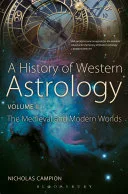
A History of Western Astrology Volume II
 73
73

A History of Western Astrology Volume II
Nicholas Campion's *A History of Western Astrology Volume II* offers a meticulously researched account of astrology's intellectual journey through an important era. The strength lies in its detailed examination of how astrological concepts permeated university curricula and royal courts, moving beyond simplistic notions of fortune-telling. Campion effectively demonstrates that in the late medieval and Renaissance periods, astrology was considered a serious, if debated, branch of knowledge. A limitation, however, is the sheer density of the material; readers unfamiliar with medieval scholasticism or Renaissance humanism may find certain sections challenging. The discussion of astrological medicine, particularly its connection to humoral theory, is a standout, illustrating the practical application of celestial principles to human health. This volume solidifies its place as an indispensable scholarly resource for understanding astrology's sophisticated historical role.
📝 Description
73
Nicholas Campion's second volume covers Western astrology from the late medieval era through the early modern period.
This book examines the evolution of Western astrological thought and practice from the late medieval period through the Renaissance and into the early modern era. It details how astrology was deeply woven into the intellectual, political, and cultural fabric of Western civilization during this time. The work moves beyond popular practice to investigate the sophisticated theoretical structures developed by scholars and practitioners, including the philosophical ideas that supported them. It shows how astrological concepts shaped fields such as medicine, theology, and natural philosophy.
The book is intended for students of esoteric history, intellectual history, and the history of science. Academics, researchers, and dedicated astrology practitioners seeking a thorough understanding of its historical development will find value here. Readers interested in the medieval and Renaissance periods, the relationship between science and religion, or the cultural role of celestial divination will encounter substantial material. The text suits those who prefer detailed scholarship and a critical look at historical sources over a general overview.
This volume situates astrology within the intellectual currents of late medieval and Renaissance Europe, a period when it was considered a respected discipline rather than a fringe belief. It highlights the syncretic nature of thought, where classical, Arabic, and Christian traditions converged, and how astrology served as a framework for understanding the cosmos. The book demonstrates astrology's integration into universities and royal courts, indicating its widespread acceptance among educated elites and its use in advising rulers. This historical context reveals astrology's role as a tool for interpreting divine will and natural phenomena.
⭐ Reader Reviews
Honest opinions from readers who have explored this book.
❓ Frequently Asked Questions
What specific time period does Volume II of A History of Western Astrology cover?
Volume II primarily covers the late medieval, Renaissance, and early modern periods of Western history, tracing astrological thought from roughly the 13th century through the 17th century.
Was astrology considered a legitimate field of study during the Renaissance?
Yes, during the Renaissance, astrology was widely considered a legitimate, albeit debated, field of study, integrated into university curricula and practiced by scholars and physicians.
How did astrology influence medicine in the periods discussed?
Astrology heavily influenced medicine through the doctrine of astrological medicine, which linked planetary positions and influences to bodily humors, diseases, and the efficacy of treatments.
Who were some key figures or thinkers discussed in relation to astrology during this era?
The book discusses numerous figures, including scholars and practitioners who engaged with complex astrological theories, and mentions figures like Johannes Kepler who operated within this intellectual milieu.
Does this book focus on the popular practice of astrology or its academic/intellectual aspects?
This volume focuses on the academic, intellectual, and philosophical aspects of astrology, examining its theoretical frameworks and integration into scholarly discourse, rather than solely its popular applications.
What is electional astrology as discussed in Volume II?
Electional astrology is a branch of astrology focused on determining the most auspicious moment to begin an undertaking, such as a marriage, a business venture, or a journey, as explored in the book's treatment of practical astrological applications.
🔮 Key Themes & Symbolism
Astrology in Higher Education
This work details how astrology was not relegated to the margins but was an established part of the medieval and Renaissance university system. It examines the curriculum, the debates among scholars, and the integration of astrological principles into fields like astronomy and natural philosophy. The book highlights how figures like Johannes Kepler, though also a mathematician, operated within an era where astrology was a recognized, if sometimes controversial, academic pursuit, influencing the intellectual range of the time.
Celestial Influence on Human Life
Volume II extensively explores the sophisticated theories concerning celestial influence on human existence. This includes astrological medicine, where planetary positions were believed to affect bodily humors and health outcomes, and the philosophical discussions surrounding determinism versus free will. The book explores how practitioners used astrological charts to understand character, predict potential events, and determine optimal timings for actions, demonstrating a complex worldview where the cosmos and human affairs were inextricably linked.
Theological and Philosophical Debates
A significant aspect of this volume is its examination of the intricate theological and philosophical debates surrounding astrology. Campion illustrates how scholars grappled with reconciling celestial determinism with concepts of divine providence and human agency. The work explores arguments that sought to legitimize astrology within Christian frameworks, or conversely, those that challenged its compatibility with religious doctrine, showcasing the intellectual ferment of the period.
Practical Applications of Astrology
Beyond theoretical discussions, the book addresses the practical applications of astrology that were prevalent during the late medieval and Renaissance eras. This encompasses horary astrology, used to answer specific questions, and electional astrology, employed to find propitious moments for commencing significant undertakings like building projects, marriages, or voyages. The detailed analysis of these practices reveals astrology's embeddedness in daily life and decision-making.
💬 Memorable Quotes
Direct passages from the work, attributed to the author.
“Medieval and Renaissance Europe marked the high water mark for astrology.”
— This statement captures the book's central thesis regarding the period's academic and cultural integration of astrology, positioning it as a peak of its influence before later shifts in scientific and philosophical paradigms.
“Astrology was a subject of high theological speculation.”
— This highlights that astrology was not merely a folk practice but a topic debated by theologians, indicating its intellectual weight and its complex relationship with religious doctrine during the historical periods covered.
“It was used to advise kings and popes.”
— This points to the practical political and religious influence of astrology, illustrating its role in decision-making at the highest levels of power, underscoring its perceived utility and authority.
“The work explores the sophisticated theoretical frameworks developed by scholars and practitioners.”
— This interpretation emphasizes the book's focus on the intellectual depth and complex systems of astrology, distinguishing it from simplistic popular forms and positioning it as a subject of serious scholarly inquiry.
“The influence of Ptolemy's Tetrabiblos and its commentaries remains a significant thread.”
— This suggests the foundational importance of ancient astrological texts and their subsequent interpretations throughout the medieval and Renaissance periods, indicating a continuous lineage of astrological thought.
🌙 Esoteric Significance
Tradition
This work fits within the broad Hermetic and Neoplatonic traditions of Western esotericism, which emphasize the interconnectedness of the cosmos and the influence of celestial bodies on earthly affairs. It traces a lineage that sought to understand the divine through the study of natural phenomena, particularly the stars and planets. Campion's scholarship positions astrology not as a mere predictive tool but as a complex philosophical system integral to understanding the medieval and Renaissance worldview, aligning with esoteric pursuits that seek hidden knowledge and cosmic order.
Symbolism
Key symbols explored include the zodiacal signs and planets, not merely as astronomical bodies but as potent archetypal forces influencing human character and destiny. The concept of the 'celestial spheres' and their harmonious movements represents a cosmic order reflecting divine intelligence. Additionally, the book explores the symbolism inherent in astrological medicine, where the association of planets with specific humors and organs reveals a holistic understanding of the human body as a microcosm reflecting the macrocosm.
Modern Relevance
Contemporary Western esotericism, particularly in psychological astrology and modern Hermeticism, draws heavily on the historical foundations detailed in this volume. Thinkers and practitioners who seek to understand archetypal patterns, the integration of psyche and cosmos, and the philosophical underpinnings of celestial interpretation find value in Campion's meticulous research. The work informs modern discussions on the history of science and the enduring human impulse to find meaning in cosmic patterns, influencing schools of thought that look to historical esoteric systems for contemporary wisdom.
👥 Who Should Read This Book
["• Academic historians and students of intellectual history seeking a comprehensive overview of astrology's role in medieval and Renaissance society, gaining detailed insights into its integration with science and religion.", '• Dedicated practitioners of Western esotericism and astrology who wish to deepen their understanding of the historical roots and philosophical complexities of their craft, moving beyond modern interpretations to source material.', '• Researchers in comparative religion and philosophy interested in how celestial divination shaped worldviews and theological discourse during an important period of Western thought, understanding its interplay with established doctrines.']
📜 Historical Context
The late medieval and Renaissance periods represented a golden age for astrology in Western Europe, a time when it was deeply embedded within intellectual, political, and cultural life. Far from being a marginal belief, it was a respected discipline studied in universities, influencing fields as diverse as medicine, theology, and natural philosophy. Figures like Johannes Kepler, a renowned astronomer and mathematician, also practiced astrology, illustrating the era's integrated approach to celestial studies. The intellectual climate was one of expansive inquiry, where classical, Arabic, and Christian traditions were synthesized. While the Church's attitude varied, astrology was frequently employed to advise monarchs and papal courts. The advent of the printing press in the 15th century facilitated the widespread dissemination of astrological texts, further solidifying its pervasiveness. Competing with this was the burgeoning empirical scientific method, which would eventually challenge astrology's standing, though its influence remained considerable well into the 17th century.
📔 Journal Prompts
The astrological significance of the late medieval and Renaissance periods.
Integration of astrology into medieval university curricula.
The concept of astrological medicine and humoral theory.
Philosophical debates on celestial determinism versus free will.
The practical application of electional astrology in historical contexts.
🗂️ Glossary
Astrological Medicine
A system of healing that linked the health and temperament of individuals to the positions and influences of celestial bodies, often in conjunction with humoral theory.
Horary Astrology
A branch of astrology focused on answering specific questions posed by a querent, based on the astrological chart cast for the moment the question is understood.
Electional Astrology
The practice of selecting the most auspicious time to begin an undertaking, such as a marriage, business venture, or journey, based on astrological principles.
Humoral Theory
An ancient medical doctrine positing that the body is composed of four basic fluids (blood, phlegm, yellow bile, and black bile), and that health depends on their balance.
Determinism
The philosophical concept that all events, including human actions, are predetermined and inevitable, often debated in relation to astrological influence.
Ptolemy's Tetrabiblos
An influential ancient astrological treatise by Claudius Ptolemy, considered a foundational text for Western astrology for centuries, extensively studied and commented upon.
Natural Philosophy
The historical term for the study of nature and the physical universe, encompassing what we now call science, before the scientific revolution solidified distinct disciplines.