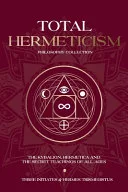
Total Hermeticism Philosophy Collection
 82
82

Total Hermeticism Philosophy Collection
The "Total Hermeticism Philosophy Collection" presents a formidable gathering of texts that have shaped esoteric discourse for centuries. Its strength lies in the sheer breadth of material, offering the foundational Hermetica alongside the distilled principles of The Kybalion and the expansive survey of The Secret Teachings of All Ages. Reading the Hermetica in conjunction with Hall’s later synthesis provides a compelling contrast between ancient source material and modern interpretation. However, the juxtaposition can also highlight significant conceptual leaps and potential misinterpretations, particularly when The Kybalion’s more dogmatic pronouncements are placed next to the philosophical nuances of the Corpus Hermeticum. A passage that exemplifies this is the discussion of the Principle of Gender in The Kybalion, which, while concise, lacks the allegorical depth found in the Hermetica's treatment of divine creation and duality. This collection is best approached by readers already familiar with the subject matter, who can critically engage with the varying perspectives presented.
📝 Description
82
This compilation brings together The Kybalion, the Hermetica, and Manly P. Hall's survey of esoteric thought.
This collection gathers significant texts on Western esotericism. It includes the Hermetica, dialogues attributed to Hermes Trismegistus; The Kybalion, a 1908 distillation of Hermetic principles by the "Three Initiates"; and Manly P. Hall's extensive 1928 encyclopedia, The Secret Teachings of All Ages. The aim is to present a unified resource for understanding the philosophical basis of many spiritual traditions.
This volume suits those seriously studying esoteric philosophy, practicing Hermetic arts, or researching comparative religion. It will appeal to individuals interested in the foundations of Western mysticism, Kabbalah, alchemy, and astrology. Readers examining the historical development of occult thought and its cultural influence will find this a useful reference.
The Hermetica, from Hellenistic Egypt (1st-3rd centuries CE), blends Greek philosophy with Egyptian religion. The Kybalion (1908) offers a modern interpretation through seven axioms. Hall's work (1928) surveys ancient religions and mystical philosophies, drawing heavily on Hermeticism and Theosophy. Together, these texts map a lineage of Western esoteric thought, from ancient roots to early 20th-century interpretations.
💡 Why Read This Book?
• Gain direct exposure to the ancient Hermetica, understanding the original dialogues attributed to Hermes Trismegistus, which form the bedrock of Western esoteric thought. • Grasp the Seven Principles outlined in The Kybalion, such as the Principle of Vibration, and learn how these axioms are presented as universal laws governing existence. • Explore Manly P. Hall's extensive research in The Secret Teachings of All Ages, examining his connections between Hermeticism and diverse global spiritual systems, including ancient Egyptian mythology.
⭐ Reader Reviews
Honest opinions from readers who have explored this book.
❓ Frequently Asked Questions
What is the historical origin of the Hermetica texts included in this collection?
The Hermetica are ancient Greek writings from Hellenistic Egypt, likely compiled between the 1st and 3rd centuries CE. They are attributed to Hermes Trismegistus, a syncretic figure blending the Greek god Hermes and the Egyptian god Thoth.
Who were the 'Three Initiates' mentioned as authors of The Kybalion?
The identity of the 'Three Initiates' remains anonymous. This group published The Kybalion in 1908, presenting a modern interpretation and distillation of Hermetic philosophy into seven core principles.
What is the significance of 'As Above, So Below' in Hermetic philosophy?
This famous Hermetic axiom, prominently featured in the Emerald Tablet and the Hermetica, signifies the principle of correspondence. It posits that the microcosm (humanity, the Earth) mirrors the macrocosm (the universe, the divine).
How does The Secret Teachings of All Ages relate to the other texts?
Manly P. Hall's work serves as a comprehensive encyclopedic survey, contextualizing Hermeticism within a vast array of global mystical traditions, ancient religions, and symbolic systems, drawing connections and influences.
Is this collection suitable for beginners in esoteric studies?
While comprehensive, the density of the Hermetica and Hall's expansive research may be challenging for absolute beginners. However, The Kybalion offers a more accessible entry point to core Hermetic principles.
When was the first publication date for the individual works in this collection?
The Hermetica's texts date back to antiquity. The Kybalion was first published in 1908, and Manly P. Hall's The Secret Teachings of All Ages was first published in 1928.
🔮 Key Themes & Symbolism
The Seven Principles
Central to The Kybalion, these principles—Mentalism, Correspondence, Vibration, Polarity, Rhythm, Cause and Effect, and Gender—are presented as fundamental laws of the universe. The collection allows for examination of how these axioms are derived from or interpreted through the more philosophical Hermetica and Hall's broader surveys, offering a layered understanding of cosmic order and human potential.
Divine Correspondence
The principle of 'As Above, So Below' is a recurring motif, linking the celestial and terrestrial realms. This theme is explored through the Hermetica's dialogues on creation and the nature of God, and further elaborated in Hall's work by drawing parallels with creation myths and symbolic systems from various cultures, illustrating the interconnectedness of all things.
The Path to Illumination
The texts collectively address the human quest for spiritual understanding and liberation. From the Hermetica's teachings on the soul's journey to the afterlife, to The Kybalion's focus on mental mastery, and Hall's mapping of esoteric traditions, the collection offers diverse perspectives on achieving higher consciousness and gnosis.
Ancient Wisdom Traditions
This compilation serves as a gateway to the roots of Western esotericism. It highlights Hermeticism's influence on alchemy, astrology, Kabbalah, and Gnosticism, demonstrating how its core tenets have permeated subsequent mystical and philosophical movements throughout history.
💬 Memorable Quotes
Direct passages from the work, attributed to the author.
“The lips of wisdom are closed, except to the ears of Understanding.”
— This aphorism from The Kybalion suggests that true esoteric knowledge is not readily available to everyone. It requires a prepared mind and a genuine desire for wisdom to perceive and comprehend profound truths.
“For the mind is the measure of all things.”
— A core tenet of Mentalism, this statement emphasizes the power of consciousness and thought. It suggests that reality is fundamentally mental and that our perception and understanding shape our experience of the world.
“The All is Mind; The Universe is Mental.”
— This is the first Hermetic Principle, Mentalism, presented in The Kybalion. It posits a monistic view where the ultimate reality is a universal, infinite mind, and the cosmos is its manifestation.
💡 Key Ideas
Editorial paraphrase of the work's core concepts — not direct quotes.
Know then, that the world is ruled by a certain law, and that nothing happens in the world by chance or accident.
This quote, reflecting the Principle of Cause and Effect, highlights the deterministic aspect of Hermetic philosophy. It implies an ordered universe governed by immutable principles, where events are interconnected chains of causation.
Man is the measure of all things; of the things that are, that they are; of the things that are not, that they are not.
This is a paraphrase of a concept found in the Hermetica, echoing the Greek Sophists. It emphasizes humanity's central role in perceiving and defining reality, linking to the Principle of Mentalism.
🌙 Esoteric Significance
Tradition
This collection sits firmly within the Hermetic tradition, one of the foundational pillars of Western esotericism. It is a primary source for understanding the philosophical and mystical lineage that predates and heavily influenced Gnosticism, Kabbalah, alchemy, and later Theosophical and New Age movements. The texts provide a direct link to ancient concepts of cosmology, divine nature, and human potential.
Symbolism
Key symbols include the Caduceus, representing the union of opposites and the flow of divine energy, often associated with healing and balance. The Emerald Tablet, containing the core Hermetic axiom 'As Above, So Below,' symbolizes the tablet on which Hermes Trismegistus inscribed the secrets of alchemy and the universe. The concept of the All, or the One, is a recurring motif representing the ultimate, unified divine source from which all manifest reality emanates.
Modern Relevance
Contemporary practitioners of Western esoteric traditions, including ceremonial magicians, Rosicrucians, and alchemists, continue to draw directly from the Hermetica and The Kybalion for foundational principles. Philosophers and spiritual seekers exploring consciousness, quantum physics analogies, and the nature of reality often reference Hermetic concepts, finding relevance in its ancient inquiries into the mind and the cosmos.
👥 Who Should Read This Book
• Aspiring practitioners of Hermetic arts: Gain access to the foundational texts that inform modern magical and alchemical practices, understanding core principles like Mentalism and Correspondence. • Students of comparative religion and philosophy: Examine the historical roots and cross-cultural influences of Hermetic thought, comparing its ideas with Gnosticism, Neoplatonism, and Eastern philosophies. • Individuals seeking a deeper understanding of esoteric cosmology: Explore the ancient concepts of divine unity, the nature of the soul, and the interconnectedness of the universe as presented in these seminal works.
📜 Historical Context
The Hermetica, texts attributed to the legendary Hermes Trismegistus, emerged from Hellenistic Egypt, a melting pot of Greek, Egyptian, and Jewish thought, likely between the 1st and 3rd centuries CE. This period saw a flourishing of philosophical schools, including Neoplatonism, which shared an interest in divine revelation and cosmology. The Corpus Hermeticum, a collection of these dialogues, was rediscovered in Renaissance Europe, profoundly influencing thinkers like Marsilio Ficino and Giordano Bruno, and fueling the Hermetic revival. The Kybalion, published in 1908 by the anonymous "Three Initiates," represented a modern, distilled interpretation of these ancient principles, appearing during a surge of interest in occultism and spiritualism, a movement that also saw figures like Helena Blavatsky and the Theosophical Society gaining prominence. Manly P. Hall’s expansive The Secret Teachings of All Ages, first published in 1928, further synthesized these ideas with a vast array of global mythologies and esoteric systems, positioning Hermeticism within a broader historical and comparative religious framework.
📔 Journal Prompts
The Principle of Vibration and its manifestation in daily life.
Hermes Trismegistus's concept of the divine mind.
The symbolic meaning of the Caduceus in Hermeticism.
Reflecting on the Principle of Correspondence between the human and the cosmic.
The role of understanding in receiving Hermetic wisdom.
🗂️ Glossary
Hermeticism
A philosophical and religious tradition based on writings attributed to Hermes Trismegistus. It emphasizes divine wisdom, the interconnectedness of all things, and the pursuit of spiritual illumination through understanding cosmic laws.
Corpus Hermeticum
A collection of Greek philosophical and religious treatises attributed to Hermes Trismegistus, dating from the 2nd and 3rd centuries CE. It covers topics ranging from theology and cosmology to ethics and alchemy.
The Kybalion
A book published in 1908 by the 'Three Initiates,' presenting a modern interpretation of Hermetic philosophy through seven core principles, intended to be a simplified guide to the ancient wisdom.
As Above, So Below
A fundamental Hermetic axiom stating that the principles and laws governing the universe (the macrocosm) are reflected in the workings of the individual and the Earth (the microcosm).
Mentalism
The First Hermetic Principle, stating 'The All is Mind; The Universe is Mental.' It posits that reality is fundamentally mental and shaped by thought and consciousness.
Principle of Correspondence
The Second Hermetic Principle, encapsulated by 'As Above, So Below.' It highlights the mirroring relationship between different planes of existence, from the spiritual to the material.
Gnosis
Spiritual knowledge or insight, particularly in a Gnostic context. Hermeticism also emphasizes the attainment of higher knowledge as a path to liberation and understanding of the divine.