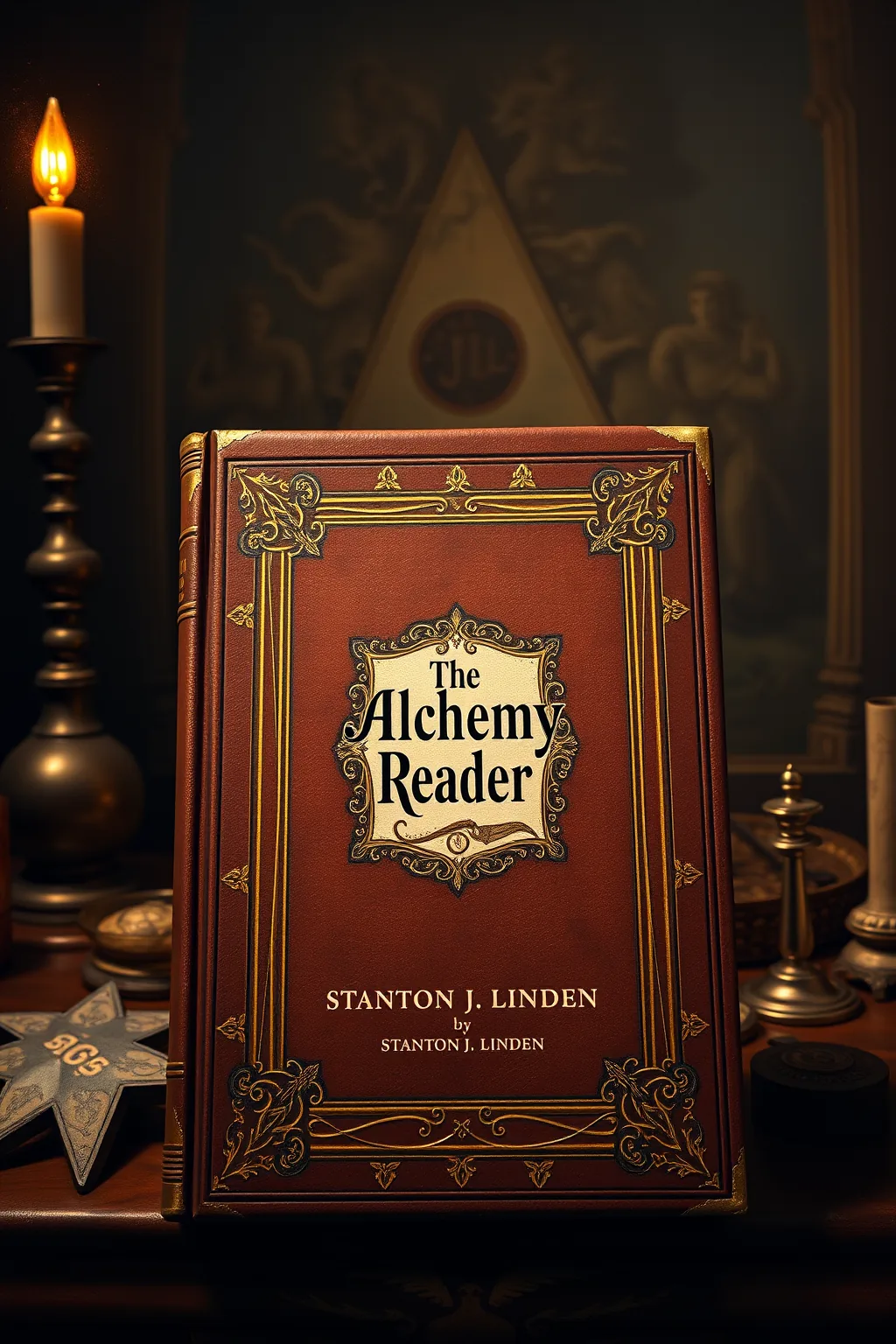
The alchemy reader
 73
73

The alchemy reader
Stanton J. Linden’s compilation, *The Alchemy Reader*, provides a valuable, albeit densely academic, survey of Western alchemical texts. Its strength lies in its judicious selection of source material, offering a coherent narrative arc through the evolution of alchemical ideas. The inclusion of excerpts from figures like Nicolas Flamel and Paracelsus, presented with scholarly apparatus, allows for a focused study of their contributions. However, the book’s academic rigor can also be its limitation; the language and contextualization are geared towards specialists, potentially alienating the casual seeker of alchemical lore. A particularly illustrative section might be the discussion of the *Mysterium Magnum*, where Linden elucidates Jakob Böhme's mystical interpretations, showcasing the text's capacity to bridge philosophical and theological discourse. Ultimately, *The Alchemy Reader* serves as a robust academic resource for understanding alchemy’s historical textual tradition.
📝 Description
73
Stanton J. Linden's 2003 compilation offers a scholarly look at Western alchemy's historical writings.
The Alchemy Reader, compiled and introduced by Stanton J. Linden, provides a scholarly entry point into the complex world of Western alchemical texts. Published in 2003, this volume selects primary sources that cover centuries of alchemical thought and practice. It focuses on the philosophical, spiritual, and symbolic meanings of alchemy as found in historical documents, rather than on practical laboratory instructions.
This collection is intended for students and academics interested in esoteric traditions, comparative religion, and the history of science. It will appeal to those who view alchemy as a symbolic system connected to Gnosticism, Hermeticism, and Renaissance Neoplatonism, going beyond its roots in early chemistry. Readers should have a background in historical philosophy and be prepared to engage with older, complex writing styles.
Linden's work arrives in an academic climate that revived interest in alchemy, moving past earlier romantic views. It connects alchemy to broader Renaissance intellectual movements, influenced by scholars who placed it within wider historical currents. Published in 2003, the book benefits from digital scholarship while still valuing curated print anthologies for concentrated study of these historical traditions.
💡 Why Read This Book?
• Gain direct access to foundational alchemical texts, such as passages from Paracelsus, allowing for an appreciation of their original language and conceptual frameworks distinct from modern interpretations. • Understand the historical evolution of key alchemical concepts like the *prima materia* and the *Magnum Opus* as presented through primary sources from the 17th century and earlier, offering a nuanced view of their development. • Explore the symbolic lexicon of alchemy, including the significance of metals and planetary correspondences, as discussed within the context of specific historical alchemical writings compiled by Linden.
⭐ Reader Reviews
Honest opinions from readers who have explored this book.
❓ Frequently Asked Questions
What historical periods does The Alchemy Reader primarily cover?
The Alchemy Reader spans a significant period of Western alchemical thought, with its selections drawing from texts that largely originate from the late medieval era through the early modern period, offering insights into alchemical ideas as they developed over several centuries.
Is The Alchemy Reader suitable for beginners in occult studies?
While it provides foundational texts, the reader is academically oriented and assumes some prior knowledge of historical philosophy and esoteric traditions, making it more suited for intermediate students or scholars.
Who was Stanton J. Linden?
Stanton J. Linden is an editor and scholar known for his work on esoteric literature. His compilation, The Alchemy Reader, reflects his expertise in presenting historical alchemical texts for academic study.
What is the 'Great Work' in the context of alchemy as presented in the book?
The 'Great Work,' or *Magnum Opus*, as explored in The Alchemy Reader, refers to the ultimate alchemical objective, encompassing both the creation of the philosopher's stone and profound spiritual transformation of the practitioner.
Does The Alchemy Reader include practical alchemical recipes?
No, The Alchemy Reader focuses on the philosophical, symbolic, and theoretical aspects of alchemy, rather than providing practical laboratory instructions or recipes for chemical operations.
What distinguishes this reader from other books on alchemy?
Its distinction lies in its curated selection of primary source excerpts with scholarly introductions, offering a focused academic perspective on the historical and conceptual evolution of Western alchemy, as opposed to more general overviews or purely theoretical discussions.
🔮 Key Themes & Symbolism
The Philosopher's Stone
The text engages deeply with the concept of the Philosopher's Stone, not merely as a mythical substance for transmuting base metals into gold, but as a symbol for spiritual perfection, divine knowledge, or ultimate redemption. Linden's selections illustrate how various authors, from the medieval period onward, interpreted this central tenet of the Great Work, reflecting its many-sided significance within alchemical philosophy and its connection to spiritual liberation.
Symbolic Language of Alchemy
A significant theme is the intricate symbolic language employed by alchemists to veil their teachings. The reader showcases how symbols like the dragon, the lion, celestial bodies, and specific colors (nigredo, albedo, rubedo) were used to represent stages of material and spiritual transformation. Linden's presentation highlights how deciphering this symbolic lexicon is crucial for understanding the deeper, often Gnostic or Hermetic, meanings embedded in alchemical treatises.
The Great Work and Transformation
The collection underscores the concept of the 'Great Work' (*Major work*) as a process of both external material transformation and internal spiritual purification. Selections explore how alchemists viewed their practice as a path to understanding divine principles and achieving a state of wholeness or 'reintegration.' This theme reveals alchemy's profound philosophical underpinnings, linking it to broader mystical and Neoplatonic traditions of seeking unity and enlightenment.
Alchemy and Esoteric Traditions
The reader positions alchemy within its broader historical and esoteric context, demonstrating its connections to Hermeticism, Gnosticism, Kabbalah, and early modern mysticism. It illustrates how alchemical ideas often served as a vehicle for expressing theological, philosophical, and cosmological concepts that were sometimes at odds with prevailing orthodoxies, making it a key area of study for understanding Western esotericism.
💬 Memorable Quotes
Direct passages from the work, attributed to the author.
“The Work is one, the Matter is one, the Vessel is one, the Operation is one.”
— This concise statement, often attributed to alchemical literature, emphasizes the unity and interconnectedness of the alchemical process. It suggests that the transformation of matter and the spiritual development of the practitioner are inseparable aspects of a singular, holistic endeavor.
“Seek the hidden nature of things, for therein lies the secret.”
— This concept, representative of alchemical inquiry, points to the belief that true understanding and the power of transmutation are found not on the surface, but within the hidden essences and fundamental principles of the natural world.
“The seven metals correspond to the seven planets.”
— This refers to a core symbolic correspondence in alchemy, where each of the known metals (e.g., lead, tin, iron, copper, mercury, silver, gold) was associated with a celestial body (e.g., Saturn, Jupiter, Mars, Venus, Mercury, Moon, Sun), forming a system of correspondences vital for alchemical theory and practice.
💡 Key Ideas
Editorial paraphrase of the work's core concepts — not direct quotes.
The Stone is not made by the hand, but by the spirit.
This paraphrase captures a frequent sentiment in alchemical texts, highlighting that the creation of the Philosopher's Stone and the attainment of alchemical wisdom are primarily spiritual or intellectual achievements, rather than purely mechanical ones.
The black stage is the beginning of the Art.
This paraphrase points to the *nigredo*, the initial phase of the alchemical process, often symbolized by blackness, representing dissolution, putrefaction, and the necessary breakdown of the *prima materia* before purification and transformation can occur.
🌙 Esoteric Significance
Tradition
This work is situated within the Western Esoteric Tradition, drawing heavily from Hermeticism, Renaissance Neoplatonism, and early modern Christian mysticism. It serves as a vital bridge, illustrating how alchemical symbolism and philosophy provided a unique language for exploring concepts of divine creation, spiritual regeneration, and the hidden order of the cosmos, often as an alternative or complement to more orthodox religious or philosophical systems.
Symbolism
Key symbols explored include the *prima materia*, representing the chaotic, undifferentiated potential from which all things arise and the starting point of the alchemist's transformative quest. The Philosopher's Stone is central, symbolizing not just material transmutation but spiritual perfection and divine union. The cyclical stages of the Great Work—nigredo (blackening), albedo (whitening), and rubedo (reddening)—represent the processes of dissolution, purification, and completion, mirroring stages of spiritual awakening and cosmic renewal.
Modern Relevance
Contemporary practitioners and scholars of Hermeticism, Rosicrucianism, and various forms of Western ceremonial magic often reference the historical alchemical texts represented in Linden's reader. Its importance lies in providing direct textual evidence for the philosophical underpinnings of these modern traditions, offering insights into their symbolic systems and spiritual methodologies. Thinkers and artists interested in the historical interplay between science, religion, and mysticism also find value in its exploration of a pre-modern worldview.
👥 Who Should Read This Book
• Students of the History of Science and Western Esotericism: Those seeking to understand alchemy's role as a philosophical and proto-scientific discipline will benefit from the curated primary source excerpts and scholarly context. • Scholars of Renaissance and Early Modern Philosophy: Researchers interested in the intellectual currents of the period will find valuable material demonstrating the integration of mystical, philosophical, and practical pursuits. • Aspiring Alchemists and Hermeticists: Individuals interested in the theoretical and symbolic foundations of alchemy can gain a foundational understanding of its core concepts and historical expressions.
📜 Historical Context
Published in 2003, *The Alchemy Reader* arrives in an academic landscape that had long moved past viewing alchemy solely as primitive chemistry. Stanton J. Linden's compilation builds upon the groundwork laid by scholars like Frances Yates, whose *Giordano Bruno and the Hermetic Tradition* (1964) re-contextualized Renaissance thought, and Allen G. Debus, who extensively documented the scientific and philosophical roles of alchemy. The late 20th century saw a flourishing of interdisciplinary studies that embraced alchemy as a complex symbolic, spiritual, and proto-scientific system. Linden’s work entered this scholarly conversation by providing focused access to primary texts, allowing for a deeper engagement with the historical evolution of alchemical ideas. This period also saw the rise of digital resources, making Linden’s curated print selection a valuable tool for structured study amidst a growing sea of information, offering a deliberate pathway through a complex historical and philosophical tradition.
📔 Journal Prompts
The alchemical concept of *prima materia* as a symbol of potential.
The symbolic meaning of the *nigredo* stage in personal transformation.
How do the planetary correspondences reflect a holistic worldview?
The relationship between the Great Work and spiritual liberation.
Interpreting the alchemical lexicon beyond literal chemical processes.
🗂️ Glossary
Prima Materia
The fundamental, undifferentiated substance from which all matter is believed to originate in alchemical theory. It represents chaos, potential, and the starting point of the alchemical transformation.
Major work
Latin for 'Great Work,' referring to the entire process of alchemical transmutation, from the preparation of the *prima materia* to the creation of the Philosopher's Stone. It encompasses both material and spiritual transformation.
Philosopher's Stone
The legendary alchemical substance believed to be capable of transmuting base metals into gold or silver, and often associated with a elixir of life or spiritual enlightenment.
Nigredo
The first stage of the Great Work, characterized by blackness, decay, and dissolution. It symbolizes the breakdown of the original substance and the necessary purification before further transformation.
Albedo
The second stage of the Great Work, following the *nigredo*, symbolized by whiteness. It represents purification, washing away impurities, and the emergence of a refined substance.
Rubedo
The final stage of the Great Work, symbolized by redness. It signifies completion, perfection, the creation of the Philosopher's Stone, and the attainment of spiritual illumination or the perfected state.
Transmutation
In alchemy, the process of changing one substance into another, most famously base metals into gold. It also refers to the spiritual transformation of the alchemist.
🔮 Readers Also Liked
Browse all →







![Archetypal principles and hierarcheis [sic]](/img/thumb/archetypal-principles-and-hierarcheis-sic-john-peter-anton.webp)
More by Stanton J. Linden
All books →

More Free Alchemy & Hermeticism Books
View all →